

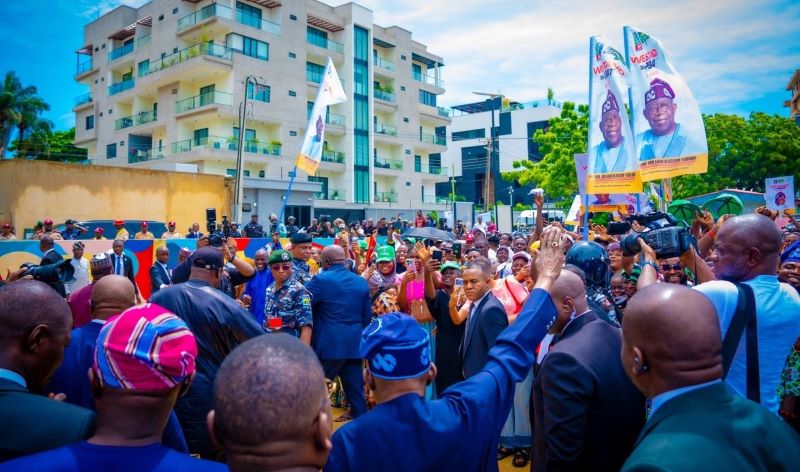
THE ruling All Progressives Congress on Saturday staged what many party leaders described as one of its biggest nationwide political mobilisations since coming to power in 2015, as members trooped out across Nigeria’s 8,809 wards for the party’s presidential primary election ahead of the 2027 general polls.
In this Sunday political feature, News Point Nigeria takes a deeper look at the scale, symbolism, political calculations, and implications of the APC primaries that effectively positioned President Bola Ahmed Tinubu for a second-term battle in 2027.
From Lagos to Rivers, Kaduna to Imo, and from Ogun to Akwa Ibom, the exercise turned into more than just an internal party contest. It became a nationwide demonstration of political structure, party loyalty, grassroots mobilisation, and a public reaffirmation of the APC’s determination to retain power despite mounting opposition criticism and growing economic discontent across the country.


Though two candidates President Tinubu and Stanley Osifo participated in the exercise, the outcome quickly evolved into a sweeping endorsement of the president by party members nationwide.
By the end of the exercise, Tinubu had secured overwhelming victories in state after state, with his challenger failing to record votes in several declared results, reinforcing the ruling party’s effort to project unity and strength ahead of what is expected to be another fiercely contested presidential election cycle.
The atmosphere across many states resembled a major national election rather than an internal party process. Governors, ministers, lawmakers, party executives, and thousands of supporters gathered in wards and local government areas to participate in the direct primary system adopted by the party.
At his polling unit in Ikoyi, Lagos State, President Tinubu arrived alongside his wife, Senator Oluremi Tinubu, to cast their votes amid cheers from party loyalists.
For Tinubu, the moment was not merely about securing another ticket. It was also about projecting legitimacy, continuity, and the image of a political structure deeply rooted at the grassroots.
After voting, the president took to his X handle to reflect on the significance of the exercise and what he described as the essence of democracy.

“Today, I participated in the APC Presidential Direct Primary at my ward in Ikoyi, Lagos, alongside my dear wife, Senator Oluremi Tinubu, CON,” he wrote.
“Democracy is not sustained by noise, speculation, or borrowed platforms. It is sustained by citizens who show up, party members who believe, institutions that endure, the grassroots, and a political family rooted in the people.”
That message appeared carefully crafted not only for party faithful but also for the opposition coalition that has intensified political realignments ahead of 2027.


Across the country, APC leaders moved swiftly to present the primaries as evidence of internal democracy and organisational discipline within the ruling party.
The APC National Chairman, Nentawe Yilwatda, cast his vote in Dungung, Kanke Local Government Area of Plateau State, while governors and other party chieftains supervised exercises in their various states.
In Rivers State, the outcome underscored the APC’s attempt to showcase dominance in a politically strategic region long considered a battleground in national politics.
Tinubu secured 280,468 votes, while Stanley Osifo failed to record a single vote in all councils announced during the exercise.
Obio/Akpor Local Government Area emerged with the highest votes for the president, followed by Port Harcourt City and Khana.
In Kaduna State, party members unanimously endorsed Tinubu through an affirmation process conducted across all political wards and local government areas.
The exercise attracted large crowds of APC supporters and stakeholders who rallied behind the president’s re-election bid.
Party officials described the process as peaceful and orderly, while officials of the Independent National Electoral Commission monitored proceedings alongside designated APC officials.
In Akwa Ibom State, Tinubu secured 389,197 votes during the exercise conducted across the state’s wards.
Governor Umo Eno, who served as the State Collation Officer, announced the results and praised party members for what he described as the peaceful conduct of the exercise.
According to him, the turnout reflected growing confidence in both the APC and Tinubu’s administration.
A similar political atmosphere played out in Kogi State where Governor Ahmed Ododo announced that Tinubu polled 197,370 votes.
Ododo said the same number of accredited voters participated in the exercise, a development APC leaders cited as evidence of party discipline and mobilisation.
In Ogun State, Tinubu also recorded a sweeping victory.
Governor Dapo Abiodun, who doubled as chairman of the election committee in the state, announced that the president defeated his challenger across the state’s wards and local government areas.
Bayelsa also delivered a substantial bloc of votes for the president, further reinforcing APC’s narrative of national spread and support.
In Kebbi State, the primary election took on a visibly symbolic dimension as Governor Nasir Idris joined party members in queue alongside Minister of Budget and National Planning Atiku Bagudu to participate through a voice vote process.
The image of top government officials lining up with ordinary party members was repeatedly highlighted by APC supporters as proof of grassroots inclusion within the party structure.
For the APC, however, perhaps one of the strongest political messages came from Imo State.
Governor Hope Uzodimma openly challenged opposition parties to emulate the APC’s mobilisation strategy if they hoped to compete effectively in 2027.
Uzodimma argued that the APC’s electronic membership registration and validation process had significantly strengthened grassroots participation and positioned the party ahead of future elections.
“Well, it is no longer a democracy if there is no opposition. I also encourage opposition parties to work hard and do what the ruling party has done. And when, by the grace of God, it becomes their turn, they will elect their own president,” he said.
The governor described the turnout witnessed during the primaries as evidence that Nigerians remained committed to democratic participation despite criticisms directed at the ruling party.
He pointed specifically to the large concentration of party members registered in a single ward in Oru East Local Government Area.
“If you look at what is happening at the grassroots and how the grassroots has been stimulated, starting from the membership registration, which was done electronically, to the validation of members, you can see 35,000 human beings in just one ward in Oru East Local Government Area.
“It means that if only our party members vote for President Bola Tinubu, he has already won the election,” he stated.
Beyond the numerical outcomes, the APC primaries also carried broader political implications.
The exercise came only days after the ruling party concluded governorship, National Assembly, and state assembly primaries across the federation, a process that itself generated tensions, alignments, protests, and internal contests in several states.
Yet the presidential primary appeared designed to project cohesion after weeks of internal battles among party stakeholders over tickets and succession calculations.
For Tinubu, the exercise also served as an opportunity to consolidate control of the ruling party machinery while sending a strong message to emerging opposition coalitions seeking to challenge APC dominance in 2027.
The opposition has repeatedly accused the APC of mismanaging Nigeria since taking power in 2015, citing economic hardship, insecurity, inflation, and governance concerns.
But APC leaders continue to reject those criticisms, insisting that the party remains Nigeria’s strongest political platform with the widest grassroots structure.
Political analysts believe the direct primary was as much about optics as it was about votes.
By mobilising millions of party members simultaneously across thousands of wards nationwide, the APC succeeded in projecting the image of a ruling party still firmly in control of its structure despite economic dissatisfaction in parts of the country.
Attention now shifts to Abuja, where Tinubu is expected to formally receive the APC Certificate of Return and the party flag as its presidential candidate for the 2027 election.
According to presidential spokesman Bayo Onanuga, the presentation ceremony will take place at the Bola Ahmed Tinubu International Conference Centre.
The event is expected to attract APC governors, members of the National Executive Committee, National Working Committee, lawmakers, and senior party stalwarts from across the federation.
As Nigeria inches closer to another major election cycle, the APC appears determined to once again rely on the political formula that brought it to power in 2015 strong grassroots mobilisation, broad national spread, and the projection of internal unity.
Whether that strategy will withstand mounting opposition pressure, public frustration, and the unpredictable dynamics of Nigerian politics remains one of the defining questions ahead of 2027.