

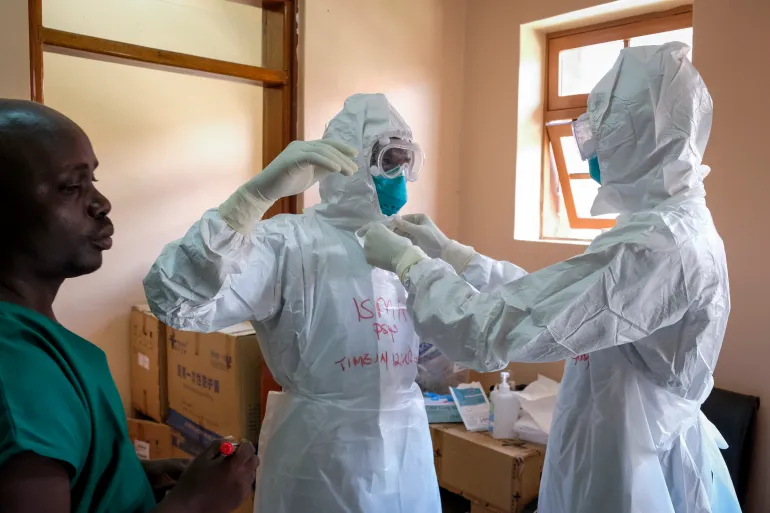
PRESIDENT Bola Tinubu has approved the release of N10 billion in emergency funding to bolster Nigeria’s preparedness against a possible Ebola outbreak following renewed cases reported in parts of Africa.
The intervention, according to a statement sent to News Point Nigeria on Tuesday by the President’s Special Adviser on Information and Strategy, Bayo Onanuga, is designed to reinforce the country’s health security systems and enhance its capacity to respond swiftly to any public health emergency.

According to the statement, the funding will strengthen the operational readiness of the Nigeria Centre for Disease Control and Prevention (NCDC) and support critical national public health emergency response activities.


“The fund will strengthen the operational preparedness of the National Centre for Disease Control and Prevention and support critical national public health emergency response activities,” the statement said.
The emergency allocation will primarily support the activities of the NCDC as the country intensifies efforts to prevent the importation and spread of the deadly virus.
As part of the broader response strategy, President Tinubu also approved the establishment of a Presidential Task Force on Ebola Virus Disease Preparedness and Emerging Public Health Threats.
The task force will be chaired by the Chief of Staff to the President, Femi Gbajabiamila, and will comprise representatives of relevant federal agencies as well as state governments.
The development comes amid growing concerns over Ebola outbreaks recently reported in the Democratic Republic of the Congo and Uganda, prompting Nigerian authorities to strengthen preventive measures nationwide.
To guard against the importation of the virus, the Federal Government is ramping up surveillance at the nation’s borders and international airports.

The statement noted that the new directive will enforce the “intensification of passenger screening at all international airports, including enhanced temperature checks and crowd-control protocols.”
Several key agencies have been tasked with implementing the measures, including the Federal Airports Authority of Nigeria (FAAN), the Nigeria Immigration Service (NIS), and the Nigerian Civil Aviation Authority (NCAA), working alongside state governments and relevant federal ministries.
Additional measures announced by the government include enhanced monitoring of passengers arriving through high-risk routes, the activation of isolation centres at the international airports in Lagos and Abuja, and the introduction of mandatory health declaration systems for inbound travellers.


President Tinubu also directed that airport facilities, cargo zones, and baggage handling areas be subjected to regular disinfection as part of efforts to reduce the risk of transmission.
Furthermore, the newly constituted task force has been mandated to coordinate with security, aviation, and diplomatic agencies to regulate flights originating from affected regions and designate specific airport terminals for high-risk arrivals as part of strengthened containment procedures.
The Federal Government said the measures form part of a comprehensive strategy to protect public health and ensure Nigeria remains prepared to respond effectively to any potential Ebola threat.