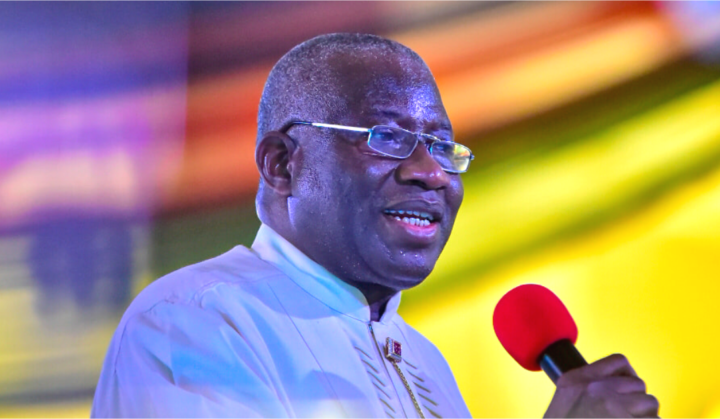

GOMBE State Governor, Muhammadu Inuwa Yahaya, CON, has said the North-East Governors’ Forum (NEGF) has recorded significant progress in regional cooperation since its establishment in 2020, with collective action yielding concrete results in infrastructure, energy, connectivity and economic development.
Governor Inuwa Yahaya highlighted the rehabilitation of strategic roads, renewed efforts towards regional power and connectivity, the revival of the North-East Trade Fair and progress towards establishing a regional airline.
Read also: 2027: ‘If You Don’t Deliver Your State, Don’t Claim Victory,’ Wike Tells APC Governors

News Point Nigeria reports that he said the achievements reflected the value of the six states working together to address challenges that transcend individual state boundaries.


The Governor’s remarks were contained in a statement signed by Ismaila Uba Misilli, Director-General, Press Affairs, Government House, Gombe, following the 13th meeting of the North-East Governors’ Forum held on Saturday in Maiduguri, Borno State, where Inuwa Yahaya delivered his opening remarks.
He, however, challenged the Forum to build on the progress recorded by moving beyond policy resolutions and strengthening mechanisms to ensure that decisions translate into measurable outcomes for the people.
The Governor said the Forum was established out of necessity, as the challenges confronting the region, including insurgency, banditry, cross-border crime, infrastructure deficits, energy shortages and the humanitarian crisis, could not be effectively addressed by individual states acting in isolation.
Six years and 12 meetings later, he said, the NEGF had evolved into an institutional platform with a Secretariat, a Technical Working Committee of the Secretaries to State Governments, a Technical Working Group of experts and sectoral committees responsible for advancing decisions between meetings.
Governor Inuwa Yahaya said one of the clearest outcomes of the Forum’s collective advocacy was the joint presentation of 17 strategic road projects, the Port Harcourt-Jos-Bauchi-Maiduguri rail corridor and frontier oil exploration opportunities at Kolmani and the Lake Chad Basin to the Federal Government in September 2025.
He noted that the Federal Government subsequently flagged off the rehabilitation of the Dikwa-Gamboru Ngala and Bama-Banki roads, covering nearly 99 kilometres of strategic corridors critical to security, recovery and cross-border trade.
He added that the Akwanga-Jos-Bauchi-Gombe-Biu-Maiduguri highway had also been adopted as a legacy road project of President Bola Ahmed Tinubu, GCFR.
On energy, Governor Inuwa Yahaya said the Forum had helped shift the conversation from isolated state-level concerns to a regional energy agenda, noting that the Dadinkowa Hydropower Plant was now feeding the national grid.
He said the new electricity law had also created opportunities for states to reform their electricity markets and expand renewable energy solutions, including solar power and mini-grids.
The Governor further cited the revival of the North-East Trade Fair in Bauchi in 2024 as another example of a Forum resolution being translated into concrete action.
He said the region’s ability to pool resources had also been demonstrated through the N30 billion financing plan for the establishment of a North-East regional airline, with each of the six states contributing N5 billion.
In human capital development, Governor Inuwa Yahaya said all six states had domesticated the Education Law 2022 and established the North-East Education Council, while various state-specific initiatives were being implemented to tackle the Almajiri and out-of-school children crisis.
He also noted that Commissioners of Health across the region had established a regional health platform to strengthen collaboration, improve responsiveness and facilitate the exchange of best practices.
On security, the Gombe State Governor said the Forum had transformed insecurity from six separate state challenges into a shared regional responsibility.
He said the regional approach combined military action with interventions aimed at addressing the underlying drivers of insecurity, including poverty, unemployment, illiteracy, drug abuse and illegal mining.
He cited community-based security structures across the region, including GOSTEC in Gombe and the Taraba Marshals, as examples of initiatives from which states could learn and draw lessons.
Read also: Wike Defends Rainbow Coalition, Says ‘Nothing Anybody Can Do To Stop It’
Governor Inuwa Yahaya said the collective efforts of the Forum had also helped change the national and international perception of the North-East, with the regional conversation gradually shifting from emergency humanitarian assistance towards recovery, resettlement, stabilisation and long-term development.
He, however, cautioned that significant challenges remained, noting that Boko Haram had been weakened but not defeated, while attacks on communities, banditry and communal clashes continued to pose threats.
“Boko Haram has been weakened but not defeated, and we still see attacks on our communities. Banditry and communal clashes are emerging as new threats,” he said, adding that many displaced citizens were still waiting to return home in safety and dignity.
The Governor identified the non-realisation of the Mambilla hydropower project, railway connectivity to the region and broadband infrastructure as outstanding priorities requiring sustained advocacy.
He also said the promise of the Kolmani oil exploration project must translate into actual production, jobs and revenue, while the region’s solid mineral resources must be legally and responsibly exploited for the benefit of its people rather than being allowed to finance criminal activities.
Governor Inuwa Yahaya equally expressed concern over the persistent burden of out-of-school children and the region’s weak health indicators, stressing the need for sustained regional interventions.
Against this backdrop, he called for stronger implementation and accountability mechanisms to close the gap between resolutions adopted by the Forum and results delivered to citizens.
“To speak plainly, our next task is to turn political agreement into measurable results. We must close the gap between the resolutions we adopt and the outcomes our people can see and feel,” he said.
He therefore welcomed proposals for the establishment of a Results and Delivery Unit within the NEGF Secretariat, a dashboard to track Federal Government infrastructure commitments, a regional power master plan, a stronger security and intelligence framework and a focused portfolio of flagship projects that can be completed and handed over.
Looking beyond the North-East, Governor Inuwa Yahaya said the region’s challenges were interconnected with those confronting wider northern Nigeria, including insecurity, poverty, unemployment, climate change, desertification, the out-of-school children crisis and infrastructure deficits.
He said the experience of the NEGF had demonstrated that sub-regional cooperation could provide a practical model for addressing challenges that cut across state boundaries.
Against this background, he said the Northern States Governors’ Forum was being restructured and its institutions strengthened to improve coordination, technical capacity and implementation across the 19 northern states.
He disclosed that the reforms included the establishment of the Northern Nigeria Security Trust Fund to provide a sustainable pooled source of support for security and peacebuilding initiatives across the region.
He also announced plans to reform the New Nigeria Development Company (NNDC) to restore its role as a vehicle for investment, enterprise and economic development across northern Nigeria.
Governor Inuwa Yahaya stressed that the reforms were intended to complement, rather than replace, existing sub-regional platforms such as the NEGF.
“The past six-and-a-half years have proved that the Governors of this region can come together and agree. The years ahead must prove what our six states, working together, can achieve for our people,” Governor Inuwa Yahaya said.
In his remarks, the host Governor of Borno State, Professor Babagana Umara Zulum, commended the Federal Government for interventions supporting recovery and economic resilience in the North-East, particularly the One Billion Dollar Household Prosperity and Economic Social Protection Project (HOPE-SP).
He said the intervention was significant for a sub-region that had endured prolonged insecurity, displacement, disrupted livelihoods and humanitarian dependence, noting that it could help vulnerable households rebuild their livelihoods and become economically self-reliant.
Read also: Seyi Tinubu Defends Father’s Reforms, Says Short-Term Pain Will Bring Lasting Benefits
Governor Zulum stressed the need for a deliberate shift from relief to recovery and sustainable prosperity, with the return of displaced persons backed by access to housing, education, healthcare and economic opportunities.
He also acknowledged the considerable improvement in the security situation across the North-East, attributing the progress to the sacrifice of the Armed Forces and other security agencies, the resilience of the people and the commitment of governments at all levels.