

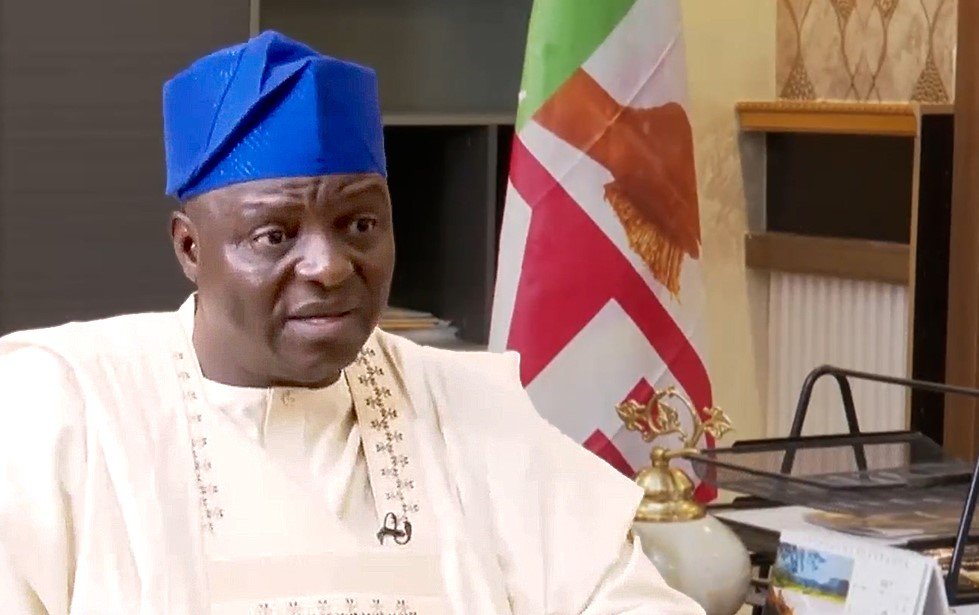
THE National Chairman of the All Progressives Congress (APC), Prof. Nentawe Yilwatda, has declared that political appointments after the 2027 general elections will be reserved strictly for party loyalists, insisting that governance is inseparable from politics and that technocrats who are unwilling to engage in party mobilisation should not expect appointments.

News Point Nigeria reports that Nentawe made the declaration on Tuesday night in Abuja at an event titled “Renewed Hope Promise Kept 2027: Meet and Greet North-West Mobilisation,” organised by the Minister of State for Works, Bello Goronyo.
A video clip of the APC chairman’s remarks went viral on Wednesday, igniting intense national debate among politicians, policy analysts, civil society organisations, and members of the public, with reactions sharply divided between party loyalists and governance advocates.


Addressing party members and stakeholders, Nentawe argued that political appointments must go to individuals who actively work for the APC and defend its policies, stressing that elections are won through votes, not professional credentials.
“We should always look back and remind ourselves of what brought us here. It is votes. There is no vote called technocrats,” he said.
“Once you are given a political appointment, you are a politician. Simple.”
The APC chairman said he would firmly defend a policy that excludes non-party members from political appointments, urging professionals who do not want to engage in party activities to remain consultants rather than government appointees.
“As party chairman, I will stand strong to defend the position that if you are not prepared to join us, you shouldn’t be given an appointment. If you are a technocrat, go and be a consultant,” he stated.
Nentawe maintained that government policies are extensions of campaign promises and must be defended and promoted by those implementing them.

“Government policies are campaign promises that must be defended, explained and promoted. Appointees cannot divorce themselves from party objectives,” he said, warning that detachment from political mobilisation could weaken the APC’s grip on power.
He further argued that if appointees distance themselves from party activities, the ruling party risks losing elections.
“Once you are given a political appointment, you are a politician. If all appointees decide to become technocrats, the party will never return to power,” he warned.


The APC chairman described the North-West as the party’s electoral backbone, noting that the region played a decisive role in the APC’s victory in the 2023 elections and would remain central to its 2027 strategy.
According to him, the North-West accounts for about 20 per cent of APC membership nationwide, with young people dominating the party’s base.
“Out of the registered members in the North-West, 48 per cent are between the ages of 18 and 35. This means young people own this party,” Nentawe said.
He added that members aged 50 and above constitute just 17 per cent of the APC’s membership in the region, underscoring the strategic importance of youth mobilisation.
Also speaking at the event, the Special Adviser to the President on Policy Coordination and Head of the Central Results Delivery Coordination Unit (CRDCU), Hadiza Bala-Usman, reinforced Nentawe’s position.
She said the North-West delivered the highest number of votes for the APC in 2023 and must remain united to surpass that performance in 2027.
“We are a vote basket and we must retain that. Nobody should work hard to win elections while others stroll in to collect appointments and hide behind being technocrats,” she said.
Bala-Usman warned that political appointees who fail to campaign or mobilise for the party would not be tolerated.
“Once you are a political appointee, you must come out, show your face, show your hand, and support the party,” she added.
These include the Minister of Communications, Innovation and Digital Economy, Bosun Tijjani, the Executive Vice Chairman of the Nigerian Communications Commission (NCC), Wada Maida, and other professionals whose appointments were largely driven by expertise rather than party loyalty.
Critics argue that sidelining such individuals could disrupt continuity in critical ministries and agencies, despite their roles in driving reforms and implementing national development programmes.
Since the return to democracy in 1999, Nigerian presidents have consistently blended politicians with technocrats in governance.
Former presidents Olusegun Obasanjo, Umaru Musa Yar’Adua, Goodluck Jonathan, Muhammadu Buhari, and incumbent President Bola Tinubu have all relied on technocrats for key roles.
Notable examples include Ngozi Okonjo-Iweala, former Finance Minister and current Director-General of the World Trade Organisation; Akinwunmi Adesina, former Minister of Agriculture and ex-President of the African Development Bank; Obi Ezekwesili, former World Bank executive; and Nasir el-Rufai, who initially served as Director-General of the Bureau of Public Enterprises before becoming a partisan politician.
Reacting to the controversy, the Peoples Democratic Party (PDP) said it would take a different approach if voted into power in 2027.
The party’s National Publicity Secretary, Comrade Ini Ememobong, said competence, not party loyalty alone, would guide appointments under a PDP government.
“When our party wins, we will run a system with a fair mix of politicians and technocrats. The key determinant will be what the appointee has to offer,” he said.
He cautioned against hyper-politicising governance, stressing that “governance is too important to be left to politicians alone.”