

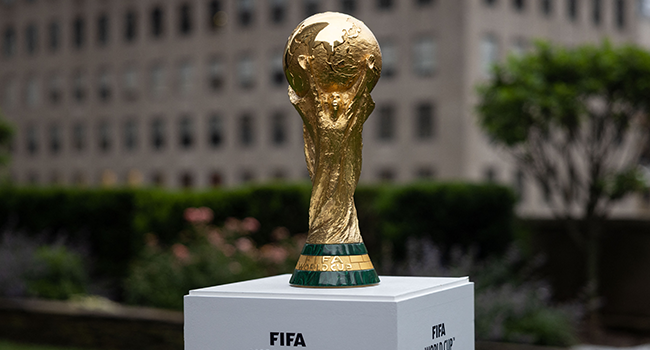
AS the expanded 48-team 2026 FIFA World Cup kicks off across the United States, Canada, and Mexico on June 11, attention has increasingly shifted to the tournament’s notable absentees.
Despite the expansion from 32 to 48 teams, several traditional powerhouses and emerging “golden generations” have failed to qualify, leaving a visible gap in both the competitive balance and global appeal of the tournament.
The expansion was expected to usher in a wave of newcomers, but breaking into football’s elite has remained difficult. Only four nations, Uzbekistan, Jordan, Curaçao, and Cape Verde will make their World Cup debuts, falling short of the record six debutants seen in 2006.


However, a number of countries are ending long absences. Haiti returns for the first time since 1974, while Iraq qualifies for only its second World Cup since 1986. DR Congo reappears for the first time since competing as Zaire in 1974. In Europe, Scotland, Austria, and Norway return after 28 years, alongside Türkiye (last seen in 2002) and Czechia (2006).
Yet, despite the expanded format, several high-profile nations will not feature in 2026. The most notable absentees include Italy, Denmark, Nigeria, Poland, and Cameroon.
Four-time world champions Italy will miss a third consecutive World Cup following a playoff defeat to Bosnia and Herzegovina. For a nation of such pedigree, the absence signals a deeper structural decline, with a generation growing up without seeing the Azzurri on football’s biggest stage.
Denmark’s elimination ranks among Europe’s biggest surprises. The Danes fell to Czechia on penalties after a 2–2 draw, with a team known for tactical cohesion faltering at a decisive moment.
Nigeria, one of Africa’s most talent-rich squads, will miss a second straight World Cup after losing to DR Congo in a playoff final. The Super Eagles’ absence is widely viewed as a major underachievement given the quality within the squad.
Poland’s hopes ended with a 3–2 defeat to Sweden in their final qualifier, marking the close of an era as Robert Lewandowski steps away from international football without another World Cup appearance.

Cameroon’s campaign unravelled in the group stage as Cape Verde surged ahead. Inconsistency ultimately cost the Indomitable Lions, who failed to recover even when qualification remained within reach.
Off the pitch, FIFA is facing mounting criticism over ticket pricing. Category 1 tickets for the July 19 final at MetLife Stadium have surged to $10,990, the highest in World Cup history.
The figure represents a nearly 600 percent increase from FIFA’s initial 2018 projection of $1,550, raising serious concerns about accessibility. Lawmakers in the United States have already criticised the use of dynamic pricing, warning it could make the 2026 edition the most financially exclusionary World Cup to date.


With semi-final tickets exceeding $3,000 and technical issues affecting sales, attending the tournament is proving increasingly difficult for ordinary fans.
The 2026 World Cup promises fresh narratives, new entrants, and expanded global reach. Yet the absence of several football heavyweights, combined with rising financial barriers, underscores a shifting landscape where expansion does not guarantee inclusion, and access to the game’s grandest stage is becoming more exclusive both on and off the pitch.