

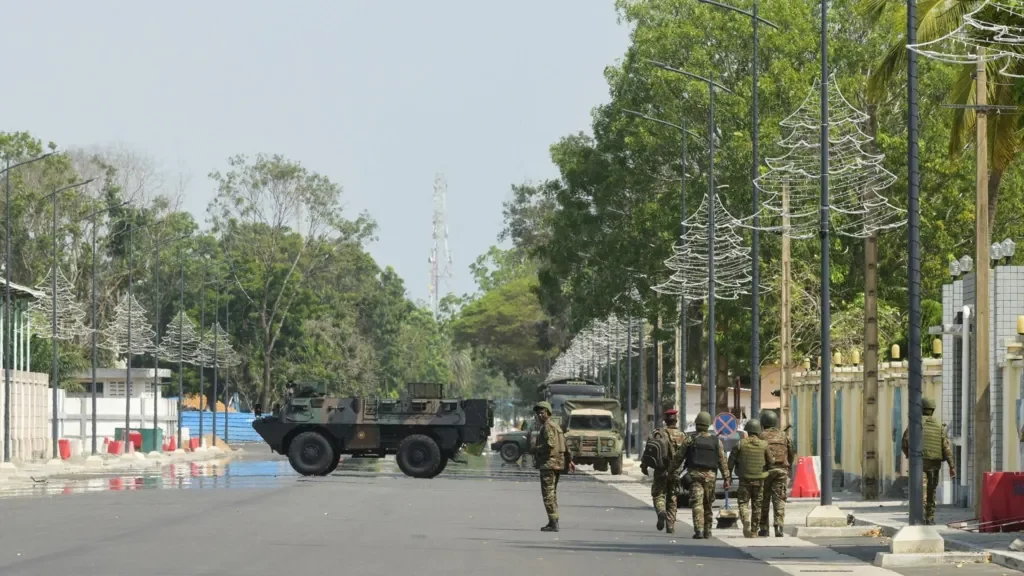
BENIN’s Foreign Affairs Minister, Olushegun Bakari, on Thursday revealed how his country sought urgent military assistance from Nigeria to help thwart last Sunday’s attempted coup aimed at toppling President Patrice Talon.

News Point Nigeria reports that Bakari, who addressed journalists on the sidelines of the ECOWAS Council of Ministers meeting in Abuja, said Benin’s request for intervention was made under existing ECOWAS security protocols, noting that the swift response from Nigeria and other regional partners played a decisive role in averting a national tragedy.

The minister praised Nigeria, Ghana, Côte d’Ivoire, and Sierra Leone for responding rapidly to Benin’s call for help, stressing that their involvement prevented what could have been a bloody confrontation in densely populated areas where the insurgents had barricaded themselves.

Bakari explained that although Benin’s military had already repelled the mutineers and prevented them from seizing key state assets, the rebels retreated into a military barracks encircled by civilian neighbourhoods, a factor that made direct military retaliation extremely risky.


“We requested the intervention under the ECOWAS protocol… not because our army was incapable,” he said.
“It was mainly because the area where they had entrenched themselves was surrounded by civilians. An all-out military assault would have led to massive casualties.”
According to him, the insurgents had attempted to seize the presidential residence before shifting their attack to the national broadcaster, Office de Radiodiffusion et Télévision du Bénin.
Their effort to take over state transmission failed after forces loyal to President Talon pushed them back.
Bakari said the rebels had also attempted to move toward the airport, prompting Benin to activate emergency defence measures and call on regional allies for specialised support to neutralise rebel armoured vehicles and secure critical installations.

The minister clarified that the coup attempt had already been crushed before ECOWAS troop mobilisation began, but the risk of escalation remained high.
“Our defence forces, the Republican Guard blocked them. They fought back and then withdrew into a military camp,” he explained. “The coup had already failed. But we needed precise, surgical intervention to avoid unnecessary deaths.”
He stressed that the collaboration with Nigeria and other ECOWAS states proved crucial in accomplishing this objective.


Bakari thanked President Bola Tinubu, who also chairs ECOWAS for immediately authorising military support to Benin.
He said the episode demonstrated the strength of regional cooperation and ECOWAS’ determination to defend democratic governance.
“We showed that together we can fight for democracy. We can stop attempts to derail democratic order in our region,” he said.
The attempted coup began early Sunday as armed mutineers stormed the presidential residence in Cotonou. After being repelled, they moved to seize the state broadcaster in an effort to control national communication channels.
Their attack was short-lived, as security forces and the Republican Guard swiftly neutralised the threat before the rebels retreated into the military barracks.
Following the incident, President Tinubu announced that Nigeria would deploy troops to support Benin in stabilising the situation and safeguarding democratic rule.