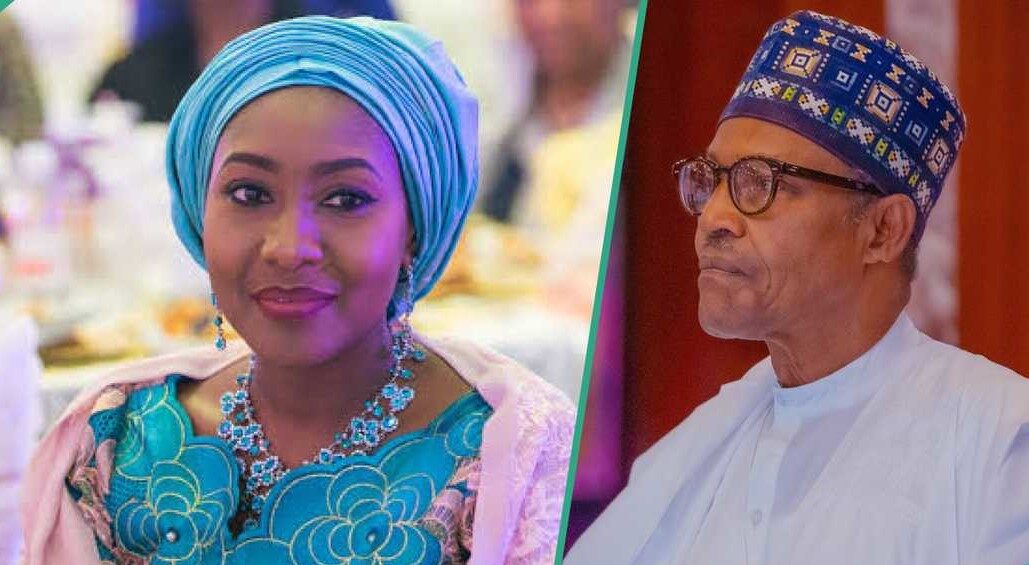
FRESH revelations have emerged about the deep mistrust and tension that allegedly permeated Nigeria’s Presidential Villa during the administration of the late former President Muhammadu Buhari, with his daughter, Fatima Buhari, disclosing that her father once believed his office was under secret surveillance.
News Point Nigeria reports that the disclosure is contained in a newly released biography titled From Soldier to Statesman: The Legacy of Muhammadu Buhari, authored by the Director-General of the Institute for Police and Security Policy Research, Dr Charles Omole.

Read also: Buhari Would Find It ‘Distasteful’ For Osinbajo To Challenge Tinubu, Babachir Lawal Reveals
The book was unveiled in Abuja on Monday and offers intimate insights into Buhari’s personal life, leadership years, and the unseen pressures of power.

According to Fatima, there were periods when her father suspected that listening devices had been planted inside his office at the Presidential Villa, forcing them to adopt unusual and covert means of communication.
She revealed that during some meetings, Buhari avoided speaking entirely, choosing instead to communicate through written notes and hand signals to avoid being overheard.


“There were times he believed conversations in his office were being monitored,” Fatima recounted in the book. “On one occasion, he touched his cheek as if he had a toothache and signalled that we shouldn’t talk. We wrote notes to each other, like spies in a film.”
Fatima said her father warned her to be cautious at all times, noting that he himself was constantly on guard despite occupying the nation’s highest office as Commander-in-Chief of the Armed Forces.
The biography describes the episode not as paranoia or theatrics, but as a coping mechanism in an environment where trust had eroded and privacy was no longer guaranteed, even at the heart of power.

More troubling, according to the account, was Buhari’s apparent resignation to the situation. Despite the immense authority attached to his office, the former president reportedly chose quiet vigilance over confrontation.
Fatima openly questioned how alleged surveillance could take place within the highly fortified Presidential Villa, raising concerns about the influence and reach of individuals often described as “the cabal.”
“How powerful must those people be for such things to happen inside the Villa?” she wondered in the book.


The biography further claims that some security chiefs who served under Buhari later confirmed that unusual objects were occasionally discovered in the president’s office and bedroom during routine security sweeps. However, how such items made their way into restricted and heavily secured areas reportedly remained unexplained.
Fatima described the atmosphere in Aso Rock during those periods as deeply unsettling, at times verging on what she termed “diabolical.”
“We’re Africans. We know supernatural powers,” she said, declining to go into details about certain incidents and adding that some matters were best left to divine judgment.
The book also sheds light on Buhari’s personal temperament and how it shaped his response to perceived betrayal and internal threats.
According to Fatima, age, faith, and a deep sense of compassion softened her father, making him reluctant to confront or publicly disgrace those around him, even when trust appeared compromised.
“He understands people’s histories their parents, their families and he doesn’t want to destroy hope,” she said.
She added that once Buhari placed his trust in someone, it was difficult for him to withdraw it without overwhelming proof. Instead of sackings or public humiliation, he often preferred quiet corrections, warnings, and restraint.
Fatima also disclosed that she lived in constant fear for her father’s safety during his time in office, alleging that there were moments she believed attempts were made to harm him.
“There were attempts. Harm was done, but his time was not yet,” she said, without providing further details.
As part of measures to manage perceived threats and protect those close to him, Fatima said Buhari sometimes publicly reprimanded her to create the impression of distance, even though he would later reach out privately to reassure her and her children.
Read also: 95 Suspected Cultists Arrested As Delta Police Recover Guns, Cartridges, Charms
“I cried in front of them,” she recalled, “but deep inside, he would call me and the kids.”
The revelations add to a growing body of personal accounts emerging since Buhari’s death, painting a picture of a leader grappling with immense pressure, suspicion, and the isolating realities of power at the highest level of governance.