

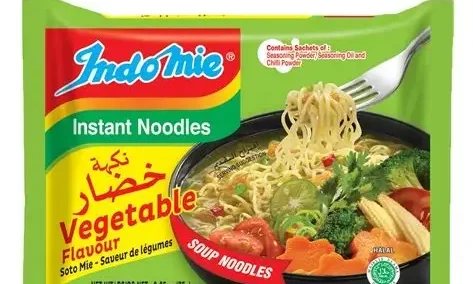
ANXIETY has spread across Nigeria following a public alert by the National Agency for Food and Drug Administration and Control (NAFDAC) over the recall of a variant of Indomie noodles in Europe, triggering widespread concern among consumers and reigniting debates around food safety, regulation and border enforcement.

The alert, issued by NAFDAC under Public Alert No. 041/2025, warned about the recall of Indomie Noodles, Vegetable Flavour, due to the presence of undeclared allergens, milk and eggs, which could cause severe or even life-threatening reactions in individuals with allergies or intolerances.

According to NAFDAC, the recall followed a notification from Rappel Conso, France’s food safety authority, which flagged the product for failing to properly declare the allergens on its label. The recall affects all batches of the product with a best-before date of February 6, 2026, although the country of origin was not specified in the French notice.

In its statement, NAFDAC cautioned that while the official risk of the recalled product entering Nigeria is low given the Federal Government’s ban on the importation of noodles, vigilance remained essential.


“Although the official risk of these products entering Nigeria is low due to the Federal Government’s ban on noodle importation, there remains a need for heightened vigilance to prevent possible illicit entry or circulation of the implicated Indomie brand,” the agency said.
NAFDAC added that acquisition through online purchases, informal channels or international travel could not be ruled out, prompting it to activate nationwide surveillance measures. Zonal directors and state coordinators have been directed to intensify market checks and immediately mop up the product if found anywhere in the country.
The agency advised distributors, retailers and consumers to avoid the sale or consumption of the recalled product and urged Nigerians to discard it if found. It also encouraged the public to report suspicious sales or adverse reactions to the agency through its offices or dedicated hotlines.
The alert quickly ignited reactions across social media platforms, particularly X (formerly Twitter), Instagram and Facebook, where Nigerians voiced fear, confusion and anger over how a recalled product could potentially find its way into the country despite an import ban.
Many expressed concern for children, who are among the highest consumers of instant noodles, while others questioned the effectiveness of border surveillance and regulatory enforcement.

“It’s been years now since my husband stopped eating Indomie. I never liked it, but it was his favourite food. There are too many artificial flavours,” an Instagram user, Veeyoni_Detox, wrote.
Another user, Prince Alli, went further, calling for stricter measures: “Ban the full Indomie or force them to state that it is carcinogenic on the pack so people know what they eat.”
However, several users sought to clarify the situation, stressing that the recalled product was not the Nigerian-made Indomie commonly found in local markets.


“The popular and usual Indomie is still very much in the market. This particular variant isn’t even common,” wrote Hellen Semilore on Instagram.
On X, Oracle Oshare pointed out inconsistencies in the circulating images, noting that the recalled product bore unfamiliar inscriptions and flavours not associated with Indomie Nigeria.
Public health voices also joined the conversation. Dr Bukky Starr, a public health expert, contrasted the recalled foreign product with Nigerian-made noodles, stating that locally produced Indomie variants registered by NAFDAC remain safe for consumption.
Despite these reassurances, some Nigerians remained sceptical, with concerns that unsafe food products could already be in circulation through informal markets and online platforms.
In response to the growing concern, Indomie Nigeria, produced by Dufil Prima Foods, firmly distanced itself from the recalled product.
In a statement, the company said it does not produce, import, distribute or sell any noodle variant known as Vegetable Flavour in Nigeria, describing reports linking it to the recall as misleading.
“The product referenced in the NAFDAC alert is not manufactured, imported, distributed, or sold in Nigeria,” the company said, adding that the recall in France occurred months earlier and that NAFDAC’s alert was a precautionary step.
Indomie Nigeria reassured consumers that all its locally produced noodles meet strict quality control standards and are fully compliant with NAFDAC regulations. It also noted that images of the recalled product circulating online do not match its approved packaging or branding.
The company further reminded Nigerians that the importation of noodles into the country is prohibited by law and urged consumers to be cautious of any unfamiliar packaging.
As public concern persisted, NAFDAC issued a further clarification, signed by its Director-General, Prof. Mojisola Adeyeye, stressing that the recalled Indomie Noodles Vegetable Flavour is not registered for sale in Nigeria and is not available in the Nigerian market.
The agency reiterated that noodles are on Nigeria’s Import Prohibition List, significantly reducing the likelihood of the affected product entering the country. It also confirmed that its Ports Inspection Directorate had been placed on heightened alert to prevent illegal importation.
NAFDAC recalled a similar incident in 2023 involving Indomie Special Chicken Flavour in parts of Asia, noting that investigations at the time confirmed that Nigerian-made noodles were safe.
Reaffirming its commitment to public health, the agency urged Nigerians to remain calm but vigilant, assuring that it remains proactive in safeguarding food safety for both residents and travellers.