
IN the next forty-eight hours, the world would bid goodbye to the year 2025 and usher in a New Year. As it is our practice, The Discourse will today, review the outgoing year, point out areas of progress in our national life, and offer suggestions on what we can do better to make life more meaningful for Nigerians.
At the beginning of 2025, the economy was still weighed down by high inflation, elevated interest rates, and weak consumer demand due to the high prices of goods, especially food items, as well as subdued business activity following subsidy removal, exchange-rate liberalisation, and aggressive monetary tightening policies embarked upon by the Tinubu administration.
Read also: Will A Nobel Solve The World’s Trump Problem? The President Thinks So – By Azu Ishiekwene
Inflation remained one of the defining challenges at the start of the year, hovering around 34 per cent, and driven largely by high food prices, energy costs, and the pass-through effects of earlier naira depreciation. These pressures eroded household purchasing power and constrained consumption.

However, as the year progressed, the National Bureau of Statistics (NBS) rebased Nigeria’s Gross Domestic Product (GDP) and the Consumer Price Index (CPI), a process of revising the base year or reference point used to calculate various key economic indicators. For inflation, the proposed new base year for its computation became 2024, and it intended to capture the structural changes in the economy driven by the removal of subsidies on petrol and the foreign exchange rate. For the GDP, the NBS opted for 2019 as the new base year because economic activities were relatively stable that year compared to subsequent years, disrupted by the impact of the COVID-19 pandemic and policy shifts.
The rebased GDP aimed to capture new economic segments, such as the digital economy, activities of pension fund administrators, the National Health Insurance Scheme, the Nigerian Social Insurance Trust Fund, activities of modular refineries, domestic households as employers of labour, and coverage of illegal and hidden activities. According to the NBS, the Nigerian economy grew by 3.98 percent in the third quarter of 2025, representing a sharp increase from the 3.86 percent growth recorded in the third quarter of 2024.


Also, the Nigerian economy ended the year with an inflation rate of 14.45 percent in November, aligning with Tinubu’s projected figure of 15 percent at the end of 2025 and the budget’s projected target. That was a massive leap. Nigeria’s 2025 Budget, themed ‘Budget of Restoration’ aimed to stabilise the economy by targeting a significant drop in inflation from over 34 percent to around 15-16 percent, alongside achieving GDP growth and exchange rate stability (N1500/$1). Now, inflation has dropped to 14.5 % while the exchange rate hovers around N1450/$1.
Some key events defined the economy this year, delivering a positive impact overall. These include the rebasing of the GDP, which captured fintech and entertainment booms; Nigeria’s exit from the FATF grey list, unlocking $30 billion in investments; tax and securities reforms; and bank/insurance recapitalisation, with 16 banks meeting the new threshold as of December.
Also, Dangote Refinery, despite the full-scale war the company fought during the year, ensured that the nation reduced its dependency on petroleum products imports, which eased FX pressure, allowing Naira-FX market gains and stabilisation.

However, even as these macroeconomic advances take shape, the troubling reality is that Nigeria’s growth too often bypasses the poor, leaving millions mired in hardship despite headline figures. On paper, the nation’s economy is doing tremendously well, but in reality, majority of Nigerians are not feeling the effects in their pockets and lives.
With a minimum wage pegged at N70,000 by the federal government – even though some states pay more than that – the purchasing power of the average Nigerian has been effectively curtailed by the high cost of food alone. It is no longer news that most Nigerians spend more than 70 per cent of their salaries on food alone. The high cost of transportation is another issue most Nigerians had to contend with, as many workers leaving home on Monday can’t return until Friday evening after the close of work. In between, many have converted their offices and places of work to temporary homes, particularly those working on the Island in Lagos and living in the mainland, all in a bid to reduce transportation costs.
Additionally, with 139 million Nigerians still trapped in poverty, the Federal Government and sub-nationals had to allocate more funds to education, health, housing, and food production, in order for most of its policies to have a direct impact on the masses.

Nigeria’s poverty rate surged, with projections reaching around 61% (139 million people) by 2025, up from 40% in 2019, as high inflation and slow growth eroded purchasing power despite recent economic reforms, pushing more Nigerians into poverty. As at 2024, 56 percent of Nigerians lived below the poverty line, totalling roughly 129 million people. But by 2025, that figure rose to 61 per cent, with 139 million in poverty, according to the World Bank in October, 2025. Again, multidimensional poverty, as computed by the NBS, reported 63 per cent (133 million) in that category, lacking access to clean energy, sanitation, and education.
In 2024-2025, Nigeria saw fluctuating maternal deaths but modest gains in under-five survival, with figures from late 2025 showing 5,391 maternal deaths in 2024, and 3,689 so far in 2025, while under-five mortality dropped to around 102-110 per 1,000 live births by 2024, down from 132 in 2018, although neonatal rates remain high.
The disconnect from the figures on paper and the day-to-day realities of Nigerians stem from what economists’ term “jobless growth”, where expansion concentrates in capital-intensive sectors like oil and finance, rather than labour-absorbing areas such as manufacturing or agriculture. In 2025, services, including ICT and financial services, drove over half of GDP gains, but these created few entry-level jobs for the masses, echoing patterns from prior years.
Read also: Nigerians’ Mental Health Is Under Siege – By Boma West
Compounding this is Nigeria’s stark inequality, where benefits accrue to a narrow elite while the wealth gap widens. Inflation, even as it eased to 14.45 per cent in November, outstripped wage growth for most workers, eroding real incomes and purchasing power.
Prices of most staple foods remain high due to serious challenges facing the agricultural sector, especially insecurity in farming belts, limited application of technologies, low yields, and poor roads that escalate logistics costs. Weak job creation in manufacturing was largely due to high production costs driven by skyrocketing power tariffs, imported raw materials, and prohibitive interest rates that stifled factory expansion and limited employment opportunities.
However, some progress was recorded in the implementation of the Federal Government’s National Social Safety Net Programme, which has made cash transfers to over 8.3 million vulnerable Nigerians. While each beneficiary is expected to get N75,000 paid in three tranches, it is still not clear what impact this has had on poor Nigerians amid allegations of fund diversion and outright stealing of funds meant for the masses.
Insecurity was the most significant destabilizing factor in 2025, and the highest impending threat to Nigeria’s unity and development. Banditry increased in Kebbi, Katsina, Niger, Zamfara, and some parts of Kaduna States. Terrorist-linked groups also expanded their activities, including the comparatively recent sect known as Lakurawa. Several attacks on mosques, churches, schools, mines, and villages conveyed a symbolism that expressed disdain for the authority meant to protect them.
Mass killings in Benue and Plateau, killings at a mosque in Katsina, kidnapping of schoolgirls in Kebbi and Niger, live coverage of an attack on a church in Kwara, as well as ongoing attacks on mining infrastructure, served to reinforce a perception that state security was overstretched. While military intervention or rescue efforts were sometimes successful, they were more often reactive than pre-emptive. This situation has weakened investment confidence, especially amongst agricultural and mining stakeholders. It represented yet another political blow and undermined the state’s control over violent actors.
Another critical political event of 2025 was the declaration of a state of emergency in Rivers State. Tinubu suspended the state’s Governor, Deputy governor, and the House of Assembly for six months due to paralysis of governance and legislative and executive conflicts that posed a danger to the country’s critical oil infrastructure. According to the federal government, its involvement was to protect the nation’s economic assets and restore peace and order. As the nation steadily marches towards the 2027 general elections, the polity also witnessed mass defections of political office holders from the PDP to the ruling APC.
The defections, buoyed by the internal wrangling within the PDP has left the party reduced to a shadow of itself, as a large chunk of its members left to take charge in a relatively unknown party, the ADC. The mass defections have led to the fear of a possible one-party state in the country, as many of the opposing political parties are battling one form of internal crisis or the other.
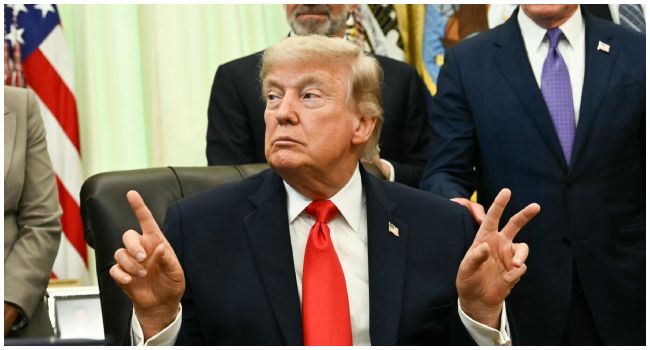
As the year wound down, America’s President, Donald Trump, on Christmas day, made true his threat of military intervention in Nigeria in October over what he described as “government’s failure to curb violence targeting Christian communities”. He served Nigerians a cold Christmas dish when he ordered strikes on terrorists’ enclaves in Sokoto State. Offa, a town in Kwara state suffered some collateral damages from the airstrikes.
Trump, who declared Nigeria a Country of Particular Concern, threatened to go into Nigeria ‘guns a-blazing’. The impact of the bombing is still being evaluated, with the nation divided on whether it was appropriate for the country to allow another nation to bomb any part of the country. Indeed, under international laws and conventions, Trump’s action could be deemed to have violated known conventions. Article 2(4) of the United Nations Charter prohibits the use of force against the territorial integrity or political independence of any sovereign state, save for three narrowly defined exceptions.
First, is authorization by the UN Security Council, under Chapter VII. Second, is self-defence, under Article 51, and third, is the derivative basis of intervention by consent, which is only lawful where such consent is validly given by the recognized government acting within its constitutional authority.
However, as Nigerians have been told that the US airstrike was with the approval of the country’s President, then the inquiry shifts to the constitutional validity of that consent. Under the 1999 Constitution (as amended), executive power is vested in the President by Section 5, but that power is not absolute. It is circumscribed by the Constitution and subject to legislative oversight. The control and operational use of the armed forces is addressed in Sections 217 and 218.
While Section 218(1) designates the President as Commander-in-Chief, Section 218(4) expressly empowers the National Assembly to make laws regulating the operational use of the armed forces. This provision has consistently been interpreted as anchoring civilian and legislative oversight over military deployments and security cooperation, particularly where such actions have far-reaching implications for national sovereignty and external relations.
The above sections of the constitution notwithstanding, the war against bandits and terrorists has been allowed to fester for too long and if Trump could provide the much-needed solution, it should be welcome by all peace-loving Nigerians.
Read also: Trump Administration Seeks To Strip Ilhan Omar Of US Citizenship
Wishing us all a happy and prosperous New Year in advance.
See you next week.
- Akintunde is the Publisher and Editor-in-Chief of Glittersonline newspaper. His syndicated column, Monday Discourse, appears on News Point Nigeria newspaper on Monday.