

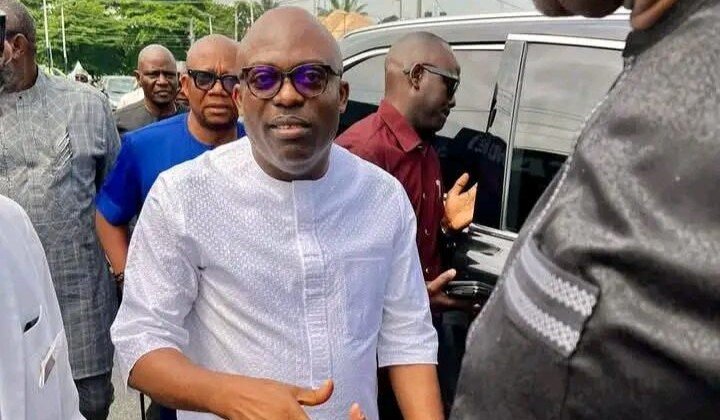
THE Rivers State House of Assembly on Friday intensified its standoff with Governor Siminalayi Fubara by formally calling on the Chief Judge of the state to set up a panel to investigate allegations of gross misconduct against him and his deputy, Ngozi Odu.

News Point Nigeria reports that the lawmakers, acting through a unanimous vote, vowed to continue with impeachment proceedings.

The move comes amid a sustained political crisis that has gripped the oil‑rich state since Fubara’s relationship with lawmakers and former governor and current Minister of the Federal Capital Territory, Nyesom Wike, collapsed.

Although Governor Fubara recently defected from the Peoples Democratic Party (PDP) to the All Progressives Congress (APC) — a decision he described as a bid to align with President Bola Tinubu’s agenda — the shift has done little to mend ties with the Assembly or Wike.


The defection, announced in December 2025, followed sustained political friction in the state, including the departure of several Assembly members to the APC.
Despite the governor’s assurances that the move was intended to ease tensions and support stability, his relationship with the majority of lawmakers — who have largely remained aligned with Wike — has remained strained.
The feud previously led President Tinubu to intervene in March 2025 by declaring a state of emergency in Rivers State and suspending the governor, his deputy and the Assembly for six months after tensions threatened governance and security.
Under the emergency rule, a sole administrator was appointed to oversee the state before the suspended officials were reinstated late last year.
Addressing journalists at a live press conference in Port Harcourt, the lawmakers accused Fubara of blackmail and constitutional breaches that have eroded trust and stalled governance. In the briefing, Deputy Speaker Dumle Maol reiterated that the legislature had been left with no option but to pursue constitutional remedies.

They also accused both the governor and his deputy of intimidating the parliament in a bid to stifle legislative oversight, claims that have heightened political tensions in the state. Despite their firm stance, the Assembly thanked President Tinubu for previous efforts to mediate the crisis.
“It is obvious that the only solution now is to apply the solution prescribed by the 1999 Constitution as altered, which is the impeachment of the incorrigible governor and the deputy governor,” Maol said.
“We therefore strongly appeal to leaders at all levels and the good people of Rivers State to kindly consider the problem at hand and understand that the impeachment process is the best way to go at this point.


“We are using this medium to call on the Speaker to allow the constitutional process to proceed unhindered. We thank our dear President, Bola Tinubu, who has demonstrated so much love for Rivers State.
“He did his best for the resolution of this impasse, but the governor and deputy governor are adamant,” the lawmaker added.
The lawmakers also called on Speaker Martin Amaewhule to reconvene the House.
In a notable shift, four members who had previously advocated for a political solution recanted their positions and declared support for continuing the impeachment process.
Shortly after the press briefing, lawmakers moved to the Assembly chambers for plenary.
At plenary, members unanimously supported the investigation of gross misconduct allegations against Fubara and his deputy.
“This voting clearly shows the decision of the House,” Amaewhule declared as he urged the Chief Judge of Rivers State to constitute an investigative panel in accordance with constitutional provisions.
Below is a step-by-step process for impeaching a state governor in Nigeria, in line with Section 188 of the 1999 Constitution (as amended).
1. Grounds For Impeachment
Impeachment can only be initiated for “gross misconduct” — a serious breach of the Constitution or misconduct deemed by the House as amounting to gross misconduct.
2. Notice Of Allegation
At least one-third of the members of the State House of Assembly must sign a written notice of allegation against the governor, outlining the alleged misconduct. This notice is then presented to the Speaker.
3. Serving The Notice
Within seven days of receiving the notice, the Speaker must serve a copy to the governor and each member of the State House of Assembly.
4. Gov’s Response
The governor has the right to reply to the allegations in writing. Any response must be circulated to all members of the assembly.
5. Initial Assembly Vote
Within 14 days of the notice being presented, the House must vote (without debate) on whether the allegations warrant a formal investigation. A two-thirds majority of all members is required to proceed.
6. Formation Of Investigative Panel
If the motion passes, the Speaker must request the Chief Judge of the state to appoint a seven-member investigative panel of persons with unquestionable integrity (not from public service, legislature, or political parties) to investigate the allegations.
7. Panel Investigation
The panel has up to three months to investigate the allegations and submit its report to the state House of Assembly. The governor may appear or be represented by legal counsel.
8. Panel Findings
If the panel finds the allegations unproven, the impeachment process ends. If the panel finds the allegations proved, the House will consider the report.
9. Final Removal Vote
Within 14 days of receiving the panel’s report, the House must vote on a resolution to adopt the report. This also requires a two-thirds majority of all members. If adopted, the governor is removed from office immediately.
10. Succession
Upon removal, the deputy governor is sworn in as governor. If both the governor and deputy are removed simultaneously, the Speaker of the House becomes the acting governor, and elections must be held within 90 days.
11. Finality Of Process
Section 188 includes an ouster clause barring courts from entertaining or questioning impeachment proceedings or determinations once due process is followed.
This process ensures constitutional due process, safeguards the rights of the accused governor, and limits judicial interference once properly executed by the legislature.