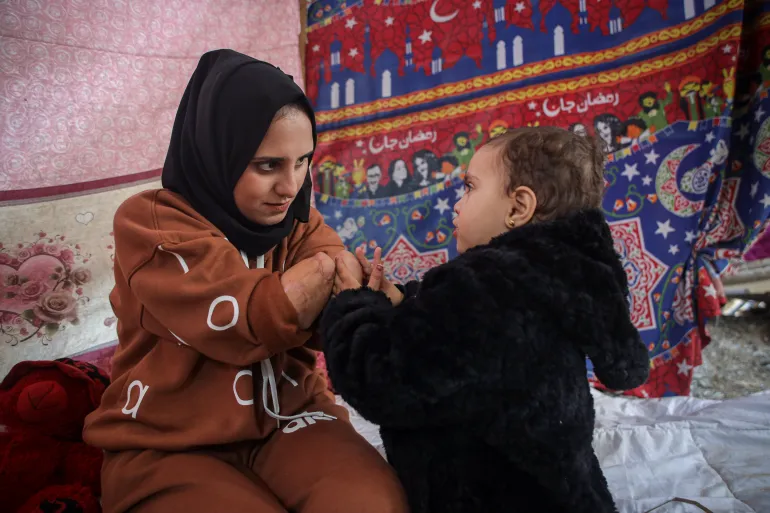
WITH what remains of her wounded forearms, Nebal al-Hessi scrolls on her phone to follow news updates on the reopening of the Rafah land crossing from her family’s tent in an-Nazla, Jabalia in the northern Gaza Strip.

Nebal’s hands were amputated in an Israeli artillery attack on the home where she had taken shelter with her husband and her daughter in the Bureij refugee camp in central Gaza, on October 7, 2024.

Read also: Suspected Israeli Online Operations Cause Alarm In Iran, Lebanon
More than a year later, the 25-year-old mother is one of thousands of wounded people placing their hopes on the reopening of the Rafah crossing between Gaza and Egypt as they seek access to adequate medical treatment outside the besieged Palestinian territory.

“It’s been a year and five months since I got injured … Every day, I think about tomorrow, that I might travel, but I don’t know,” Nebal tells Al Jazeera in a quiet voice.
Recalling the attack, Nebal says she was sitting on her bed holding her baby daughter Rita, trying to communicate with her family in northern Gaza, when the shell hit suddenly.


“I was trying to catch an internet signal to call my family … my daughter was in my lap… suddenly the shell hit. Then there was dust; I don’t remember anything else,” Nebal says.
“It was the shell fragments that amputated my hands,” she recounts.
Nebal was taken to the hospital with severe injuries, including complete amputation of both upper limbs up to the elbows, internal bleeding, and a leg injury. She underwent two abdominal surgeries.

Read also: Houthis Strike Aramco Hours After Saudi-Led Coalition Hits Sanaa Oil Site
She spent about 40 days in the hospital before beginning a new stage of suffering in displacement tents, without the most basic long-term care.
Today, Nebal, an English translation graduate and mother to two-year-old Rita, relies almost entirely on her family for the simplest daily tasks.


“I can’t eat or drink on my own … even getting dressed, my mother, sister, and sister-in-law mainly help me,” she says sorrowfully.
“Even going to the bathroom requires help. I need things in front of me because I cannot bring them myself.”
Nebal talks about the pain of motherhood left suspended, as her daughter grows up before her eyes without her being able to hold her or care for her.
“My little daughter wants me to change her, feed her, give her milk, hold her in my arms like other mothers… she asks me, and I can’t,” Nebal says with sorrow.
“My life is completely paralysed.”
Read also: Pope Leo Diagnosed With Lung Cancer After Surgery, The Vatican Confirms
Doctors tell Nebal that she urgently needs to travel to continue treatment and have prosthetic limbs fitted, emphasising that she needs advanced prosthetics to regain a degree of independence, not just cosmetic appearance.
“Doctors tell me that I need a state or an institution to adopt my case so I can gradually return to living my normal life,” she adds.