

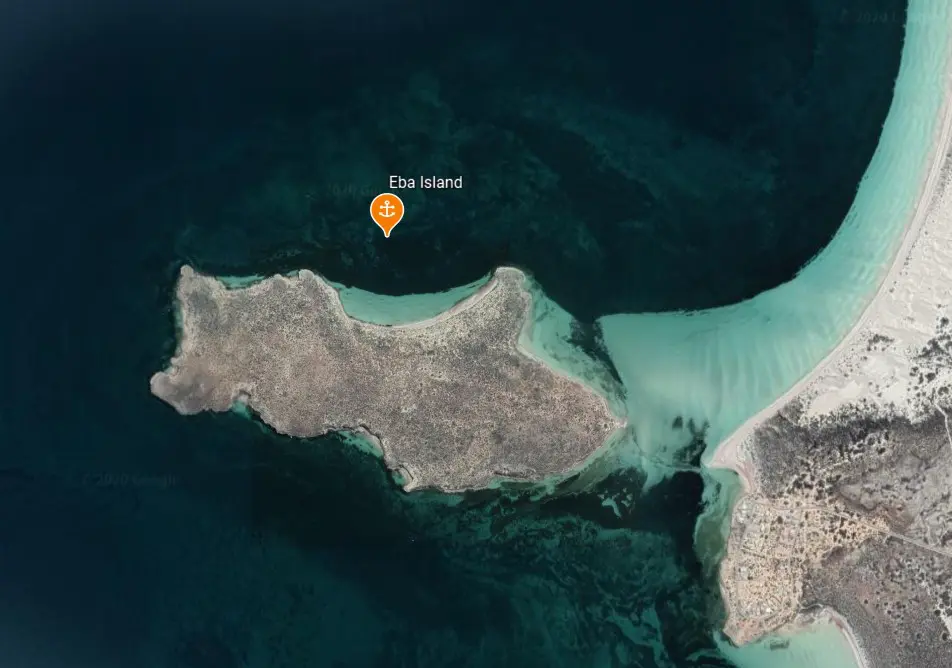
TENSIONS have flared between Ogun and Ondo states following President Bola Tinubu’s approval of drilling activities at an abandoned oil well on Eba Island, a coastal territory now confirmed to host hydrocarbon deposits, reigniting a long-simmering boundary dispute between the two South-West neighbours.
News Point Nigeria reports that the Ogun State Government has firmly restated its claim to Eba Island, located in Ogun Waterside Local Government Area, rejecting Ondo State’s counter-claim as misleading, historically flawed, and capable of triggering avoidable communal tension.
In a statement issued on Sunday, the Special Adviser to Governor Dapo Abiodun on Information and Strategy, Kayode Akinmade, said the island “falls squarely within Ogun State” based on constitutional, historical and administrative records recognised by the Federal Government.


“The Eba Island, where the approved oil well is located, falls squarely within Ogun Waterside Local Government Area of Ogun State,” Akinmade said. “Boundaries between states and local governments in Nigeria are constitutionally defined and properly documented by the National Boundary Commission. Official boundary maps and records clearly situate Eba Island within Ogun State.”
According to Ogun State, Eba is a long-established coastal community whose existence predates Nigeria’s independence and whose administrative status has remained unchanged through multiple political reorganisations, including the 1976 state creation exercise that carved Ogun State out of the old Western State.
“Since 1976, there has been no constitutional amendment, judicial pronouncement or federal gazette that altered the boundary placing Eba outside Ogun State,” Akinmade added.
The Ogun government also sought to clarify what it described as deliberate confusion over nomenclature, noting that two different locations bear the name “Eba.”
“There is an Eba near the Ondo State forest reserve, which is distinct from the larger Eba Island where the approved oil well is located. The latter lies entirely within Ogun State’s coastal corridor,” the statement said.
Akinmade further disclosed that the approval granted by President Tinubu followed extensive due diligence by the Nigerian National Petroleum Company Limited (NNPCL) and other federal agencies, which confirmed the oil well’s location within Ogun State before drilling clearance was issued.

He added that the deployment of national security assets, including naval formations around the drilling site, further underscored federal recognition of Ogun State as the host state.
Providing historical context, Ogun State revealed that in October 2024, the Molokun of Atijere in Ondo State formally approached the Osobia of Makun-Omi in Ogun Waterside, seeking permission to conduct business activities on Eba Island.
The request, according to Ogun, was declined and formally reported to the state government, NNPCL and security agencies.


“This engagement amounted to a tacit acknowledgement of Ogun State’s jurisdiction over the area,” the statement said.
Ogun also dismissed Ondo’s reliance on colonial documents dating back to 1919 and 1920, describing them as selective and misleading. Instead, it cited Colonial Government Gazette No. 660 of April 29, 1950, which defined the boundary between the former Ijebu and Ondo provinces.
Additional evidence referenced by Ogun included historical lease agreements, community records, survey plans for the Olokola Free Trade Zone, and administrative validation by the Independent National Electoral Commission (INEC), which registers polling activities at LA Primary School, Eba, under Makun/Irokun Ward in Ogun Waterside Local Government Area.
While urging restraint, the Ogun State Government insisted that the facts were settled.
“The facts are clear, and the law is settled. Eba Island, where the approved oil well is located, is in Ogun State,” the statement concluded.
However, Ondo State has rejected Ogun’s position, maintaining that Eba Island belongs to Atijere community in Ilaje Local Government Area.
In a counter-statement issued on Sunday, the Special Adviser to Governor Lucky Aiyedatiwa on Communication and Strategy, Allen Sowore, accused Ogun State of issuing misleading public statements and attempting to shape public opinion through media narratives.
“It must be clearly stated that mineral resources, including oil wells, are assets of the Federal Government, domiciled within different states of the Federation,” Sowore said, citing Item 39 of the Second Schedule (Part I) of the 1999 Constitution, which places oil fields and oil mining on the Exclusive Legislative List.
While acknowledging the constitutional framework governing mineral resources, Sowore stressed that territorial claims must be grounded in historical documentation, statutory authority, and judicial determinations.
“Ownership of land or territorial location of petroleum resources is not established by press statements or shifting public narratives,” he said. “In this case, the oil deposit in question is situated in Atijere, Ondo State.”
The Ondo government insisted that Ilaje indigenes are the landowners in the disputed area and that the settlement has existed since at least 1937.
“Eba Island has historically fallen under the Atijere Native Court Authority. River Ufara, which runs through Imakun into Oluwa River, serves as a natural boundary between Ilaje land and Ijebu land,” Sowore said.
He added that Ogun and Ondo states have historically enjoyed cordial relations and warned against actions capable of undermining regional harmony.
The Ondo State Government has now called on the National Boundary Commission and other relevant federal agencies to publish authoritative records to conclusively resolve the boundary dispute.