

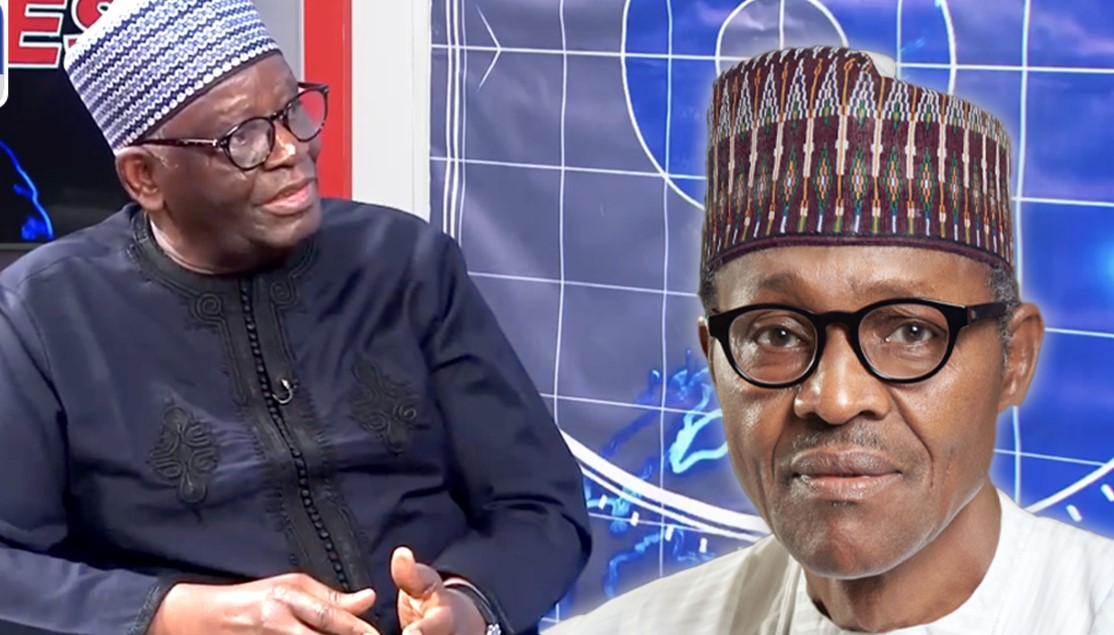
FORMER Chief of Staff to ex-President Muhammadu Buhari, Professor Ibrahim Gambari, has revealed that one of the deepest regrets of the late Nigerian leader was his inability to fully resolve the country’s security challenges before leaving office in 2023.
Gambari made the disclosure on Monday during an appearance on Politics Today, a current affairs programme on Channels Television monitored by News Point Nigeria, where he reflected on Buhari’s leadership, personal struggles in office, and the broader realities of governance in Nigeria.
According to Gambari, although Buhari achieved notable successes against Boko Haram insurgents, the persistence of insecurity in other parts of the country weighed heavily on him until the very end of his tenure.


“One of the things that pained him the most is that he was unable to do more about the security situation in the country before he left,” Gambari said.
“He did a lot by making sure that no territory of Nigeria was under Boko Haram.”
Buhari’s administration recorded early gains in the North-East, reclaiming territories previously controlled by Boko Haram and degrading the group’s conventional fighting capacity. However, insecurity later evolved and spread, particularly in the North-West and North-Central regions, where banditry, mass kidnappings, and communal violence escalated.
Gambari said these developments deeply troubled the former president.
“The situation in the North-West, in the North-Central, even in banditry, it pained him a lot. And he felt, ‘I’ve done everything I can for these people.’ He even said at some point that maybe the base was not good enough,” he added.
Buhari served as Nigeria’s democratically elected president from 2015 to 2023, having earlier ruled as military head of state between 1983 and 1985. His eight-year civilian tenure was marked by recurring and shifting security threats, which remained one of the administration’s most unresolved challenges, despite visible efforts and reforms in the military and security architecture.

The former president died on July 13, 2025, at the age of 82, after a prolonged illness.
Gambari also addressed claims by the Minister of Defence that coup threats existed toward the end of Buhari’s administration, stating that he was not aware of any such intelligence reaching the president through his office.
“Honestly, I’m not aware of that. The president had many sources of information. The Chief of Staff is probably a principal one, but not the only one. He could have received information that I was not privy to,” he said.


He explained that Buhari’s background as a former military ruler gave him deep institutional ties with the armed forces, but stressed that he governed strictly within constitutional limits during his civilian presidency.
Beyond security, Gambari offered insights into Buhari’s leadership style, describing him as deeply loyal to individuals he believed had contributed to his personal and political development.
Recalling his own appointment as Chief of Staff in 2020 following the death of Abba Kyari, Gambari said Buhari personally insisted on his return to government service.
“Nobody mentioned my name, but he said, ‘Go and bring me Gambari,’” he recalled.
Gambari, who also served as a minister during Buhari’s military regime in the 1980s, described the former president as loyal “to a fault.”
On the often-debated issue of a presidential cabal, Gambari said every administration has influential inner circles, but noted that those around Buhari understood their boundaries.
“Sometimes more powers are ascribed to these cabals than is actually the case. The so-called cabal under Buhari knew their limitations. They dared not push beyond that because everybody knew Buhari had what I call creative stubbornness,” he said.
Reflecting on his three years in office, Gambari said the experience exposed him to a troubling reality: that many of those who benefit most from Nigeria are the least committed to its development.
“What is shocking is that I have seen the possibilities of that office, of the presidency. But I have also seen how those who benefitted most from what this country has to offer are the least committed to its stability, progress and development,” he said.
According to him, many power seekers lack the willingness to make the sacrifices required to govern responsibly.
“They seek power, but they are not willing to make the sacrifices that come with the responsibility to govern, which include being fair and just, and thinking nationally rather than ethnically or religiously.”
Gambari added that while opportunities for change exist, experience in government also reveals the structural and political limitations that make rapid transformation difficult.
Gambari also dismissed the notion that Buhari sought to impose a successor ahead of the 2023 general election, insisting that the former president believed leadership choices should be left to party members and the electorate.
According to him, Buhari resisted pressure to anoint a candidate, maintaining that democratic processes must prevail.