

THE Jos-Akwanga-Abuja federal highway exemplifies Nigeria’s road infrastructure crisis, where deplorable conditions have turned vital transport corridors into scenes of carnage and economic loss.

A journey that should take hours stretches into an entire day, as vehicles navigate treacherous potholes and crumbling sections. This is the daily reality for those traveling Nigeria’s federal highways, where infrastructure has deteriorated to such an extent that these roads have earned the grim nickname “death traps”.

The situation on the Jos-Akwanga-Abuja corridor highlights a national crisis in transportation infrastructure, with profound implications for safety, security, and economic development.

The story of this particular road also reveals a developing narrative of political intervention and potential improvement, as both state and federal governments have recently committed to addressing its deplorable condition.


Nigeria’s road infrastructure crisis is both widespread and severe. With approximately 204,000 kilometers of roads handling over 80% of national transportation needs, the deteriorating condition of these arteries has created a national emergency. Statistics paint a grim picture: in just the last quarter of 2025, the Federal Road Safety Corps recorded 5,320 road traffic crashes involving 8,808 vehicles, resulting in 2,471 deaths.
The problem extends far beyond statistics to impact every facet of Nigerian life.
Road traffic injuries have risen from the 11th to the 9th leading cause of death globally since 2000.
There is also economic impact arising from road accidents in Nigeria, which is put as an estimated cost of N9.8 billion in just the first three quarters of 2023.
The comparatively, Nigeria’s road casualty average of 33.7 per 100,000 people annually far exceeds the African average of 26.6 and the global average of 17.4.

The deplorable state of Jos-Akwanga-Abuja corridor which feeds about seven states stretching from North-Central to the North- East should present a serious national concern.
This particular road exemplifies the broader crisis affecting Nigeria’s federal highways. This critical corridor, has deteriorated into what residents describe as a “death trap”.
The problems plaguing this route mirror those found nationwide from severe road damage, deep potholes and failed sections that make navigation treacherous with serious security vulnerability which armed bandits are using to attack motorists.


There is also extended travel times, with journeys which ordinarly should take two to three hours now requiring seven to eight hours due to road conditions.
The Jos-Akwanga-Abuja road condition has become a daily nightmare for farmers who struggle to transport their produce to markets, students who face dangerous journeys to school, and businesses suffering from supply chain disruptions. The situation has become so dire that some commercial drivers have abandoned the route entirely, isolating communities and stifling economic activity.
Disturbed by this federal road condition, the Plateau State Governor, Caleb Mutfwang has committed millions of Naira in rehabilitating some sections of the roads which has not made much impact due to the the severity of the road condition and pressure on the highway.
The governor has also on several occasions made lobby trips to the Minister of Works, Engr. David Umahi
to mount pressure on the Ministry to go beyond its announcement of awarding contract for the road to actually accelerating its reconstruction.
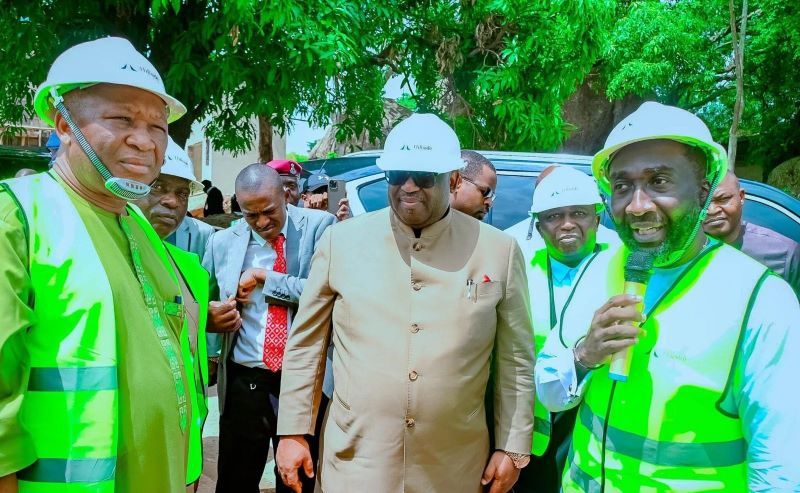
Mutfwang after a recent meeting with the Works Minister, expressed delight at the news that the contractors have been mobilized to site, signaling federal government’s attention to this long-neglected corridor.
According to Mutfwang, this commitment aligns with broader federal efforts to rehabilitate critical highways across the North Central region under President Bola Ahmed Tinubu’s Renewed Hope Agenda.
The Federal Ministry of Works, under Minister David Umahi, has intensified construction, rehabilitation, and inspection of federal road projects across the North Central region. These efforts span multiple states and aim to ease traffic congestion, reduce travel time and enhance safety.
The deplorable state of the Jos-Akwanga-Abuja road represents both a failure of infrastructure governance and an opportunity for meaningful improvement. While Governor Mutfwang’s attention to the issue and the federal government’s commitment to reconstruction offer hope, tangible progress will be measured in the dual carriage way, asphalt and concrete not just promises.
As Nigeria strives to improve its road network, the transformation of this particular corridor from “death trap” to safe passage will serve as an important test case for the nation’s ability to address its infrastructure challenges.
The safety of countless travelers and the economic vitality of entire regions depend on this transformation becoming reality rather than remaining another unfulfilled pledge in Nigeria’s long history of infrastructure deficits.
- Abu, is the Deputy President, Nigerian Guild of Editors.