

AT dawn on August 10, 2024, Yasmin Mahani walked through the smoking ruins of al-Tabin school in Gaza City, searching for her son, Saad. She found her husband screaming, but of Saad, there was no trace.
“I went into the mosque and found myself stepping on flesh and blood,” Mahani told Al Jazeera Arabic for an investigation that aired on Monday. She searched hospitals and morgues for days. “We found nothing of Saad. Not even a body to bury. That was the hardest part.”
Mahani is one of thousands of Palestinians whose loved ones have simply vanished during Israel’s genocidal war on Gaza, which has killed more than 72,000 people.


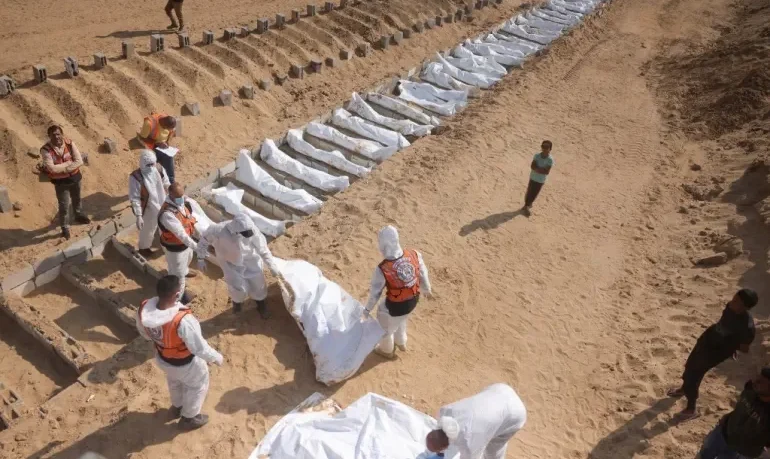
According to the Al Jazeera Arabic investigation, The Rest of the Story, Civil Defence teams in Gaza have documented 2,842 Palestinians who have “evaporated” since the war began in October 2023, leaving behind no remains other than blood spray or small fragments of flesh.
Experts and witnesses attributed this phenomenon to Israel’s systematic use of internationally prohibited thermal and thermobaric weapons, often referred to as vacuum or aerosol bombs, capable of generating temperatures exceeding 3,500 degrees Celsius [6,332 degrees Fahrenheit].
The figure of 2,842 is not an estimate, but the result of grim forensic accounting by Gaza’s Civil Defence.
Spokesperson Mahmoud Basal explained to Al Jazeera that teams use a “method of elimination” at strike sites. “We enter a targeted home and cross-reference the known number of occupants with the bodies recovered,” Basal said.
“If a family tells us there were five people inside, and we only recover three intact bodies, we treat the remaining two as ‘evaporated’ only after an exhaustive search yields nothing but biological traces—blood spray on walls or small fragments like scalps,” he added.
The investigation detailed how specific chemical compositions in Israeli munitions turn human bodies into ash in seconds.

Vasily Fatigarov, a Russian military expert, explained that thermobaric weapons do not just kill; they obliterate matter. Unlike conventional explosives, these weapons disperse a cloud of fuel that ignites to create an enormous fireball and a vacuum effect.
“To prolong the burning time, powders of aluminium, magnesium and titanium are added to the chemical mixture,” Fatigarov said. “This raises the temperature of the explosion to between 2,500 and 3,000 degrees Celsius [4,532F to 5,432F].”
According to the investigation, the intense heat is often generated by tritonal, a mixture of TNT and aluminium powder used in United States-made bombs like the MK-84.


Dr Munir al-Bursh, director general of the Palestinian Ministry of Health in Gaza, explained the biological impact of such extreme heat on the human body, which is composed of roughly 80 percent water.
“The boiling point of water is 100 degrees Celsius [212F],” al-Bursh said. “When a body is exposed to energy exceeding 3,000 degrees combined with massive pressure and oxidation, the fluids boil instantly. The tissues vaporise and turn to ash. It is chemically inevitable.”