

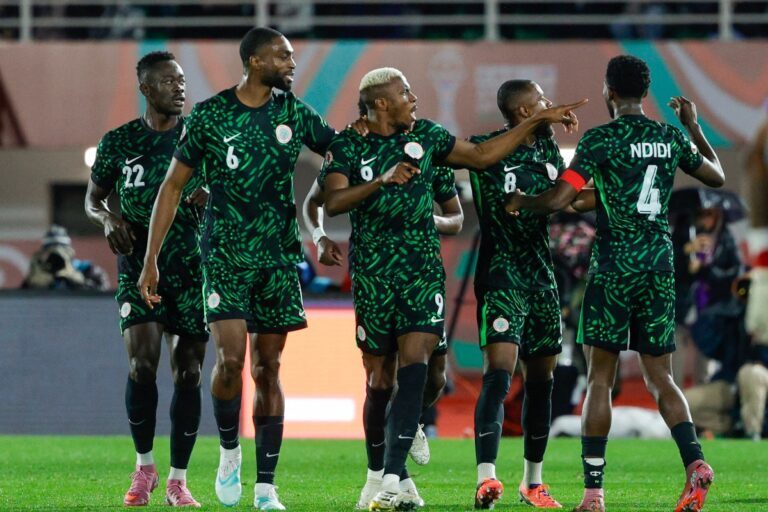
THERE is renewed optimism within the Nigeria Football Federation (NFF) that the Super Eagles may yet receive an unexpected lifeline in their quest to qualify for the 2026 FIFA World Cup, as the football body awaits a decisive ruling from FIFA over a protest filed against DR Congo.
News Point Nigeria Sport reports that Nigeria’s hopes of reaching the expanded 48-team tournament appeared dashed last November after the Super Eagles suffered a painful penalty shootout defeat to DR Congo in the final of the African play-offs in Morocco. The defeat left the three-time African champions on the brink of missing another global showpiece.
However, the NFF quickly lodged a formal protest, alleging that DR Congo fielded players who were ineligible during the qualifying series, thereby potentially invalidating the result.


With the intercontinental play-offs scheduled to take place between March 26 and March 31 in Mexico, FIFA’s verdict is expected imminently. DR Congo have already been drawn to face the winner of the tie between New Caledonia and Jamaica, with two final World Cup slots available at the tournament.
Should Nigeria’s petition be upheld, the Super Eagles could replace DR Congo in the Mexico play-offs and revive their qualification campaign.
Speaking on the matter, NFF General Secretary, Dr Mohammed Sanusi, expressed confidence in the strength of Nigeria’s submission.
“We are still waiting for them to reach out to us,” Sanusi said.
“We believe that we have a chance; that is why we petitioned. If we knew we didn’t have a chance, we wouldn’t have petitioned. That is our submission — it is now left to FIFA to decide.”
The NFF’s protest centers on what it describes as the alleged illegal switch of nationality by certain DR Congo players who featured during the play-offs.

Under FIFA statutes, a player may apply to change national team allegiance only once, subject to strict procedural requirements. The request must be made formally, supported with documentation, and approved by FIFA’s Players’ Status Committee.
Crucially, while FIFA requires a player to possess a passport of the new association they wish to represent, Congolese domestic law prohibits dual nationality — a factor the NFF argues complicates the legitimacy of the players’ eligibility.
“FIFA rules say once you have a passport of your country, you’re eligible, and that is why they were cleared,” Sanusi explained.


“But our concern is that FIFA was deceived into clearing them. It is not FIFA’s responsibility to enforce Congo’s domestic regulations; FIFA acts based on what is submitted to it. What we are saying is that the process was fraudulent.”
The petition was formally submitted last December, and since then, both federations have awaited FIFA’s disciplinary and regulatory review.
Among the Super Eagles squad, there is cautious optimism that the door may not yet be completely shut.
Midfielder Alex Iwobi admitted that the players are monitoring developments closely.
“I mean, we’re still waiting — hopefully we can go to the World Cup,” Iwobi said recently.
For many of the squad members, qualification would represent a second chance after the emotional disappointment in Morocco.
The Chairman of the National Sports Commission, Shehu Dikko, has suggested that regardless of FIFA’s ruling, the matter could ultimately proceed to the Court of Arbitration for Sport (CAS), potentially prolonging the dispute.
“It requires a lot of things, and by the time it is finally decided, whether Nigeria wins or DR Congo wins, I believe the case might even go to the Court of Arbitration for Sport,” Dikko said during a visit to Morocco last month.
“For us, we are waiting to see how it goes. All I know is that FIFA is still handling the petition.”
Such a development could create a legal race against time, given the proximity of the Mexico play-offs and the fixed timeline for the 2026 tournament.
The 2026 FIFA World Cup, which will be co-hosted by the United States, Canada and Mexico from June 11 to July 19, will feature an expanded format of 48 teams competing across 16 cities.
If Nigeria’s protest succeeds and they advance through the Mexico play-offs, the Super Eagles would join Portugal, Uzbekistan and Colombia in Group K of the World Cup proper.
For now, however, the fate of Nigeria’s World Cup dream rests firmly in the hands of FIFA’s adjudicating bodies — and possibly, the global sports court.