

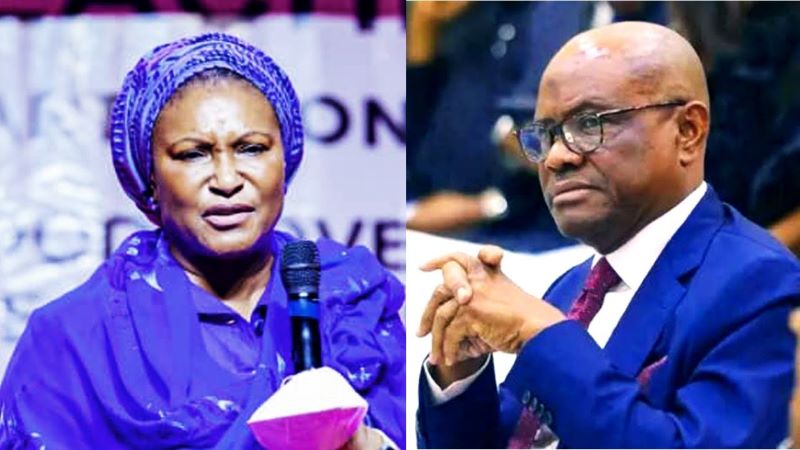
THE Minister of the Federal Capital Territory (FCT), Nyesom Wike, has defended the controversial restriction of movement imposed ahead of Saturday’s area council elections in Abuja, insisting that the decision was taken with the approval of President Bola Ahmed Tinubu.
News Point Nigeria reports that Wike made the clarification on Saturday while monitoring the polls in several parts of the FCT, including Garki, Karu, Karshi, Wasa, Apo and Ketti.

“It is unfortunate, I thought as a Senator she should be able to read. I never imposed a curfew on my own. I said with the approval of Mr. President,” Wike stated, responding to criticism from the senator representing the FCT.

In a special broadcast aired on national television and radio stations on Thursday, the minister had declared Friday a work-free day in preparation for the council polls.


He also announced a restriction on human and vehicular movement across the FCT from 8 p.m. on Friday to 6 p.m. on Saturday, a move he said was aimed at ensuring a peaceful and orderly election.
The announcement immediately generated debate within political circles and among residents, with some expressing concern over the sweeping nature of the directive.
Reacting to the development, Senator Ireti Kingibe criticised the curfew, describing it as unacceptable in a democratic society.
Speaking on Channels Television’s Politics Today, the lawmaker argued that imposing a movement restriction across the Federal Capital Territory without broad consultation amounted to executive overreach.
“The people of the FCT are not subjects under a dictatorship. They are citizens of a democratic republic. Any sweeping restriction on their movement and livelihoods must be justified by compelling evidence, subjected to scrutiny, and carried out with transparency,” she said.

While acknowledging the need to maintain law and order, Kingibe emphasised that security concerns should not serve as a blanket justification for limiting citizens’ constitutional rights.
Wike, however, dismissed the senator’s remarks, saying he would not engage in a public exchange of words.
“When you hear someone’s speech, why not take time to listen to what was said? She has her problem, I don’t want to join issues,” the former Rivers State governor said.


He added that the ultimate verdict would come through the election results.
“At the end of the election, when the results come out, then we will know,” he stated.
Assessing the conduct of the area council polls, Wike observed that voter turnout appeared low, particularly in central parts of the capital city.
Despite the turnout concerns, the minister commended residents who participated in the exercise for maintaining peace and order throughout the voting process.
He also praised officials of the Independent National Electoral Commission (INEC) and security agencies for their coordination and professionalism.
According to Wike, reports available to him indicated that no incidents of violence had been recorded as of the time of his assessment.
The minister specifically lauded INEC for deploying the Bimodal Voter Accreditation System (BVAS), describing it as an important tool in strengthening electoral credibility.
He urged residents to continue to maintain calm and orderliness until the conclusion of the electioneering process and the announcement of results.
The curfew controversy, however, has added a political dimension to what would otherwise have been routine council elections, underscoring broader debates about executive powers, democratic safeguards and the balance between security and civil liberties in Nigeria’s capital.
As results trickle in, attention is likely to remain not only on who wins the area council seats, but also on the wider implications of the policy decisions taken ahead of the polls.