

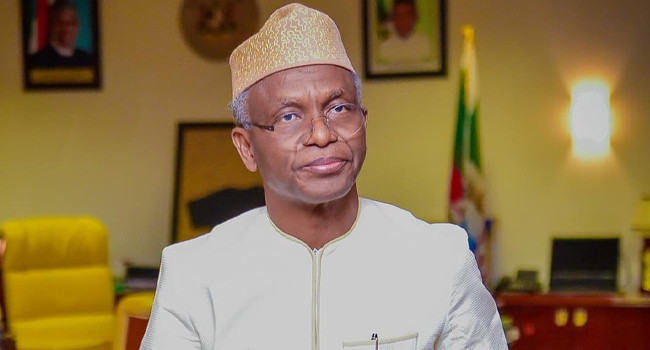
AS Nigeria’s political temperature rises ahead of the next electoral cycle, the legal and political travails of former Kaduna State governor, Nasir El-Rufai, have become one of the most riveting national stories.
From attempted airport arrest and EFCC interrogation to DSS charges and an ICPC raid on his residence, the unfolding drama cuts across law enforcement, national security, party politics and long-standing elite rivalries.
In this Sunday Politics feature, News Point Nigeria examines the sequence of events, the legal implications, the political undercurrents, and the broader questions they raise about power, accountability and opposition politics in Nigeria.


The Department of State Services (DSS) has fixed February 25 for the arraignment of El-Rufai before a Federal High Court in Abuja over allegations bordering on cybercrime and breach of national security.
He is expected to appear before Justice Joyce Abdulmalik following the filing of a three-count charge by the secret police.
According to court documents, the charges stem from allegations that the former governor unlawfully intercepted a telephone conversation involving the National Security Adviser (NSA), Nuhu Ribadu.
The DSS maintains that the alleged act contravenes provisions of the Cybercrimes (Prohibition, Prevention, etc.) Amendment Act, 2024, as well as the Nigerian Communications Act, 2003.
The charges follow comments made by El-Rufai during an appearance on Prime Time, an Arise Television programme, where he alleged that “someone wiretapped” the phone of the NSA, enabling him to hear Ribadu allegedly directing security operatives to arrest him.
Security authorities have not publicly provided full details of the alleged interception but insist that any such act violates telecommunications and cybercrime laws.

Before the DSS charges, El-Rufai had already spent two nights in the custody of the Economic and Financial Crimes Commission (EFCC).
Muyiwa Adekeye, his media aide, confirmed that the former governor honoured the invitation of the anti-graft agency and was answering questions from detectives.
At 10:07 p.m. on Monday, Adekeye posted: “Malam Nasir @elrufai today honoured the invitation extended to him by the EFCC. He had a frank and fruitful interaction with the EFCC officials, whom his counsel noted were entirely professional in their approach and conduct. He remains with the EFCC.”


Sources told News Point Nigeria that detectives grilled El-Rufai over alleged fraud during his tenure as governor of Kaduna State from 2015 to 2023.
“He is with our investigators, but cannot confirm how long he would be questioned; it is still early to know how long he will stay there,” a source said.
The Kaduna State House of Assembly had earlier recommended his probe over alleged fraud to the tune of N432 billion, an allegation he has consistently denied.
However, shortly after he was granted administrative bail by the EFCC, officials of the Independent Corrupt Practices and Other Related Offences Commission (ICPC) took him into custody.
In a statement, ICPC’s Head of Media and Public Communications, Mr. J. Okor Odey, confirmed: “Malam Nasiru El-Rufai, the former Governor of Kaduna State, is in our custody… in connection with ongoing investigations.” The commission did not disclose details of the investigation but promised updates in due course.
The situation escalated further when El-Rufai’s Aso Drive residence in Abuja was reportedly searched by ICPC officials. Adekeye posted on social media:
“UPDATE: The Aso Drive residence of Malam Nasir @elrufai was today searched by the ICPC.”
His lawyer, Ubong Esop Akpan, condemned the action as unlawful and a violation of legal procedures and fundamental rights.
Details regarding the warrant status and outcome of the search remained unclear at press time, and authorities have yet to issue an official statement on the operation till date.
The chain of events began days earlier with an attempted arrest at the Nnamdi Azikiwe International Airport.
According to Adekeye, security agents approached El-Rufai as he arrived from Cairo, Egypt, and sought to take him into custody. He reportedly declined to follow them without a formal invitation.
Adekeye alleged that operatives seized his passport during the encounter. It remains unclear whether the DSS or EFCC initiated the move. A video circulated online showed an official of the Federal Airports Authority of Nigeria (FAAN) attempting to prevent bystanders from recording the incident.
The legal storm intensified after El-Rufai claimed in interviews that he had listened to an intercepted phone conversation in which Ribadu allegedly directed security operatives to arrest him.
Speaking on ARISE Television, he said: “Someone tapped his phone… The government believes it is the only one that listens to calls, but we also have our ways.” While admitting that such access would ordinarily be illegal, he argued that phone interception is often carried out by authorities.
Beyond the alleged wiretapping, sources indicated that the DSS may also investigate other matters touching on national security, including statements made by El-Rufai regarding alleged importation of thallium sulphate by the Office of the National Security Adviser.
In a letter titled “Request for Clarification on the Procurement of Thallium Sulphate,” El-Rufai asked the NSA to clarify reports that ONSA imported approximately 10 kilograms of the toxic substance from Poland. He requested details about purpose, permits, storage, and regulatory oversight.
Another issue resurfacing in the controversy is the disappearance of Abubakar Idris, popularly known as Dadiyata. Human rights groups had long demanded answers over his 2019 abduction.
El-Rufai denied any involvement, stating that Dadiyata was not a critic of the Kaduna State Government but of the Kano State Government. He said his administration only learned of him after his family reported the abduction.
He claimed that information gathered suggested abductors came from Kano and alleged that years later, a police officer confessed to involvement.
The case remains unresolved.
Beyond the legal dimensions, the crisis reflects deeper political fractures. El-Rufai has openly criticised the administration of President Bola Tinubu, distancing himself from any personal relationship with the president and insisting their alliance was purely political.
He also alleged that Ribadu is positioning for 2031 and is responsible for his current travails, an allegation Ribadu declined to engage publicly, saying he would not join issues “out of respect for our past association.”
El-Rufai, now a chieftain of the African Democratic Congress (ADC), has declared that the “political struggle to unseat the current administration has just begun,” insisting he has no immediate ambition to contest elective office but intends to contribute to removing the government he helped bring to power.
At the EFCC headquarters, protesters both for and against El-Rufai gathered.
As February 25 approaches, all eyes are on the Federal High Court in Abuja. Will the DSS substantiate its claims under the Cybercrimes Act? Will the EFCC and ICPC proceed with corruption-related prosecutions? Or will the legal battles morph into a prolonged political contest?
For now, El-Rufai faces multiple fronts: corruption allegations, cybercrime charges, national security scrutiny, and a public war of words with powerful figures.