

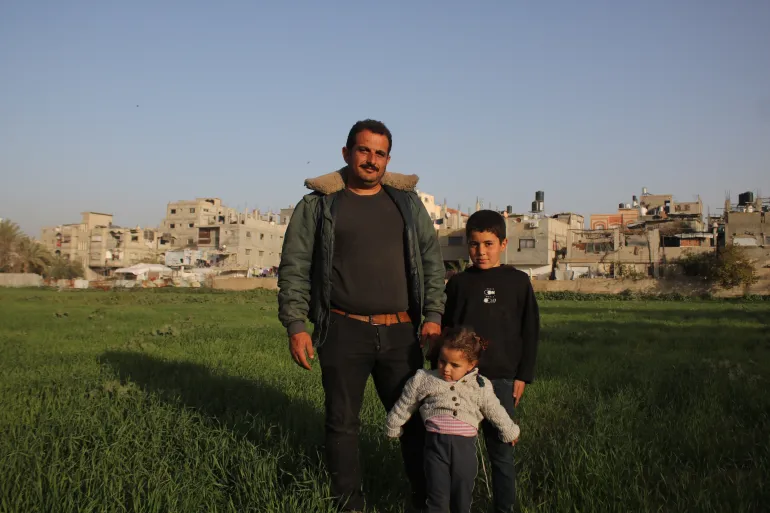
AS soon as the “ceasefire” in Gaza began in October, Palestinian farmer Mohammed al-Slakhy and his family headed straight for their farms in the Zeitoun area of Gaza City.
After more than two years of Israel’s genocidal war on Gaza – and despite ongoing Israeli attacks – it was finally safe enough to return, and attempt to rebuild and restore.

Mohammed and his family spent months clearing rubble from the ground and whatever was left of their greenhouses, which were flattened during the fighting, like many of the buildings in Gaza.


With very limited resources, they prepared the soil and planted the first courgette crop, hoping it would be ready to harvest by early spring.
But even this limited attempt to bring the family’s land back to life is not without risk. As Mohammed explains, every time he goes to tend to his field, he is risking his life. A few hundred metres away sit Israeli tanks, and the sound of bullets flying by is common.
Before the war, Mohammed’s farm produced large quantities of vegetables.
“I learned farming from my father and grandfather,” he told Al Jazeera. “Our farm used to produce abundant, high-quality crops for the local market and for export to the [occupied] West Bank and abroad. Now, everything we had has been destroyed in the war.”
More than three hectares (7.5 acres) of Mohammed’s greenhouses were levelled to the ground. The destruction also included his entire irrigation network, all nine of his wells, two solar power systems, and two desalination plants.
Mohammed’s losses reflect the wider extent of the damage to the agricultural sector in Gaza. According to a July 2025 report by the United Nations Food and Agriculture Organization (FAO), more than 80 percent of cropland was damaged, and less than 5 percent remained available for cultivation.

And even with the “ceasefire”, the losses have not stopped for Gaza’s farmers, as Israel expands a so-called buffer zone, within which its forces are based.
In fact, many Palestinians fear that Gaza’s agricultural lands will be forcibly taken by Israel if the buffer zone becomes a permanent fixture. Blueprints released as part of United States President Donald Trump’s “Board of Peace” plan for Gaza show many agricultural areas erased.
Israel still controls about 58 percent of the Gaza Strip, calling it a security buffer zone in the east, north, and south of the Gaza Strip. The majority of that buffer zone is Palestinian agricultural land.


Mohammed has only been able to return to one hectare (2.5 acres) of the more than 22 hectares (54 acres) of farmland his family had cultivated in Gaza City before the war. The other 21 hectares lie within the Israeli buffer zone, and he cannot access them.
The solitary hectare is only about 200 metres (650 feet) from the “yellow line”, which marks the border between the buffer zone and the rest of Gaza. Mohammed says that Israeli tanks frequently approach and fire randomly.
One such incident occurred on February 12, when Israeli tanks advanced into Salah al-Din Street and opened fire. Two Palestinians were killed, and at least four others were reported wounded. Mohammed was in his farmland, close to the Israeli tanks.
“We were working in the field when suddenly a tank approached and opened fire towards us. I had to take cover behind a destroyed building and waited there for more than an hour and a half before I could escape west,” Mohammed said.
The dangers to Mohammed’s farm are mirrored in central Gaza, where 75-year-old Eid al-Taaban is increasingly worried.
His land in Deir el-Balah lies only about 300 metres (980 feet) from the yellow line and the Israeli areas of control.
“We planted eggplants in an open field after the ceasefire. Now, we can’t reach it and harvest the crop because of the expansion of the buffer zone,” Eid told Al Jazeera.
“The sounds of Israeli heavy machineguns are heard every day in our area. Every time my sons go to irrigate the crops in the greenhouses, I just pray that they come back alive,” he added.
On February 6, the Palestinian news agency Wafa reported that the Israeli army killed Palestinian farmer Khaled Baraka while he was working on his land in eastern Deir el-Balah. Khaled was Eid’s neighbour and friend.
“Khaled Baraka was a great farmer,” Eid said. “He dedicated his life to cultivating his land and teaching his sons and daughters about farming.”
According to Palestinian farmers, the Israeli blockade of Gaza is one of the biggest challenges they face in their efforts to reclaim agricultural land.
Since October 7, 2023, Israel has largely prevented the entry of any agricultural equipment or supplies, such as seeds, pesticides, fertilisers, irrigation networks, or tractors.
That has led to a huge shortage, with what is available still liable to being damaged in bombing, or in the case of seeds, pesticides, and fertilisers, reaching expiry. The prices of what little is available have also skyrocketed due to the Israeli restrictions.
And even when the materials can be obtained, they do not guarantee a return.
Eid said that he had planted tomatoes in his greenhouses to harvest in the spring, paying an exorbitant amount to acquire the seeds, fertilisers, and pesticides.
After 90 days of costly care for the plants, and when it was time to start harvesting, the entire crop was ruined because the pesticides and fertilisers he had bought turned out to be ineffective. He was forced to replant the crop.
Eid noted that the current economic conditions in Gaza mean that it is hard to find customers for the produce.
“Even when we manage to keep the plants alive and harvest the crop, we don’t know if we’ll be able to sell it,” Eid said.
The instability of the market in Gaza is causing heavy losses for local farmers.