

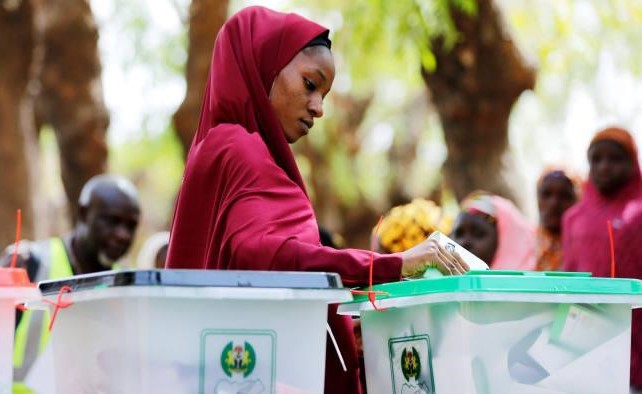
THE National Assembly has introduced far-reaching reforms in Nigeria’s electoral framework with the enactment of the Electoral Act 2026, prescribing a two-year jail term for any Resident Electoral Commissioner (REC) who withholds vital electoral documents and establishing a dedicated fund to guarantee the financial autonomy of the Independent National Electoral Commission (INEC) ahead of the 2027 general election.

News Point Nigeria reports that the sweeping reforms were disclosed on Sunday by the Leader of the Senate, Opeyemi Bamidele, in a statement issued in Abuja, where he outlined what lawmakers described as a painstaking two-year process of recrafting Nigeria’s electoral governance structure.

Bamidele’s clarification of the benefits embedded in the new law came barely 24 hours after opposition parties criticised certain provisions, alleging that aspects relating to party primaries, campaign funding and election timelines tilt the political playing field in favour of the ruling All Progressives Congress (APC).

While the Presidency and the APC have strongly defended the amendments as necessary and progressive steps to deepen democracy, opposition figures insist the changes may undermine political competition.


One of the most consequential provisions of the new Act is captured under Section 74(1), which mandates a REC to release a certified true copy of any requested electoral document within 24 hours of payment. Failure to comply now attracts a minimum of two years’ imprisonment without the option of a fine.
Lawmakers say the provision is aimed at curbing administrative impunity and preventing electoral manipulation through the withholding of sensitive documents.
Similarly, Section 72(2) provides that a certified true copy of a court order shall suffice for swearing in a candidate declared winner by the court, where INEC fails or neglects to issue a certificate of return.
In a bold move designed to strengthen institutional independence, Section 3 of the new law establishes a dedicated fund for INEC to ensure financial autonomy, operational stability and administrative continuity.
The Act also mandates that election funds must be released at least six months before any general election, a provision expected to enhance preparedness and reduce last-minute logistical bottlenecks.

According to Bamidele, the reform empowers INEC with quicker corrective mechanisms, including expanded authority to review questionable result declarations made under duress or procedural violations.
Section 60(3) makes electronic transmission of results to the INEC Result Viewing Portal (IReV) mandatory, while Section 60(6) prescribes six months’ imprisonment or a fine of N500,000, or both, for any presiding officer who willfully frustrates the electronic transmission of results.
Bamidele clarified that IReV is not a collation platform but a transparency tool, noting that a fully electronic collation system would require its own structured planning.


However, the law conditionally allows the use of Form EC8A in cases where electronic transmission fails due to communication challenges, as prescribed by INEC guidelines.
Under Section 125(1-2), the Act strengthens sanctions against vote-buying, impersonation and result manipulation, recommending a two-year imprisonment or fines ranging between N500,000 and N2 million, or both, upon conviction.
Political parties that fail to submit accurate audited returns within the stipulated timeframe now face a N10 million fine.
The 2026 Act phases out indirect primaries, retaining only direct and consensus primaries under Section 84(1-2), a move lawmakers say is intended to broaden participation and reduce the monetisation of party delegates.
Section 77(1-7) mandates political parties to maintain a digital register of members, issue membership cards, and submit the register to INEC at least 21 days before primaries, congresses or conventions.
Any party that fails to comply with this requirement will be barred from fielding candidates for that election.
“These are indeed consequential restraint measures that will deepen internal democracy and reduce the monetisation of politics,” Bamidele stated.
The new law also significantly reviews spending limits for elective offices under Section 92(1-8).
The presidential spending cap has been increased from N5 billion to N10 billion; governorship from N1 billion to N3 billion; Senate from N500 million to N1 billion; House of Representatives from N70 million to N250 million; House of Assembly from N30 million to N100 million; Area Council from N30 million to N60 million; and councillorship from N5 million to N10 million.
Other notable provisions include gender-sensitive queue arrangements in areas where cultural norms require separation of men and women, as well as enhanced support mechanisms for persons with visual impairment.
The Electoral Bill 2026 was harmonised by both chambers of the National Assembly, particularly over contentious Clause 60(3), before being transmitted to President Bola Tinubu for assent.
The President signed the bill into law within 24 hours of its passage, a move that drew mixed reactions from civil society groups who questioned the speed of the assent.
However, the Senate leadership insisted that the reform process was inclusive and exhaustive, involving consultations with the Office of the Accountant-General of the Federation, civil society organisations, INEC and development partners.
Bamidele described the law as a consolidation and refinement of Nigeria’s electoral governance framework.
“In all, the Act seeks to enhance electoral credibility, reduce disputes, and strengthen democratic governance in Nigeria,” he declared.