

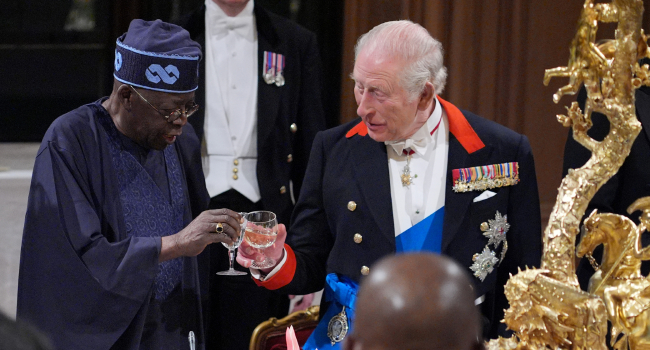
A HISTORIC state visit by Nigeria’s President, Bola Ahmed Tinubu, to the United Kingdom reached a symbolic high point on Wednesday as he and King Charles III delivered powerful speeches reaffirming the enduring partnership between both nations at a grand state banquet in Windsor Castle.
News Point Nigeria reports that the event, attended by senior members of the British Royal Family including Queen Camilla, Prince William, and Catherine, Princess of Wales, underscored centuries of shared history, cultural ties, and growing economic cooperation between Nigeria and the United Kingdom.
In his address, King Charles warmly welcomed President Tinubu and First Lady Oluremi Tinubu, praising Nigeria’s rapid transformation and growing global influence.

Reflecting on his previous visits to Nigeria and interactions with traditional rulers, the monarch described the country as a vibrant and youthful nation brimming with energy and ambition.


“Nigeria hasn’t merely changed, it has arrived,” he declared, noting that the country’s population of over 230 million people, many of them young, positions it as a key player in addressing global challenges.
The King also paid tribute to Nigerians in Britain, highlighting their immense contributions across sectors such as healthcare, business, academia, sports, and the arts. He described the Nigerian diaspora as a “living bridge” connecting both nations and enriching British society.
From Afrobeats music to Nollywood films and Premier League football, King Charles acknowledged Nigeria’s deep cultural imprint on British life, adding a touch of humour as he referenced a recent “Jollof and Tea” gathering where the debate over the best Jollof rice Nigerian, Ghanaian, or Senegalese remained diplomatically unresolved.
The British monarch emphasised the growing economic partnership between both countries, noting that Nigerian businesses are increasingly investing in Britain, with major banks establishing a presence in the City of London and companies listing on the London Stock Exchange.
He revealed that Nigeria recently emerged as the UK’s largest export market in Africa, while bilateral travel and tourism continue to flourish, with significant spending recorded on both sides.

King Charles further highlighted collaboration in education and technology, with British institutions expanding into Nigeria and joint innovation partnerships gaining momentum.
While celebrating shared progress, the King acknowledged the complexities of the historical relationship between both nations, admitting that parts of their shared past left “painful marks.”
However, he stressed the importance of learning from history to build a future rooted in mutual respect, growth, and cooperation.


He also underscored Nigeria’s role as a leader in Africa and within the Commonwealth of Nations, emphasising the need for stronger global alliances in an increasingly interconnected world.
In his response, President Tinubu described the occasion as a profound honour, noting that he was the first Nigerian leader to speak at a state banquet in Windsor Castle.
He praised Britain’s historical contributions to democratic governance, referencing the Magna Carta and the works of influential thinkers such as Thomas Hobbes, John Locke, and Edmund Burke, whose ideas continue to shape political systems worldwide.
Tinubu acknowledged that Nigeria’s legal and institutional frameworks have been influenced by British traditions, particularly English common law and parliamentary systems, adapted to suit Nigeria’s unique context.
The President highlighted the importance of the Nigerian diaspora in the UK, describing it as one of the most dynamic communities globally.
He commended Nigerians working within the National Health Service and across various sectors, noting their significant contributions to British society.
Tinubu also pointed to prominent figures of Nigerian heritage in sports, including Maro Itoje, Bukayo Saka, Eberechi Eze, and Anthony Joshua, as examples of the strong human connections binding both nations.
Addressing regional challenges, Tinubu stressed Nigeria’s role in tackling terrorism in West Africa, particularly in the Sahel region, and called for continued cooperation with the UK.
He disclosed plans to meet with British Prime Minister Keir Starmer to further strengthen security collaboration and strategic partnerships.
In a deeply personal moment, Tinubu expressed gratitude to the United Kingdom for providing refuge during Nigeria’s years of military dictatorship.
He recalled how he was protected by British authorities during that period, describing the experience as a defining chapter in his political journey.
“That solidarity remains etched in our collective memory,” he said, adding that it was humbling to return as the democratically elected President of Nigeria.
Both leaders emphasised the importance of the Commonwealth as a platform for cooperation among 56 member states, with King Charles and Tinubu calling for stronger trade, regulatory alignment, and economic integration.
They highlighted initiatives such as the Enhanced Trade and Investment Partnership as examples of how both countries can unlock growth, create jobs, and foster sustainable development.
The King also praised Nigeria’s efforts in promoting religious harmony and peace, noting the country’s example of coexistence between Christian and Muslim communities.
The evening concluded with both leaders exchanging warm wishes ahead of Eid al-Fitr, reflecting the significance of the holy month of Ramadan.
King Charles ended his speech with a spirited toast to Nigeria, declaring, “Naija No Dey Carry Last,” while President Tinubu raised a glass to the enduring friendship between both nations and a shared future built on cooperation and mutual respect.
The state visit marks a significant milestone in Nigeria–UK relations, reinforcing a partnership that continues to evolve across diplomacy, trade, culture, and security in an increasingly interconnected world.