

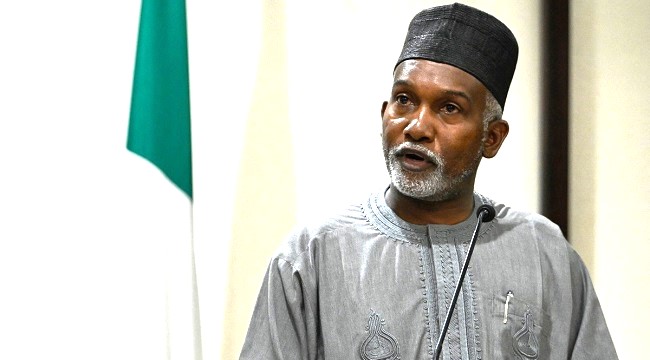
FRESH political undercurrents in Bauchi State point to a dramatic reversal of fortunes for former Minister of Foreign Affairs, Yusuf Maitama Tuggar, highlighting the intricate mix of federal influence, party power plays, and personal ambition shaping the road to 2027.
In this Sunday political analysis, News Point Nigeria, examines how Tuggar’s journey has shifted from being a trusted ally of President Bola Ahmed Tinubu to an increasingly isolated figure within Bauchi’s evolving political landscape.
At the heart of the unfolding situation is a mix of timing, internal party disputes, and what sources describe as an apparent lack of backing from “the Villa”, a term often used to reference the Presidency.


Multiple sources told News Point Nigeria that Tuggar’s challenges can be traced to the circumstances surrounding his resignation as Foreign Affairs Minister.
Following the March 31 resignation deadline for political appointees seeking elective office, Tuggar reportedly made several attempts to meet President Tinubu, both in Abuja and later in Lagos to formally seek his blessing for his Bauchi governorship ambition.
Those efforts, however, proved unsuccessful.
“Immediately after the March 31 deadline announcement, Tuggar tried to see the President in Abuja and even followed him to Lagos, but he couldn’t get access,” a source disclosed.
The situation, the source says, was not peculiar to Tuggar. A wave of ministers, agency heads, and political appointees also struggled to secure last-minute presidential audiences before the deadline.
“You can’t just see the President unless he wants to meet with you,” the source explained, noting that the restricted access discouraged several officials from resigning altogether.

For Tuggar, however, the decision was personal and strategic.
“He is almost 60 and believes this is the right time to serve Bauchi. That is why he went ahead and resigned,” the source added.
Beyond the resignation saga, deeper tensions emerged during the Bauchi State congress of the All Progressives Congress (APC), where internal disagreements exposed fractures among key stakeholders.


According to a different source, party leaders had initially agreed to retain the outgoing State Secretary for continuity, an ally of Tuggar. However, this consensus was challenged by influential figures, including former governor Isa Yuguda and the Coordinating Minister of Health, Ali Pate.
Pate reportedly pushed for the appointment of his own aide as State Secretary, a move resisted by many stakeholders at the congress.
Caught in the middle was the congress overseer, Professor Abubakar Abdulkarim Kana, who sought guidance from the party’s national leadership. That consultation, the source says, extended beyond the party hierarchy to the Presidency.
After a period of uncertainty, the directive that followed reportedly favoured Pate’s nominee.
Kana, however, was said to have raised concerns about imposing a decision contrary to the will of local stakeholders. Before the situation could be resolved, he was abruptly withdrawn from the assignment and replaced by Barrister Abdulmumin Adamu, who eventually supervised the swearing-in of a new state executive featuring Pate’s preferred candidate.
Those sworn in include: the Bauchi State Chairman, Muhammad Hassan Tilde; State Secretary, Mustapha Zurami; Zonal Vice Chairmen Yusuf Kawu Gana II and Ibrahim Ahmad (Zone III); Legal Adviser, Barr. Kabiru Garba; Assistant Legal Adviser, Mohammed A. Umar; State Treasurer, Ahmed Abubakar Yaro; Financial Secretary, Bilya Usman Burna; and Assistant Financial Secretary, Lamara Ahmad Jajo.
Others are State Organising Secretary, Alhaji Yahaya Muhammad; Auditor, Ayuba Musa; and Publicity Secretary, Shehu Dauda Mohammed; State welfare Secretary, Ibrahim Gambo; state women leader Rabi Musa, among others.
However, seven officials were not present at the swearing-in. They include Vice Chairman Ibrahim Makama; Assistant Secretary Rifkatu Samson Daniel; Zonal Vice Chairman I, Abdulmumini Kundak; and State Treasurer Alhaji Hassan Lawal, among others.
For Tuggar, the outcome represented a significant political setback. Yet, sources close to him insist he remains undeterred.
“Tuggar is a party man. He has always followed party rules from ANPP to CPC and now APC. He is not someone who jumps from party to party,” a loyalist said.
Despite the apparent odds, Tuggar has reportedly resolved to contest the APC governorship primaries, pledging to support whoever emerges as the party’s flagbearer.
Perhaps the most consequential factor shaping the unfolding drama is the reported preference of the Presidency.
Another source told News Point Nigeria that “the Villa” is more favourably disposed towards former governor Mohammed Abdullahi Abubakar, who governed the state between 2015 and 2019.
The alignment of key figures including Yuguda and Pate around Abubakar’s potential return is seen as reinforcing this perception.
This emerging consensus may explain Tuggar’s absence from a recent high-profile APC stakeholders’ gathering in Bauchi, where party leaders endorsed President Tinubu for a second term.
At the event, Pate conveyed the President’s appreciation to party members, while Yuguda praised Tinubu’s economic leadership and highlighted federal appointments benefiting the state. Abubakar also used the platform to rally support for the President ahead of 2027.
Tuggar’s absence from the gathering sparked more speculations about the presidential fallout.
However, his Special Adviser on Media and Communications Strategy, Alkasim Abdulkadir, dismissed such interpretations.
“The event was an impromptu personal gathering, not an official party function. Tuggar was engaged in his handover process, while his supporters were fully represented,” he clarified.
Even so, some a source argues that in politics, optics matter as much as intent. According to the source Tuggar may have underestimated the significance of aligning with perceived presidential preferences.
“The President’s body language has long favoured Mohammed Abubakar’s return, but Tuggar insisted on contesting,” the source noted.
As Bauchi’s political landscape continues to evolve, Tuggar’s situation reflects a broader contest between ambition and structure, loyalty and power alignment.
His decision to remain in the race despite mounting challenges sets the stage for what could be one of the most closely watched governorship contests in the North-East.
Whether his political capital, experience, and grassroots appeal can offset the influence of entrenched power blocs remains to be seen.
For now, the story of Yusuf Maitama Tuggar is one of resilience in the face of shifting alliances, a reminder that in Nigerian politics, yesterday’s insider can quickly become today’s outsider.