

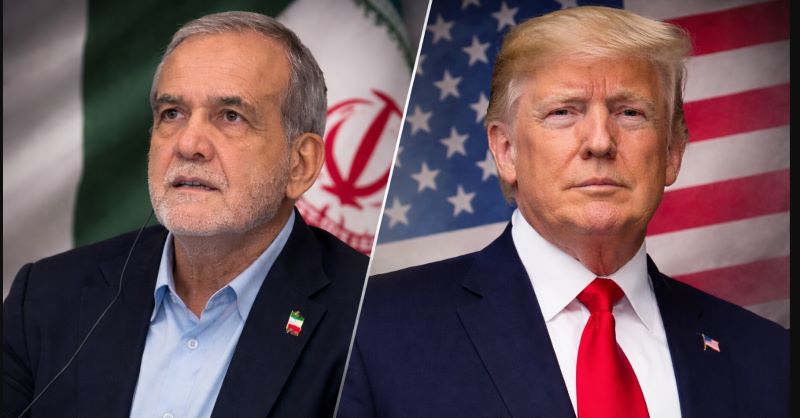
THE United States and Iran have failed to reach a truce deal after high-stakes talks in the Pakistani capital, with US Vice President JD Vance saying Tehran has refused to accept Washington’s terms after 21 hours of negotiations in Islamabad.
“The bad news is that we have not reached an agreement, and I think that’s bad news for Iran much more than it’s bad news for the United States of America,” Vance, the head of the US delegation, told reporters on Sunday, shortly before he left Islamabad after the highest-level meeting between Washington and Tehran since the 1979 Islamic Revolution.

He said Iran chose “not to accept our terms” at the talks, which began on Saturday, adding that the US needs to see a “fundamental commitment” from Tehran not to develop nuclear weapons.

“We need to see an affirmative commitment that they will not seek a nuclear weapon and they will not seek the tools that would enable them to quickly achieve a nuclear weapon,” Vance said during a ceasefire in the six-week US-Israeli war on Iran.


Al Jazeera’s John Hendren, reporting from Washington, DC, said the fact that US President Donald Trump sent Vance showed the US was taking these talks seriously.
“The fact that Vance left doesn’t necessarily mean that the talks are over,” he said, adding that the main sticking points seem to be the Strait of Hormuz, which Iran continues to essentially control, and the gaps in the nuclear issue.
“The US has been negotiating with Iran over time. Those talks can continue remotely, and leaving those talks may simply be a hard stance,” the Al Jazeera correspondent said.
Iran’s Ministry of Foreign Affairs said on Sunday that no one had expected the talks with the US to reach an agreement in one day.
“Naturally, from the beginning, we should not have expected to reach an agreement in a single session. No one had such an expectation,” ministry spokesperson Esmaeil Baghaei said, according to state broadcaster IRIB.

He said Tehran was “confident that contacts between us and Pakistan as well as our other friends in the region will continue”.
Iran’s Parliament Speaker Mohammad Bagher Ghalibaf, the leader of Tehran’s delegation in Islamabad, said it raised “forward-looking” initiatives, but the US failed to gain the trust of his delegation in the talks.
“The US has understood Iran’s logic and principles, and it’s time for them to decide whether they can earn our trust or not,” Ghalibaf said in a post on X.


Al Jazeera’s Tohid Asadi, reporting from Tehran, said the Iranian side did not share information on the technicalities or other details pertaining to the points of controversy in the talks.
“Previously, the domain of the talks between Washington and Iran was concentrated upon the nuclear dossier and stockpile of highly enriched uranium, and that was a matter of controversy in the previous rounds of negotiations,” he said.
“But this time, we’re dealing with a rather comprehensive approach when it comes to other issues, and obviously, with that comprehensiveness come other controversial issues,” the Al Jazeera correspondent said, adding that the rival sides are looking to address many other subjects, from the Strait of Hormuz to security assurances.
Asadi said people on the streets of Tehran are not hopeful about a two-week ceasefire that began on Wednesday and the diplomatic engagement between the sides.
“They say that the main reason is the lack of trust and add that this is not the first time they see Tehran negotiate with the Americans,” he said, noting that Iranians are aware that past initiatives did not produce a lasting solution.
As well as the release of frozen assets abroad, Tehran is demanding control of the Strait of Hormuz, payment of war reparations and a ceasefire across the region, including in Lebanon, according to Iranian state TV and officials.