

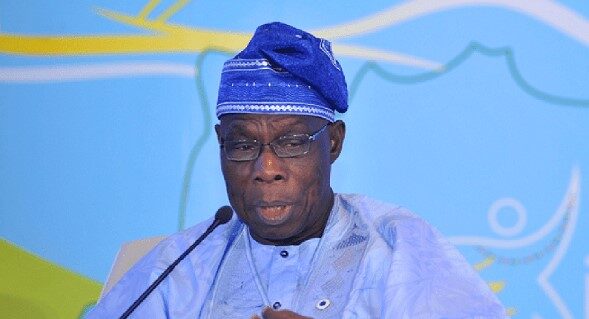
FORMER President Olusegun Obasanjo has reiterated his long-held position that Nigeria’s state-owned refineries will never function effectively, even as the Nigerian National Petroleum Company Limited continues efforts to secure technical partners for the Port Harcourt, Warri, and Kaduna facilities.
News Point Nigeria reports that speaking during a television interview aired Sunday night on Sony Irabor Live, which was monitored by our correspondent, Obasanjo anchored his argument on structural inefficiencies, past failed reforms, and deep-rooted operational challenges that have continued to undermine the country’s refining capacity.
He emphasised that one of the key lessons from his time in office was that public-private partnerships (PPP) remain the most viable model for large-scale national projects.


Citing the success of Nigeria Liquefied Natural Gas, where private investors hold a 51 per cent stake while the government retains 49 per cent, the former president contrasted it with the persistent failure of state-run enterprises.
“One of the lessons that I learnt is that PPP works. Look, one project that has not been destroyed by the government in Nigeria is the NLNG… See what we did with Nigerian railways.
“See what we did with the national shipping company. See what we are doing now, even with the NNPC. The NNPC has refineries, and I said to people that it will never work,” he said.
Obasanjo disclosed that during his administration, he made concerted efforts to bring in global expertise, including approaching Shell plc to take over the management of the refineries. However, those efforts were unsuccessful.
“Look, when I was there, I called Shell. I said, ‘Look, please, I beg you, come and take 10 per cent equity and run the refinery for us.’ They said no. I said, ‘Okay, if you don’t want to take equity, don’t take equity. Come and run the refineries.’ They said no,” he explained.
According to him, a senior Shell official later provided candid reasons for the company’s refusal. These included the company’s profit model, which prioritised upstream operations over downstream refining; the relatively small size of Nigeria’s refineries ranging between 60,000 and 100,000 barrels compared to global standards of 250,000 to 300,000 barrels; poor maintenance practices; and widespread corruption within the system.

“He said they make most of their profits on the upstream… our refineries are too small… they are not well-maintained… and there’s too much corruption around our refineries, and they don’t want to be part of that,” Obasanjo recounted.
The former president further revealed that a breakthrough appeared imminent when Aliko Dangote, President of the Dangote Group, offered $750 million to acquire a 51 per cent stake in two of the refineries during his tenure.
“Until one day, Aliko came and offered $750m to take two of the refineries… I said, ‘Wow, God, you are really a God of miracles.’ I told Aliko to bring the money quickly. They brought the money, and they paid,” he said.


However, the deal was later reversed by his successor, the late Umaru Musa Yar’Adua, following pressure from officials within the NNPC.
“When I left office, NNPC went to my successor and convinced him… I told him NNPC cannot run this thing. He said he knew… but gave in because of pressure,” Obasanjo stated, adding that the refineries would have been sold as scrap for less than $200 million if disposed of later.
He also pointed to the significant financial resources already committed to the refineries without commensurate results, noting that about $16 billion had reportedly been spent—just $4 billion short of the cost of building Africa’s largest refinery by Dangote.
In a rare acknowledgment, Obasanjo commended the current NNPC Group Chief Executive Officer, Bayo Ojulari, for what he described as telling the truth about the state of the facilities.
Meanwhile, the NNPC had in November 2025 announced a target of June 2026 to conclude the selection of technical partners to manage the refineries. Ojulari had earlier admitted that despite rehabilitation efforts and the brief reopening of the Port Harcourt and Warri refineries in 2024, the plants were operating “well below international standards” and remained commercially uncompetitive especially when compared to the privately owned Dangote Refinery.
Dangote himself has maintained that his decision to build a refinery followed the reversal of the earlier privatisation deal, and he shares the view that the NNPC refineries may never function optimally again.
As of the time of filing this report, the NNPC communications office had yet to respond to enquiries seeking its reaction to Obasanjo’s latest remarks.