

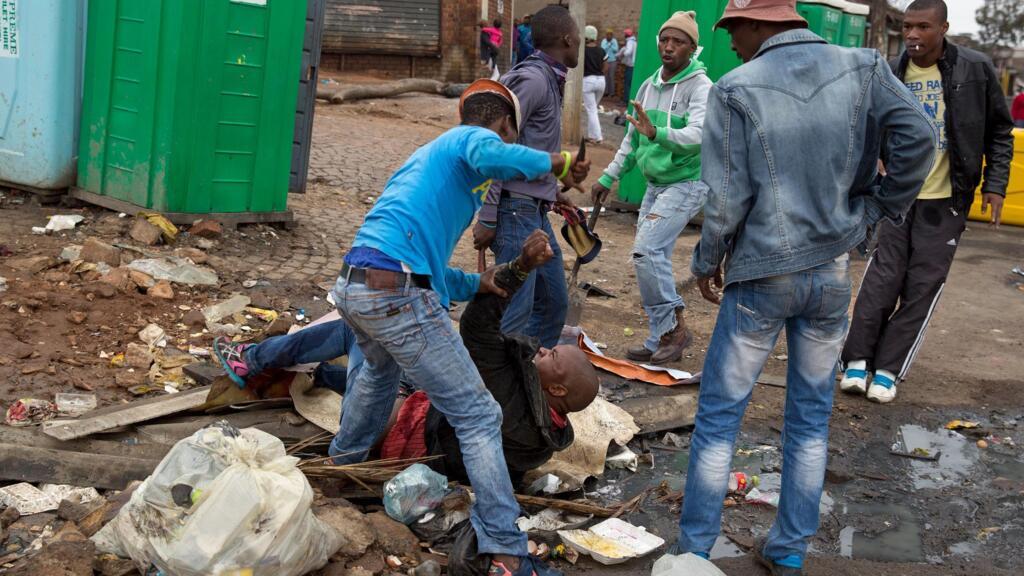
A FRESH wave of xenophobic attacks in South Africa has ignited outrage among Nigerians both at home and in the diaspora, with many criticising the Federal Government’s response as weak and ineffective, especially when compared with Ghana’s swift diplomatic intervention to protect its citizens.
News Point Nigeria reports that the backlash followed an advisory issued on Friday by the Nigerians in Diaspora Commission (NiDCOM), urging Nigerians residing in South Africa to remain indoors, avoid protests, and temporarily shut down businesses in anticipation of further violence.

The warning stemmed from an official circular issued by the Consulate General of Nigeria in Johannesburg, dated April 22, 2026, which reported that demonstrations in East London, Cape Town, Durban, and parts of KwaZulu-Natal had turned violent, resulting in looting, property destruction, and injuries.

In a statement by its Head of Media, Public Relations and Protocols Unit, Abdur-Rahman Balogun, NiDCOM disclosed that intelligence from the consulate indicated further protests were being planned in Gauteng Province between April 27 and 29, 2026, as demonstrators seek to pressure the South African government over the presence of foreign nationals.


The commission described its advisory as a precautionary measure, also urging Nigerian business owners to shut their shops on April 27, marked as Freedom Day, and consider remaining closed through April 29, noting that foreign-owned businesses are often targeted during unrest.
However, the directive has drawn widespread criticism, with many Nigerians describing it as a continuation of what they termed “passive diplomacy” in the face of recurring attacks.
Several Nigerians in South Africa expressed frustration, arguing that the government’s response appeared to shift the burden of survival onto victims rather than confronting perpetrators.
A Nigerian resident, identified simply as Augustine, said the attacks had persisted for years without meaningful intervention.
“Nigerians in South Africa have been serially attacked. Now it has extended to Ghanaians. But look at the difference in response. Ghana acted immediately. Their government demanded answers. Ours is telling us to stay indoors,” he said.

On social media platform X, similar sentiments trailed the advisory, with users accusing the government of indifference.
“It is no longer about documents. It is now ‘leave our country,’” a user, Chude, wrote.
Another user, Kasy, added, “Our government has failed us. Just imagine if these attacks were against citizens of powerful countries.”


Other Nigerians lamented the absence of strong presidential intervention, warning that continued silence could embolden further attacks.
“We have a good number of Nigerians in South Africa going through these xenophobic attacks. Our government has failed us. Just imagine if these attacks were against American citizens.
“This government will do nothing to rescue its citizens; they are after the next election. We will always cry here for nothing.”
Criticism of Nigeria’s approach intensified following Ghana’s handling of a recent xenophobic incident involving one of its citizens.
Ghana’s Minister of Foreign Affairs, Samuel Ablakwa, announced that the government would relocate the victim, Emmanuel Asamoa, at full cost after he faced threats and harassment.
The Ghanaian government also directly engaged South African authorities, leading to official apologies and diplomatic meetings.
Ablakwa stressed that the victim was a law-abiding resident and demanded accountability.
“We are demanding swift investigations and sanctions to serve as a deterrent,” he said.
Ghana further summoned South Africa’s acting High Commissioner to Accra, Thando Dalamba, over the incident, underscoring its firm stance.
Nigerian citizens in South Africa, under the umbrella of the Nigerian Citizens Association in South Africa (NICASA), have called on the Federal Government to take concrete steps to protect their lives and businesses.
In a statement issued on Sunday, NICASA President, Rev. Frank Onyekwelu, expressed deep concern and unequivocally condemned the rising wave of xenophobic aggression, targeted harassment, and reported instances of police brutality against Nigerians and other African nationals.
“We are alarmed by the increasing normalisation of hostility, manifested through inflammatory rhetoric by certain political actors, unlawful intimidation, and discriminatory enforcement practices by some law enforcement personnel.
“These actions not only undermine human dignity but also threaten the long-standing bonds of African solidarity,” he said.
The group demanded immediate high-level diplomatic engagement with South African authorities to ensure the protection of lives, businesses, and rights of Nigerians.
It also called for a transparent mechanism to report, document, and address cases of abuse, as well as clear accountability for law enforcement officers found culpable.
NICASA further urged the Nigerian government to provide public reassurance affirming its commitment to the safety and welfare of its citizens globally, while also advocating a united continental response through the African Union and regional blocs.
Security analyst Sadiq Lawal said the country’s approach had failed to deter recurring violence.
“What we are seeing is a pattern. Nigerians are attacked, statements are issued, and then nothing happens. There is no follow-through, no consequences, and that sends the wrong signal,” he said.
Lawal advocated a reciprocity-based diplomatic strategy, noting that stronger consequences could compel other countries to better protect Nigerian citizens.
Similarly, public affairs analyst Dr Amina Yusuf said Nigeria’s global standing had weakened due to inconsistent foreign policy responses.
“Nigeria used to be a dominant voice in Africa. Today, smaller countries are taking firmer positions on issues affecting their citizens abroad. That tells you something has changed,” he said.
He added that Ghana’s response demonstrated that decisive action is driven by political will rather than capacity.
“When a government prioritises its citizens, it acts decisively,” she noted, warning that weak responses could erode Nigeria’s influence on the continent.
Emerging insights suggest that election-related tensions in South Africa may be contributing to anti-foreigner sentiments ahead of the country’s next elections scheduled for November 2026.
The President of the Association of Yorubas in Diaspora, South Africa, Olusola Agbeniyi, said political actors often exploit economic concerns, particularly unemployment, to incite hostility against migrants.
“It is not that South Africa has a problem with Nigeria. Some political groups use the issue of unemployment to mobilise support by blaming foreigners,” he said.
He added that such protests often begin as peaceful demonstrations but are later hijacked by criminal elements, especially during election periods.
As tensions persist, many Nigerians in South Africa say they remain uncertain about their safety and future, urging the Federal Government to move beyond advisories to more assertive diplomatic engagement.
They are calling for stronger bilateral discussions, clear demands for accountability, and comprehensive protection frameworks for Nigerians abroad.
“There must be consequences for these attacks. Until then, they will continue,” Lawal said.