

WHILE Nigerians were marking Christmas with reflection and family gatherings, a startling announcement from the United States injected global power politics into the country’s fragile security landscape. From Washington came word of airstrikes; from Presidency, careful confirmations; and from the North-West, confusion, fear and heated debate.

President Donald Trump disclosed that U.S. forces had launched “powerful and deadly” strikes against Islamic State militants in northwestern Nigeria, linking the operation to what he described as ongoing killings, particularly of Christians. The language, the timing and the unilateral tone of the announcement quickly stirred controversy across the nation.
In this weekend report, News Point Nigeria explores how the strikes reopened old questions about sovereignty, religion and security, tracing the political calculations, public perceptions and grassroots reactions shaping Nigeria’s response to a war that is no longer fought solely within its borders.


Posting on his Truth Social platform, the US leader claimed the operation followed repeated warnings to militants to halt attacks on Christians.
“I have previously warned these Terrorists that if they did not stop the slaughtering of Christians, there would be hell to pay, and tonight, there was,” Trump wrote.
He went further, blending religious greeting with hardline rhetoric: “May God bless our Military. Merry Christmas to all including the dead terrorists.”
The Department of Defense confirmed that multiple ISIS fighters were killed, though details about locations and casualties were scarce.
The US Africa Command (AFRICOM) later stated that the strikes were conducted in Sokoto State, and crucially, “at the request of Nigerian authorities.”
Pentagon chief Pete Hegseth praised the cooperation between both governments, thanking Nigerian authorities for their support.

The strikes marked the first direct US military action in Nigeria under Trump’s renewed leadership, but they came against a backdrop of earlier controversy.
In recent months, Trump had repeatedly accused Nigeria of failing to protect Christians, describing the violence as “genocide”, a claim consistently rejected by Nigeria’s government, other governments and independent power brokers.
Successive administrations in Nigeria have insisted that Nigeria’s insecurity is criminal and insurgent-driven, not religious. Both Christians and Muslims, they argue, are victims.


Still, Washington recently returned Nigeria to its list of countries of “particular concern” on religious freedom, a move that also came with visa restrictions for Nigerians.
Hours after Trump’s announcement, Nigeria’s Ministry of Foreign Affairs confirmed the airstrikes, describing them as “precision hits” carried out through structured security cooperation with the United States.
In its statement, the ministry emphasised intelligence sharing, strategic coordination and respect for Nigeria’s sovereignty, stressing that counter-terrorism efforts were not directed at any religion.
“Terrorist violence in any form whether against Christians, Muslims, or any community remains an affront to Nigeria’s values,” the ministry said.
Later, Foreign Affairs Minister Yusuf Tuggar disclosed that President Bola Ahmed Tinubu personally authorised the strikes after consultations with US officials.
Appearing on Channels Television’s Sunrise Daily, Tuggar explained that Nigeria initiated the intelligence and insisted the operation be joint.
“It was Nigeria that provided the intelligence,” he said. “I spoke with the US Secretary of State for 19 minutes, then we spoke to Mr President. He gave the go-ahead.”
The minister rejected claims that Nigeria’s sovereignty was compromised, insisting the operation was collaborative and deliberate.
“We are a multi-religious country. This was not about religion,” Tuggar said.
The Defence Headquarters echoed that position. In a statement signed by Major-General Samaila Uba, the military confirmed joint precision strikes against ISIS-linked elements in parts of the North-West.
According to Uba, the operation followed credible intelligence and careful planning aimed at degrading terrorist capability while limiting civilian harm.
“This action demonstrates the Federal Government’s unwavering resolve to confront transnational terrorism,” the statement read.
The Armed Forces, he added, remain committed to protecting lives and property across Nigeria.
Not everyone welcomed the development.
Islamic cleric Sheikh Abubakar Gumi sharply criticised the strikes, calling on Nigeria to halt all military cooperation with the United States.
In a Facebook post, Gumi warned that foreign intervention would worsen insecurity and turn Nigeria into a battleground for global conflicts.
“No nation should allow its land to be a theatre of war,” he said, urging Nigeria to seek support from what he described as more “neutral” countries such as China, Turkey and Pakistan.
While acknowledging the need to fight terrorism, Gumi questioned America’s motives, warning that framing the intervention as protection for Christians could deepen religious divisions.
The Peoples Democratic Party (PDP) criticised the Federal Government’s communication strategy, faulting Abuja for allowing the US president to announce the strikes before Nigerians were officially briefed.
“This inverted communication approach does not help Nigerians,” PDP spokesman Ini Ememobong said, expressing concern over transparency and public trust.
Days later, the African Democratic Congress (ADC) went further, describing the strikes as evidence of what it called governance failure.
ADC spokesman Bolaji Abdullahi warned that allowing foreign forces to conduct operations on Nigerian soil was unsustainable, demanding clarity on operational control and casualties.
“Desperation must not replace Nigeria-led security action,” he said.
Across Kano, Katsina, Sokoto, Kaduna and Jigawa, reactions were mixed.
Some residents, who spoke to News Point Nigeria welcomed the action, describing it as a potential step toward restoring stability. Sani Mashi, a resident of Katsina, said foreign intervention should be supported if it helps bring peace.
“If another country is coming with the aim of creating stability or peace in Nigeria, why shouldn’t we support it? I am in support of that,” he said.
Dan Ado Tela, a resident of Kano, echoed similar sentiments, describing the strikes as a “welcome development.”
Others, however, voiced strong opposition. Ibrahim Dutse, a resident of Jigawa State, argued that Nigeria’s security challenges were being mischaracterised.
“The current issue in Nigeria is not a religious crisis,” he said. “It is about kidnapping, banditry and criminal groups trying to destabilise the country. Nigeria can handle this problem on its own.”
Human rights lawyer and conflict analyst Bulama Bukarti warned that the Federal Government risks losing public confidence if it fails to provide clear evidence that the strikes, reportedly carried out with Nigeria’s cooperation, achieved tangible results.
“So far, neither the United States nor Nigeria has provided verifiable evidence of success,” Bukarti said, noting that available information suggests strikes occurred at two locations, reportedly hitting a hotel in one area and an onion farm in another.
He added, however, that many Nigerians would be receptive to U.S. support if it demonstrably weakened terrorist networks.
In Sokoto State, Bello Nababa expressed concern over the broader implications of the strikes, describing them as potentially harmful.
“These bombs from the US are only bringing doom to Nigeria and the North,” he said. “Where was the US intervention when Boko Haram killed thousands of people in the North?”
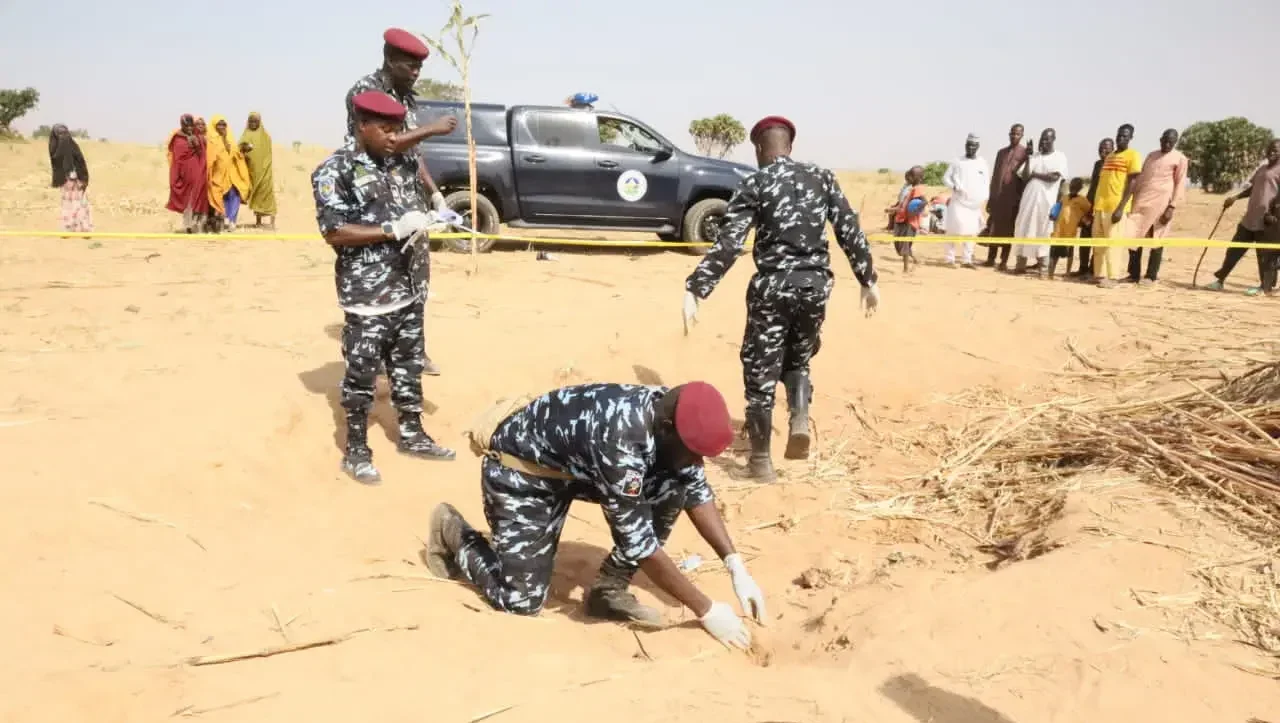
A security expert, Zagazola Makama, has said the airstrikes in Sokoto State struck a farming area and had no impact on the insurgents terrorising parts of Nigeria.
In a post shared online, Makama questioned the effectiveness of the operation, stating: “Those asking for our opinion on the U.S. strike in Sokoto should note that the bombs were dropped in a relatively safe part of the state, with no impact on terrorist groups.”
He explained that Jabo, the community reportedly affected by the strike, is a farming settlement in Tambuwal Local Government Area of Sokoto State and has no known record of activity by ISIS or ISWAP.
“We welcome U.S. interventions to assist Nigeria,” he said, “but the Jabo community in Sokoto was the wrong target for ISWAP, Boko Haram or ISIS, groups that are primarily active in North-East Nigeria.”
Makama further noted that even Jama’at Nusrat al-Islam wal-Muslimin (JNIM), also known as Lakurawa, has no established presence in the North-West.
According to him, the affected area is predominantly Muslim and does not align with claims of a targeted threat against Christians, describing the local security challenge as banditry rather than ideological terrorism.
While criticising the choice of location, Makama added that continued international support could still be beneficial if properly targeted, saying the strikes and any future ones could send a strong message if directed at verified terrorist strongholds.
A presidential source told News Point Nigeria that approving the strikes was not an easy decision for President Tinubu.
“It wasn’t easy,” the source said. “But the President acted in what he believes is Nigeria’s best interest.”
As the dust settles, Nigeria finds itself once again navigating the fine line between cooperation and sovereignty, urgency and caution, politics and security with Christmas Day airstrikes now part of its national conversation.
What remains unanswered is whether the bombs dropped will truly weaken terror networks or simply deepen the debates they leave behind.