

ON a night meant for prayer, reflection, and the quiet breaking of fast, Maiduguri was thrown into chaos by a wave of violence that shattered its calm. Yet, amid the fear and destruction, a story of extraordinary courage emerged one that continues to echo far beyond the walls where it happened.

In this weekend feature, News Point Nigeria tells the untold story of that fateful evening unfolding not merely as a tale of terror, but as a powerful narrative of sacrifice, resilience, and a man that refused to surrender to fear.
For years to come, Ali Musa Buba, a security guard at the University of Maiduguri Teaching Hospital, Maiduguri, will be remembered as one of the quiet heroes who risked his own life to thwart a terror attack and reduce what could have been a far greater tragedy.


It was 7:24pm.
Across Maiduguri, families reached for dates and water, preparing to break their Ramadan fast. It was a sacred pause in the day, a moment reserved for prayer, gratitude, and reflection.
Then came the explosions. Panic quickly replaced peace.
The first blasts echoed from the crowded Monday Market. More followed near the Post Office. Sirens wailed into the evening air. Screams rose above the confusion. Fear spread rapidly across the Borno State capital, turning a moment of devotion into one of dread.
But within the walls of the University of Maiduguri Teaching Hospital, something else was unfolding something quieter, but no less powerful.
Inside the hospital, the atmosphere had been calm. Patients rested. Families gathered in small groups, waiting for Iftar. For many, the hospital was more than a medical facility, it was a sanctuary.

At its gate stood Ali Musa Buba.
While others turned toward the distant smoke rising over the city, Musa’s attention fixed on something approaching fast, a motorbike heading straight for the hospital entrance. Three men rode on it. Their movement was deliberate. Their intent, unmistakable. They were not seeking help.
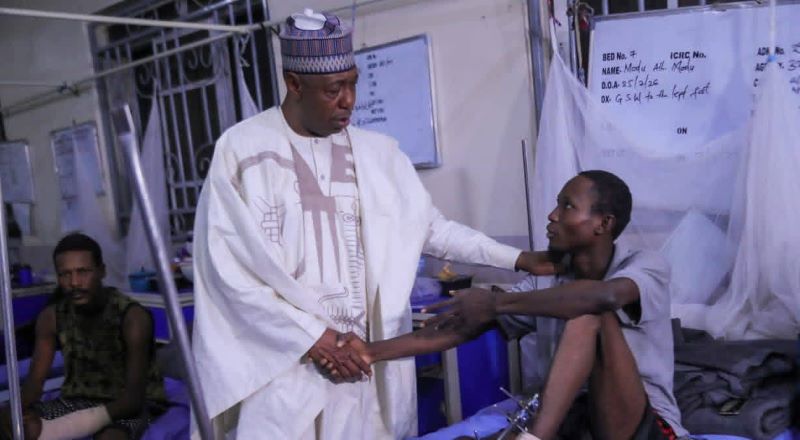
“They tried to force their way in,” Musa later said from his hospital bed, speaking in a faint voice as he recounted the moment to Governor Babagana Umara Zulum.


In that instant, Musa made a decision. He stepped forward. He blocked them. What followed happened in mere seconds.
Unable to breach the gate, the attackers hurled explosive-laden food containers at him. The symbolism was as cruel as it was tragic containers meant to nourish during Ramadan turned into instruments of destruction. The blast was deafening. A flash of fire lit the gate.
Shrapnel tore through the air, striking Musa with violent force. The explosion threw him backward, ripping into his arms and legs. But the attackers never made it inside.
Beyond that gate lay crowded wards patients too weak to move, families gathered close together, lives hanging in delicate balance.
Had the explosives crossed that threshold, the consequences would have been devastating.
Instead, Musa became the barrier. A human shield between life and catastrophe.
Even Governor Zulum would later acknowledge that the scale of death and destruction would have been far greater if Musa had not stood his ground.
Today, Musa lies in the same hospital he protected. Doctors and nurses, who had been preparing to treat victims from the blasts across the city, suddenly found themselves caring for one of their own defenders.
His body bears the wounds shrapnel scars marking his arms and legs.
Beyond the physical injuries, there is a quiet weight in his gaze, a reflection of what he faced. Yet, there is also resilience. A calm optimism that refuses to fade. Around him, the hospital continues its daily rhythm. But his story has already travelled far beyond its gates.
Among staff and volunteers, his name is spoken with a mix of gratitude and awe. A gatekeeper who refused to step aside.
As the wounded began to arrive at UMTH, the hospital’s emergency systems were pushed to their limits. Stretchers rolled in, one after another.
Doctors raised their voices over the chaos, issuing urgent instructions. Nurses moved swiftly, their hands and uniforms stained in the effort to save lives.
Then came another crisis. Blood was running out. Some victims had lost too much, too quickly. Without immediate transfusions, survival would slip away. An urgent appeal was sent out across Maiduguri. What followed was something few would ever forget.
From different parts of the city young men, traders, students, civil servants. Some had just escaped the blasts. Others had not even broken their fast. But they came anyway. Within minutes, the hospital compound transformed. Lines formed quiet, steady lines of residents rolling up their sleeves.
“We didn’t even ask who the blood was for,” one donor said. “It could be anyone. Tonight, we are all the same.” Bag after bag of donated blood moved from collection points into operating rooms and emergency wards. Lives that had been slipping away were pulled back. In the midst of chaos, the city answered with humanity.
“That is the spirit of Borno,” a doctor said.
But even as lives were being saved, others had already been lost. At Monday Market, where the evening should have been filled with the quiet joy of breaking fast, devastation unfolded in seconds. Among those caught in the violence was Malam Goni, a respected teacher and head of a Tsangaya school around Sabon Line. That evening, four of his students children under his care had gone out in search of food. They never returned.
The explosions caught them in the open, turning a simple act of survival into a tragic encounter with violence. For Malam Goni, the loss was overwhelming.
The children he had raised, taught, and guided were gone in an instant. Yet, in quiet submission, he said: “It is the design of Allah.”
A neighbour, struggling to contain emotion, described the aftermath in haunting terms: “They brought them in four black polythene bags… like meat. Just like that. Children.” The words linger heavily.
“They were just children… they went out to find food… and that was how they met their end.”
For many who survived, the experience did not end with rescue. It lingered.
And in the silence that followed when the noise faded and reality settled in. At UMTH, survivors now fill the wards Musa once protected.
In the days that followed, the hospital corridors saw a steady stream of visitors.
Vice President Kashim Shettima, accompanied by the Director General of the National Emergency Management Agency, Zubaida Umar Abubakar, moved from bed to bed, offering words of comfort. They were joined by Borno State Deputy Governor Umar Usman Kadafur.
Governor Zulum, who had been away for the lesser hajj when the attacks occurred, returned and visited the hospital, reassuring families of continued support.
Among the visitors was also social media influencer VeryDarkMan, reflecting how far the shockwaves of the attack had travelled. Yet beyond the visits, the true story remained with those who lived through the night—and those who made survival possible.
In the end, there were no cameras when Musa stepped forward. No applause. No headlines in that moment. Just a choice. And because of that choice, hundreds lived. At the same time, others like the young students of Malam Goni never returned.
Between loss and survival, something else endured. A people who refused to look away. A people who showed up. A people who, even in the face of terror, chose courage over fear, compassion over despair.
In the story of Ali Musa Buba, and in the silent lines of those who gave blood, lies a truth that will outlive that night: When it mattered most, humanity stood its ground.