

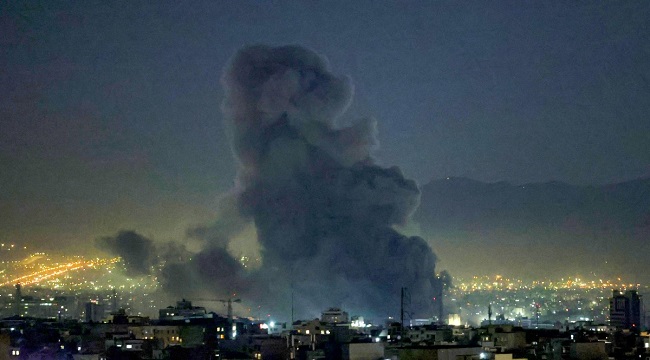
ACROSS the African continent, reactions have been pouring in since the United States and Israel launched strikes against Iran on Saturday evening and the subsequent retaliation which saw Iran attack several countries across the Middle East.
Most African countries have called for de-escalation and respect for international law, while others support Tehran’s right to respond.
The African Union (AU) said in a statement that the military strikes and Iran’s subsequent response, “represent a perilous and deeply troubling escalation, one that marks a serious intensification of hostilities in the Middle East and threatens to engulf the entire region in an uncontrollable cycle of violence, suffering, and pain.”


The bloc urged all parties to “act fully in accordance with international law and the United Nations Charter to safeguard international peace and security.”
The pan-African body’s head, Mahamoud Ali Youssouf called “for restraint, urgent de-escalation and sustained dialogue”.
“Further escalation risks worsening global instability, with serious implications for energy markets, food security, and economic resilience – particularly in Africa, where conflict and economic pressures remain acute,” he stressed.
The Chair also condemned on Saturday evening the Iranian missile and drone attacks against its neighbours Bahrain, Qatar, the United Arab Emirates, Kuwait, and Saudi Arabia.
The Economic Community of West African States (Ecowas) has also expressed its deep concern regarding the escalating hostilities in the Gulf. Ecowas emphasised that “any prolonged disruption in the Persian Gulf would threaten global oil and gas flows,” according to Afrik.com.
“A surge in energy prices would have an immediate impact on West African economies, already weakened by inflation and dependence on refined product imports,” the organisation added.

It also underlined risks to food security, as many African states rely on imports of cereals and agricultural inputs transiting through sensitive trade routes.
Ali Khamenei’s voyage: from boy cleric to Iran’s man with the final word
South Africa’s President Cyril Ramaphosa was the first African leader to react individually. He said on Saturday that the US and Israeli strikes on Iran violated international law.


“Anticipatory self-defence is not permitted under international law and self-defence cannot be based on assumption or anticipation,” he said in a statement, calling for “maximum restraint”.
South Africa was until recently the only African member of the BRICS economic group, which includes Iran, Brazil, Russia, India and China, but recently accepted a few new members from the Arab world and beyond (Egypt, Ethiopia, Indonesia, Saudi Arabia, and the United Arab Emirates).
Mindful of its ties with Tehran, the South African government reacted in a measured manner, calling on all parties to exercise restraint.
But other political parties were more vocal, like Julius Malema’s Economic Freedom Fighters (EFF). The radical left-wing group insisting that Iran “has the right to defend itself” and denounced a Washington-Tel Aviv alliance “resolutely determined to defend Israeli interests throughout the region, whatever the human cost.”
Chadian President Mahamat Idriss Déby expressed his country’s “fraternal compassion to Ayatollah Khamenei, as well as to the entire brotherly people of Iran in the face of this adversity that has struck a sister nation.”
N’Djamena however clarified later that it also “condemned with equal firmness” the Iranian attacks against brotherly countries.
The Kingdom of Morocco, closer to Israel since the signature of the Abraham Accords, denounced in a statement the “abhorrent Iranian missile attacks that violated the integrity and security of brotherly Arab states.”
Other nations, such as Senegal, Algeria, Kenya, and Ghana, have been calling for an immediate ceasefire since Saturday, while urging their citizens to exercise caution.
African media, like Seneplus in Senegal, TSA in Algeria and Ledjely in Guinea note that populations in Africa sympathise with Iran and its strategy to counteract the USA’s dominance, but fear retaliation.
African nationals living abroad are concerned for their safety, notably in Dubai, where Iranian missiles have already caused damage, including at the international airport.
“This morning, I was woken up by a missile that exploded over my neighborhood,” Ibrahima, a young Senegalese man who lives in Dubai, told RFI. “We’re trying to keep our families informed, and they’re keeping us updated through the news channels.
He added the situation is quite stressful. “We get alert messages on all our phones when the missiles are approaching. We see and hear the intercepted missiles coming from Iran. It’s true that it’s quite dramatic and stressful, all day long.”
A Cameroonian woman contacted by RFI said: “The instruction given so far is to stay home, not to go out onto balconies or look out of windows, because the missile debris that has been falling since last night is serious.”
A five-star hotel was hit overnight and large shopping centers are closed because of the debris.
The authorities in Cameroon, through their diplomatic missions, called on the entire Cameroonian diaspora residing in countries of the region to strictly adhere to the preventive security measures issued by their host governments.
Ghanaian authorities also called their citizens residing in Bahrain, Kuwait, Qatar and the United Arab Emirates to stay home as much as possible and “comply with directives issued by local authorities.”