

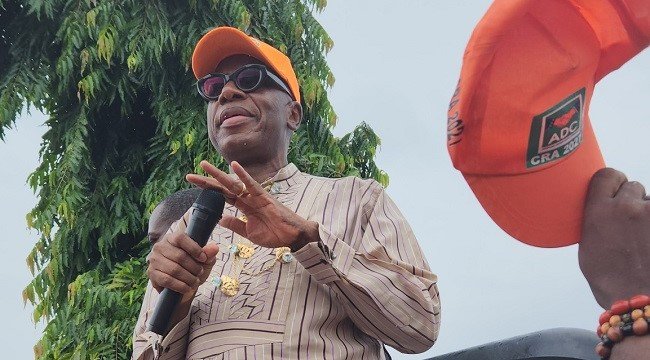
A MASSIVE wave of coordinated political messaging swept across Nigeria’s digital space on Wednesday as thousands of users on X (formerly Twitter) rallied behind former Minister of Transportation, Rotimi Amaechi, urging the African Democratic Congress to adopt him as its presidential candidate for the 2027 general elections.

News Point Nigeria reports that the online mobilisation, driven by hashtags such as #Amaechi2027, #AmaechiBuilt, and #NigeriaDecides, dominated Nigeria’s trending charts for hours, reflecting a growing digital push to influence opposition politics ahead of the next election cycle.
The trend gained traction through coordinated posting patterns, influencer amplification, and sustained engagement across different time blocks, suggesting a well-organised digital campaign.


Some Nigerians noted that the conversation maintained high visibility throughout the day, with thousands of reposts, quote tweets, and threaded discussions reinforcing its reach.
Diaspora Nigerians also joined the campaign, extending the conversation beyond domestic timelines and amplifying its global visibility.
Supporters consistently portrayed Amaechi as a proven leader with a strong governance track record, citing his tenure as governor of Rivers State and later as Minister of Transportation.
Many posts highlighted his role in advancing rail infrastructure, particularly the Abuja–Kaduna and Lagos–Ibadan corridors, which were presented as tangible evidence of his execution capacity.
Visual content ranging from project photos to archived speeches and policy clips was widely circulated to reinforce what supporters described as a “data-driven” campaign narrative.
One widely shared post read: “Quiet results, visible impact that is leadership Nigeria can measure. Competence must lead the conversation in 2027.”

A recurring theme in the online campaign was the use of “before and after” narratives to showcase infrastructure development under Amaechi’s leadership.
Supporters pointed to road expansion projects in Port Harcourt, education investments, and rail modernisation efforts as indicators of measurable governance.
“He took rail from paper proposals to moving trains that transition is what Nigeria needs at scale,” one user wrote in a viral post.


Others traced his political journey from Speaker of the Rivers State House of Assembly to governor and minister, arguing that his experience spans the full spectrum of governance.
Beyond promotion, the campaign also sought to influence internal party decisions within the ADC.
Many posts directly called on party leaders to adopt a transparent and merit-based primary process, warning against what users described as “elite imposition.”
Supporters argued that the volume and consistency of online engagement represent a form of grassroots consensus that should guide the party’s choice of candidate.
The digital push also featured comparisons between Amaechi and other prominent opposition figures, including Atiku Abubakar and Peter Obi.
Pro-Amaechi narratives emphasised executive experience, national reach, and administrative depth as key differentiators, positioning him as a candidate capable of addressing Nigeria’s governance challenges.
Amaechi has maintained his intention to contest the ADC presidential primaries, positioning himself as a central figure within the party’s evolving structure.
The latest digital mobilisation builds on earlier efforts, including his integration into the ADC and consultations across regions.
While online trends do not automatically translate into electoral success, an online political expert, Ibrahim Nadabo says the scale and persistence of the campaign signal a deliberate attempt to shape internal party decisions from outside formal structures.