

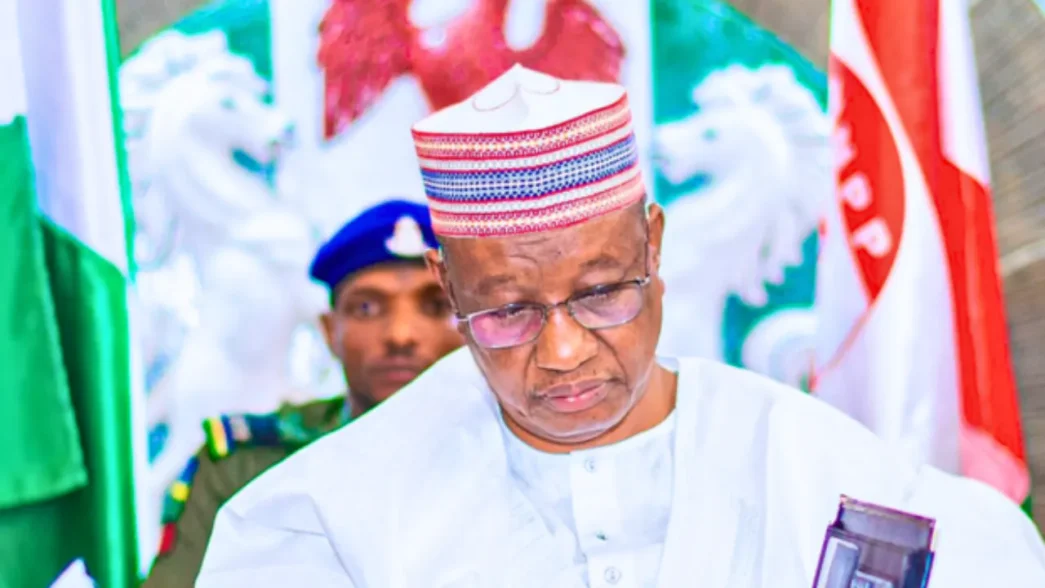
A DEEPENING political crisis is unfolding in Kano State as the state’s deputy governor, Aminu Abdussalam Gwarzo, faces a looming impeachment battle amid allegations of financial misconduct and intensifying political rivalry within the government.

The unfolding drama, which has sent shockwaves across the state’s political landscape, comes against the backdrop of shifting political loyalties following the defection of Governor Abba Kabir Yusuf from the New Nigeria People’s Party to the All Progressives Congress, a move that has sharply divided political actors in the state and altered the delicate balance that previously held the administration together.
As tensions escalate, in this Sunday political feature, News Point Nigeria takes a closer look at a crisis that now threatens to reshape the balance of power in Kano’s government, pitting political allies against one another and raising pressing questions about loyalty, governance, and the future of the administration.

The latest chapter in the unfolding saga began when the Majority Leader of the Kano State House of Assembly, Lawan Hussaini Dala, formally presented an impeachment notice against the deputy governor during plenary. Dala said the action was initiated in accordance with Section 188 of the 1999 Constitution of the Federal Republic of Nigeria (as amended), which outlines the procedure for removing a deputy governor from office on grounds of gross misconduct.
Addressing lawmakers, the majority leader explained that the allegations against Gwarzo stem from his tenure as commissioner for local government between 2023 and 2024, as well as actions allegedly taken while serving in his current position as deputy governor.
According to Dala, the deputy governor allegedly participated in the diversion of funds meant for the administration of the state’s 44 local government councils during the period he supervised the ministry overseeing local government affairs.
He claimed that between June 2023 and January 2024, Gwarzo received a monthly kickback of ₦1.5 million from each of the 44 local government areas. The arrangement, he said, amounted to about ₦66 million every month and a cumulative sum of roughly ₦462 million over a seven-month period.
The allegations did not stop there. Dala further told the Assembly that between February and July 2024, the deputy governor allegedly received additional payments from the same local government councils under the pretext of executing special assignments.
According to him, each council paid ₦3.255 million monthly, bringing the total to about ₦726 million over six months.

He argued that such alleged payments represent a serious breach of public trust and undermine the standards of transparency and accountability expected of public officials entrusted with managing public resources.
The impeachment notice also accuses the deputy governor of abuse of office. Dala alleged that Gwarzo used his position as commissioner to facilitate payments of ₦10 million each from the 44 local government councils to a company, NovoMed Pharmaceuticals Limited.
According to the majority leader, the transaction amounting to approximately ₦440 million was allegedly carried out in violation of Kano State’s procurement and fiscal management regulations.


“The misuse of official capacity to confer undue advantage constitutes abuse of power and is contrary to the obligations of public office,” Dala told the Assembly, adding that the allegations amount to gross misconduct as defined under Section 188(2) of the Constitution.
He also informed lawmakers that the impeachment notice had been endorsed by 38 members of the House, thereby meeting the constitutional threshold required to initiate the impeachment process. He subsequently urged the Speaker to transmit the notice to the deputy governor in line with constitutional provisions.
Following the presentation, members of the Assembly signalled support for the motion, while the Speaker acknowledged receipt of the notice and indicated that the legislative process would proceed according to the constitutional framework.
Under the constitution, the House is expected to formally serve the allegations on the deputy governor. If the motion subsequently secures the required legislative backing, lawmakers may request the Chief Judge of Kano State to constitute an investigative panel to examine the claims and determine whether the allegations can be substantiated.
Even before the legislative process advances to that stage, however, the impeachment move has already triggered strong reactions from political stakeholders across the state.
The influential Kwankwasiyya Movement has cautioned the Assembly against proceeding with the planned impeachment, warning that such a step could inflame political tensions and deepen divisions within Kano’s already fragile political environment.
The movement argued that removing Gwarzo whom it noted was elected by a large majority of Kano voters could undermine the popular mandate given to the administration and destabilise governance in the state.
In a statement issued on Friday and signed by the spokesperson of the movement, Dr. Habibu Mohammad, the group suggested that the impeachment initiative appeared to be politically motivated.
“The people of Kano are closely watching the unfolding events, and there is growing concern that the impeachment move may be driven more by political considerations than by genuine constitutional necessity,” the statement said.
Mohammad emphasised that although the constitution provides mechanisms for legislative oversight, impeachment remains one of the most serious powers available to lawmakers and should not be deployed for political convenience.
He also reminded the state leadership that the electoral victory which brought the current administration to power was the result of the collective efforts of thousands of supporters of the Kwankwasiyya political movement across the 44 local government areas of Kano State.
“Impeachment must never be reduced to a tool for settling political disagreements or rearranging political alignments. It must be guided strictly by justice, fairness and the interest of the people,” he said.
“The victory that produced this government was not the achievement of any single individual. It was the product of the sacrifices, loyalty and unity of Kwankwasiyya faithful across Kano State.”
The interim leadership of the New Nigeria People’s Party in Kano State has also pushed back against calls for the deputy governor’s resignation.
In a statement issued by its publicity secretary, Ibrahim Karaye, the party insisted that Gwarzo remains a legitimate member of the administration and a key component of the state government.
According to the party, the deputy governor was elected on a joint ticket with Governor Yusuf and therefore remains constitutionally entitled to continue discharging his responsibilities.
“The NNPP reaffirms the deputy governor’s right to occupy his position and his critical role in governance, underscoring the imperative of adherence to constitutional responsibilities,” the statement said.
“The party maintains that the deputy governor’s continuity in office is essential for the stability and progress of the state’s governance.”
The unfolding crisis echoes an earlier chapter in Kano’s political history. In August 2018, former deputy governor Hafiz Abubakar resigned from office following a breakdown in his relationship with then governor Abdullahi Umar Ganduje.
His resignation came amid moves by lawmakers to impeach him, although the process had not been concluded before he stepped down.
Speaking to News Point Nigeria on the matter, a top official at the Kano Government House warned the deputy governor to learn from the experience of former deputy governor Professor Hafizu Abubakar, who resigned from the administration of former governor Abdullahi Ganduje when the political rift between Ganduje and Senator Rabiu Musa Kwankwaso escalated.
The official recalled that in 2018, Hafizu Abubakar eventually resigned from the Ganduje administration after what he described as assurances from Kwankwaso.
“In 2018, Hafizu Abubakar resigned from the Ganduje administration after he was promised heaven and earth by Kwankwaso. He was even promised the governorship ticket in the next election,” the source said.
“But Kwankwaso later dumped him and brought in the same Governor Yusuf. Today, where is Hafizu? He is back with Ganduje and the rest.”
The source cautioned that the deputy governor should be careful about placing political trust in such circumstances.
According to the official, Kwankwaso and Buba Galadima had reportedly urged Gwarzo not to resign, despite mounting political pressure.
“It is unfortunate that he allowed himself to be used in that manner,” the source said.
“Kwankwaso is not someone you should rely on completely when it comes to political promises. Governor Yusuf, on the other hand, is a better man of his word and is trying to build a reliable party structure with loyal supporters.
“That is why I blame the deputy governor for allowing himself to be used. Now he is facing impeachment with several questionable issues hanging around his neck,” the official added.
Meanwhile, a commissioner in the administration offered a different perspective while speaking to News Point Nigeria, suggesting that the deputy governor’s decision to remain in office was primarily personal.
According to the commissioner, the deputy governor chose to stay in office in order to continue enjoying the privileges of power for as long as possible, even though he was aware that impeachment could eventually come.
“The deputy governor stayed on his own. He wants to enjoy the benefits of power for as long as possible because he knows he may be impeached sooner or later,” the commissioner said.
“He is simply being clever by half. His decision to remain has nothing to do with Kwankwaso; it is entirely his own calculation.”
The commissioner argued that the political crisis might have unfolded differently if the deputy governor had resigned earlier.
“If he had resigned honourably, many of these investigations into his alleged financial transgressions would probably not have surfaced. Issues like the NovoMed scandal would likely have remained in the past,” he said.
“Instead, he has now exposed himself to major political ridicule. For what? For a position he will eventually vacate anyway. It is a serious political miscalculation.
“He chose loyalty to Kwankwaso, and he should have accepted the consequences that come with that choice. It is as simple as that,” the commissioner added.
For now, the fate of Deputy Governor Aminu Abdussalam Gwarzo rests on the next steps of the legislative process and the political calculations of key power brokers within the state.
Whether the crisis ends in resignation, reconciliation or removal from office, one thing appears certain: Kano’s political landscape has entered a new and uncertain phase.