

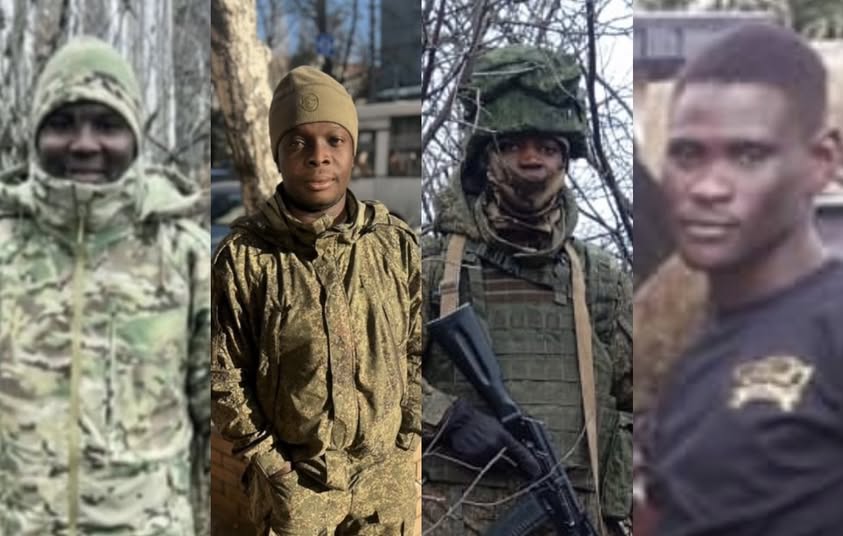
FRESH diplomatic tensions have emerged between Moscow and Kyiv following claims by Ukrainian authorities that Nigerian nationals were killed while fighting on the side of Russian forces, allegations that come days after Russia’s envoy in Abuja denied any state-backed recruitment of Nigerians for the war.

Ukraine’s military intelligence agency, the Ukrainian Defence Intelligence (UDI), announced that it had identified two Nigerian men, Hamzat Kazeem Kolawole and Mbah Stephen Udoka, who were killed in combat operations in the Luhansk region of eastern Ukraine.
The disclosure followed a press briefing in Abuja by Russia’s Ambassador to Nigeria, Andrey Podyelyshev, who firmly denied any official recruitment programme targeting Nigerians.


Addressing reporters on Tuesday, Podyelyshev stated that the Russian government was unaware of any programme recruiting Nigerians to fight in Ukraine.
“If some illegal individuals are trying to recruit Nigerians to fight in Ukraine, this is not connected with the Russian state,” he said, adding that Moscow would be willing to forward any credible information to Russian law enforcement agencies for investigation.
The ambassador emphasized that official military cooperation between Nigeria and Russia remains strictly within the framework of bilateral agreements focused on military-technical collaboration, training and equipment supply.
He described Nigeria as one of Russia’s most important African partners, stressing that cooperation with Abuja significantly shapes Moscow’s broader engagement across West Africa.
However, in a statement issued Thursday, the Ukrainian Defence Intelligence released photographs and personal details of the two Nigerian men it said were killed while fighting for Russia.
According to UDI, the bodies of Kolawole (born April 3, 1983) and Udoka (born January 7, 1988) were discovered in the Luhansk region.

The agency stated that both men had signed contracts with the Russian army in the second half of 2025 — Kolawole on August 29 and Udoka on September 28.
They were reportedly assigned to the 423rd Guards Motor Rifle Regiment (military unit 91701) of the 4th Guards Kantemirovskaya Tank Division of the Russian Armed Forces.
UDI alleged that Udoka received only five days of preparation before being deployed on October 3 to territories described by Kyiv as temporarily occupied by Russia. No formal training records were preserved for Kolawole, though Ukrainian officials suggested it was likely he also received minimal or no military training.


Both men were reportedly killed in late November during an attempted assault on Ukrainian positions in Luhansk. Ukrainian authorities claimed they were eliminated by a drone strike before engaging in direct firefight.
Kolawole is said to have left behind a wife and three children in Nigeria.
Separate reports indicate that four additional Nigerians — Adam Anas, Akinlawon Tunde Quyuum, Abugu Stanley Onyeka and Balogun Ridwan Adisa — also died on the frontlines between December 2025 and January 2026.
According to sources cited in the report, the four were allegedly recruited under the guise of “security jobs” but were later conscripted into the military after undergoing approximately three weeks of training.
The report further claimed that the Nigerian recruits were issued single-entry tourist visas by the Russian Embassy in Abuja and were promised monthly salaries of 200,000 rubles, along with allowances and other benefits.
Upon arrival in Russia, they were allegedly compelled to sign military service contracts written in Russian, without legal representation or translation. Some were said to have had their passports confiscated, limiting their ability to leave.
These claims have not been independently verified, and the Russian government has not publicly responded to the specific allegations regarding visas and contract procedures.
In its statement, UDI warned foreign citizens against traveling to Russia for work opportunities that could result in forced military deployment.
“A trip to the Russian Federation is a real risk of being forced into a suicide assault unit,” the agency stated, cautioning that foreign recruits may ultimately lose their lives in combat.
The controversy unfolded amid a broader diplomatic briefing by Ambassador Podyelyshev titled “Russia in a Multipolar World Order: African Perspective,” delivered to mark Russia’s Diplomatic Service Day.
During the briefing, Moscow reaffirmed its commitment to a multipolar global system anchored in the principles of the United Nations Charter, sovereign equality and non-interference.
Russia argued that Africa and Nigeria in particular is emerging as a central pole in the evolving global order, citing frameworks such as the African Union’s Agenda 2063 and the African Continental Free Trade Area.
Podyelyshev reiterated Moscow’s support for expanded African representation on the UN Security Council, referencing the Ezulwini Consensus and the Sirte Declaration as expressions of Africa’s collective aspirations.
He also highlighted expanding bilateral cooperation in education, healthcare, energy and security, including plans for a Centre for Nuclear Science and Technology in Nigeria and increased scholarship opportunities for Nigerian students in Russian universities.
The revelations by Ukraine and the denials by Russia have placed Nigeria at a delicate diplomatic crossroads, as questions mount over the circumstances under which its citizens may have become involved in the conflict.
While Moscow maintains that no state-backed recruitment exists, Kyiv’s publication of names and photographs has intensified scrutiny.
For now, the Nigerian government has yet to issue an official statement addressing the claims.