

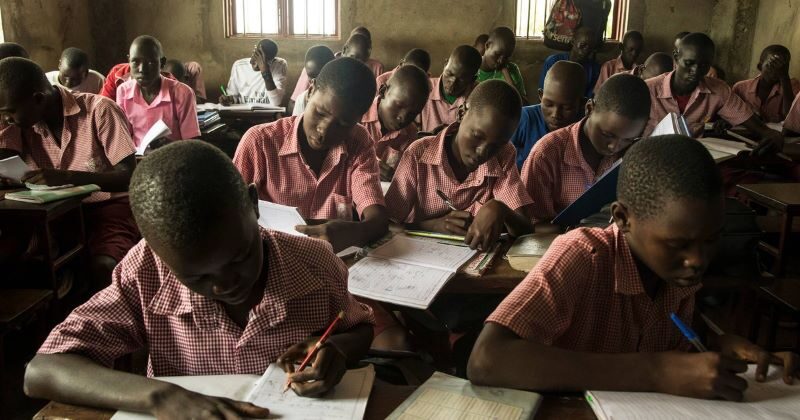
AS Governors across Nigeria present their 2026 appropriation bills to their respective state Houses of Assembly, a fresh analysis has revealed stark disparities in education funding, with Anambra, Enugu, Kano and Jigawa emerging as the country’s leading investors in the sector, while several others fall far below both national expectations and international benchmarks.
An analysis of budget proposals submitted so far by 34 state governments shows wide variations in how much priority education commands within state spending plans, raising renewed concerns about equitable development, human capital investment and the future of learning across the federation.
Anambra State tops the national ranking, allocating an unprecedented 46.9 per cent of its proposed N757 billion 2026 budget to education. The allocation positions the state as Nigeria’s most education-focused sub-national government, significantly exceeding global recommendations.


Enugu State follows closely, earmarking N522 billion for education out of its total N1.62 trillion budget, representing 32.3 per cent. The state has consistently prioritised education, having allocated over 30 per cent of its budget to the sector in both 2024 and 2025.
For 2026, Enugu’s education spending is expected to drive major infrastructure upgrades, large-scale teacher recruitment and the expansion of flagship initiatives such as the Smart Green Schools programme. The proposal also includes N30 billion specifically set aside for school feeding initiatives.
Kano State ranks third nationwide, with N405.3 billion allocated to education from a total budget of N1.368 trillion, amounting to 30 per cent. The state government has described education as a strategic driver of economic growth and social development.
Jigawa State also recorded a strong showing, committing N234.48 billion about 26 per cent of its N901.84 billion budget to education. Governor Muhammad Badaru has repeatedly emphasised that quality education remains central to Jigawa’s long-term development strategy.
Other states that came close to or met international benchmarks include Kaduna, which allocated 25 per cent of its N985 billion budget to education; Abia, which set aside N203.2 billion or 20 per cent of its N1.016 trillion budget; and Taraba, which earmarked N131.6 billion, representing roughly 20 per cent of its N650 billion spending plan.
States with moderate allocations include Kogi (18 per cent), Katsina (17.4 per cent), Oyo (17.4 per cent), Nasarawa (17.05 per cent), Ogun (16.6 per cent) and Kebbi, which allocated approximately 16 per cent of its total budget to education.

However, the analysis shows that several states fell significantly short of recommended levels. Akwa Ibom recorded the lowest education allocation nationwide, earmarking just N31.6 billion out of its N1.39 trillion budget, a mere 2.27 per cent. Imo State followed with N60.623 billion of its N1.43 trillion budget, representing 4.24 per cent.
The United Nations Educational, Scientific and Cultural Organisation (UNESCO) recommends that governments allocate between four and six per cent of their Gross Domestic Product or 15 to 20 per cent of total public expenditure to education. Many Nigerian states failed to meet this benchmark.
States allocating less than 10 per cent to education include Adamawa, Bayelsa, Delta, Gombe, Lagos, Niger and Zamfara. Lagos State, despite having the largest state budget of N4.237 trillion, allocated just 5.87 per cent, N249 billion to education.


Some states allocated around 15 per cent, including Bauchi, Ondo and Sokoto, placing them just at the lower edge of global recommendations.
In several cases, education spending was grouped under a broader “social services” category, making it difficult to determine exact allocations. States adopting this approach include Cross River, Edo, Plateau, Yobe, Kwara and Ebonyi, where social services also cover health, housing, social welfare and community development.
Meanwhile, Osun State approved a N723.4 billion budget for 2026, while Ekiti proposed N415.37 billion, though both states are yet to publish detailed sectoral breakdowns showing precise education allocations.
The analysis further revealed that Borno and Rivers states, governed by Babagana Zulum and Siminalayi Fubara respectively, are yet to present their 2026 appropriation bills to their state legislatures.
As Nigeria grapples with learning poverty, infrastructure deficits and teacher shortages, the uneven commitment to education funding across states is likely to intensify debate over governance priorities, fiscal responsibility and the country’s long-term development trajectory.