

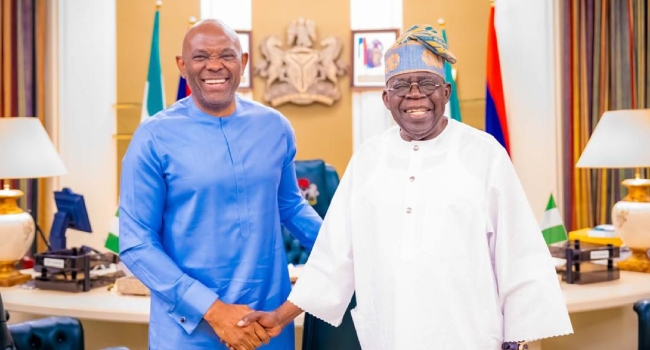
CHAIRMAN of the United Bank for Africa, Tony Elumelu, has declared that Nigeria’s foreign exchange (FX) crisis has been resolved, saying businesses are no longer struggling to access dollars as was previously the case.

News Point Nigeria reports that Elumelu made the remarks on Friday after meeting President Bola Tinubu at the Presidential Villa, Abuja.
According to the billionaire banker and investor, reforms introduced by the Central Bank of Nigeria (CBN) under Governor Olayemi Cardoso have restored predictability and stability to the economy.


Illustrating what he described as a significant turnaround, Elumelu said the intense pressure on banks to source foreign exchange for customers had virtually disappeared.
“There was a time before if I got 10 calls on banking issues, seven of those calls were about how to access foreign exchange,” he said.
“Today, if you get 10 calls on banking issues, not even one is on FX. That market is totally sorted.”
Elumelu, who also chairs Transcorp Group and serves as a member of the Presidential Economic Council, credited the Tinubu administration for creating an enabling environment that allowed the apex bank to implement bold reforms.
“If you see what the Central Bank Governor and his team are doing, it’s quite encouraging; we’ve had some predictability and stability,” he noted.
“What’s important is to be able to predict, in an economy, the direction of things, so you can plan very well. Mr President also should be commended for creating that space for the governor to do what he and his team are doing.”

Since Cardoso assumed office in September 2023, the CBN has rolled out sweeping reforms aimed at stabilising the foreign exchange market.
Key measures include the unification of multiple exchange rate windows in October 2023, the adoption of a willing-buyer-willing-seller model, and the clearance of a verified backlog of approximately $7 billion in FX obligations.
In October 2024, the apex bank introduced the Electronic Foreign Exchange Matching System to enhance transparency and efficiency in currency trading.


Nigeria’s external reserves have also strengthened significantly, rising to over $43 billion in 2025 from about $33.6 billion in October 2023, according to CBN data, a development analysts say has improved investor confidence and liquidity in the FX market.
Despite the optimism over the FX market, Elumelu raised concerns about outstanding debts owed by the Federal Government to power-generating companies.
He stressed that improved access to electricity remains critical for Nigeria’s economic development.
“Improvement in access to electricity is critical for economic development,” he said.
“Mr President realises this, embraces it, and is committed to doing more, especially helping to fast-track the payment of the power sector debt so that the power generators can do more for the country.”
Elumelu disclosed that operators in the power sector are owed significant sums but continue to generate electricity despite the financial strain.
“All of us who are in the power sector are owed significantly, but in spite of that, we continue to generate electricity. We want to see the payment made so that there is more provision of electricity to the country,” he added.
Through Transcorp Group, Elumelu holds major investments in Nigeria’s electricity industry. The conglomerate operates Transcorp Power, which manages the Ughelli Power Plant with an installed capacity of 972 megawatts, and the Afam Power Plant with a 1,000-megawatt capacity.
In 2023, the group also acquired a 60 per cent stake in the Abuja Electricity Distribution Company.
At Transcorp’s annual general meeting in April 2025, Elumelu revealed that the Federal Government owed the company more than ₦600 billion — approximately $400 million for electricity supplied to the national grid.
Beyond macroeconomic stability and energy reforms, Elumelu said his discussion with President Tinubu also covered support for small and medium-scale enterprises (SMEs).
He described the President as passionate about empowering entrepreneurs and strengthening institutions that provide financial support to businesses.
“Mr President is very passionate about capacitising the small and medium-scale entrepreneurs in Nigeria,” Elumelu said.
“He talked about tax reform and how he wants to use that to support small and medium-scale enterprises. He spoke about Bank of Industry and I was super impressed.”
According to him, the President specifically praised the leadership of the Bank of Industry and expressed a desire to see expanded support for entrepreneurs across the country.
The meeting underscored the administration’s focus on stabilising the economy, clearing sectoral debts and strengthening growth drivers such as power supply and SME development areas Elumelu said are critical to sustaining Nigeria’s economic recovery.