

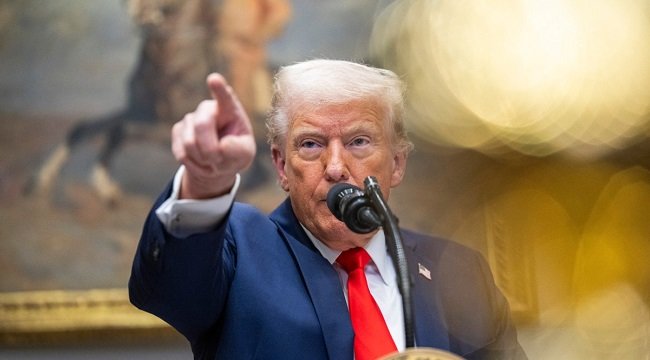
UNITED States President Donald Trump has drawn Nigeria into the global spotlight after alleging that a controversial report on the Iran-US ceasefire originated from a “fake news site” in the country.
Trump made the claim while criticising CNN over its coverage of the ceasefire agreement announced late Tuesday, about two hours before a deadline he had earlier set for possible military action against Iran.
CNN had reported a statement attributed to Iran’s Supreme National Security Council (SNSC), which claimed Tehran recorded a major victory in the conflict.


According to the report, the council said: “The enemy, in its unfair, unlawful, and criminal war against the Iranian nation, has suffered an undeniable, historic, and crushing defeat.”
The statement also suggested that Iran forced the United States to accept a 10-point plan.
However, Trump dismissed the report, alleging it was based on unverified information traced to Nigeria.
“The alleged Statement put out by CNN World News is a FRAUD, as CNN well knows,” he said.
“The false Statement was linked to a Fake News site (from Nigeria) and, of course, immediately picked up by CNN, and blared out as a ‘legitimate’ headline.”
In another post, the president described the source as “a new, trouble making site from Nigeria,” but did not name the platform or provide evidence to support the claim.

He also called on CNN to withdraw the report, noting that authorities were examining whether the publication could amount to a legal violation.
Trump’s remarks have placed Nigeria’s digital media landscape under international attention, despite the absence of any identified outlet linked to the disputed report.
As of the time of filing this report, no Nigerian news organisation has been officially named or confirmed as the source of the statement cited by CNN.


Media observers say the incident highlights the growing challenge of misinformation in a globally connected information ecosystem, where content can spread rapidly across borders without clear attribution.
They also caution that broad references to “fake news” from a specific country, without evidence, risk unfairly casting doubt on credible media institutions operating within that space.
Following the ceasefire announcement, Iran’s Foreign Minister, Abbas Araghchi, issued a separate statement outlining Tehran’s position and acknowledging diplomatic engagement.
He thanked Pakistan for its mediation role and signalled conditional de-escalation.
“If attacks against Iran are halted, our Powerful Armed Forces will cease their defensive operations,” Araghchi said.
“For a period of two weeks, safe passage through the Strait of Hormuz will be possible via coordination with Iran’s Armed Forces and with due consideration of technical limitations.”
Araghchi said he spoke on behalf of the SNSC, Iran’s top national security body.
Meanwhile, Tasnim, a news agency affiliated with the Islamic Revolutionary Guard Corps, also published a statement attributed to the council, echoing similar language reported earlier.
“The enemy has suffered an undeniable, historic and crushing defeat in its cowardly, illegal and criminal war against the Iranian nation,” the statement read.
The episode underscores the complexities of information flow in international crises, with conflicting narratives emerging from different actors.
While Trump insists the report originated from Nigeria and was falsely amplified, no independent verification has confirmed the claim or identified any Nigerian outlet involved.
The development leaves Nigeria at the centre of a high-profile media dispute, even as questions remain over the true source of the contested statement.