

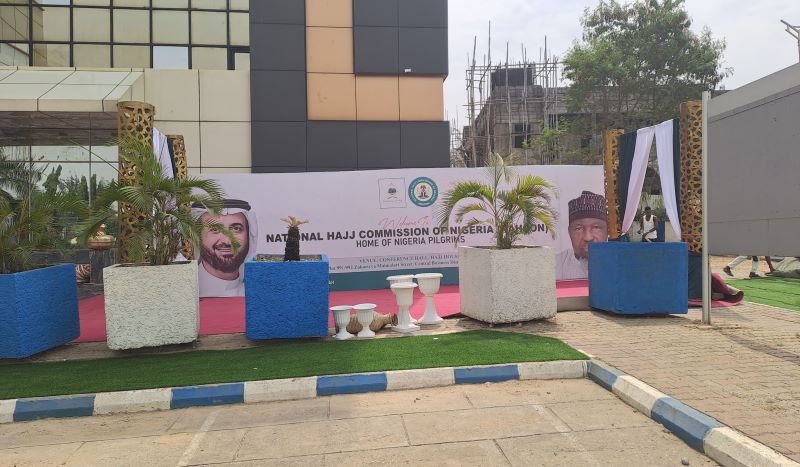
THE visit of Saudi Arabia’s Minister of Hajj and Umrah, Dr. Tawfiq bin Fawzan Al-Rabiah, to Nigeria has triggered fresh controversy within the National Hajj Commission of Nigeria (NAHCON) after the visiting minister failed to visit the commission’s headquarters, despite elaborate preparations allegedly costing millions of naira.
Dr. Al-Rabiah arrived in Abuja on Tuesday, February 3, 2026, and was received at the airport by officials of Nigeria’s Ministry of Foreign Affairs alongside some NAHCON board members.
Instead of proceeding to the Hajj House, the Saudi minister headed straight to the Foreign Affairs Ministry headquarters in Abuja’s Central Business District, where he held official engagements before departing Nigeria the following day for Egypt.


The Saudi minister’s decision to bypass NAHCON came after the commission allegedly spent about ₦20 million well above the chairman’s approval threshold on decorations, event planning, catering, and logistics at the Hajj House, in anticipation of hosting the visiting dignitary.
Multiple insiders told this newspaper that staff were ordered to stay away from work, while the commission premises were lavishly decorated in Arabian themes, complete with red carpets, incense burners, Middle Eastern cuisine, and banners bearing only the images of the Saudi minister and NAHCON Chairman/CEO, Professor Abdullahi Saleh Pakistan.
Notably absent from the displays were photographs of President Bola Ahmed Tinubu, Vice President Kashim Shettima, under whose office NAHCON operates, and Foreign Affairs Minister Yusuf Maitama Tuggar, the official host of the visiting Saudi minister.
To ensure a “seamless” reception, NAHCON management declared a stay-at-home order for most staff on Tuesday, citing parking constraints due to the anticipated visit.
In an internal circular dated February 2, 2026, management directed staff to remain at home, except select officials in the Chairman’s Office, Commissioners’ Offices, Registry, Media, Accounts, and Directorate Cadre. Security personnel were also deployed to block parking along Zakariya Maimalari Street throughout the day.
Legal and civil service experts have since described the action as an illegal declaration of public holiday, which they say falls outside the powers of the NAHCON chairman.

Guests invited to the NAHCON-hosted event—including airline executives, state pilgrims’ board officials, and private tour operators—arrived from different parts of the country, only to wait for hours in a fully decorated hall for a visitor who never came.
One airline executive who travelled from Kano told this newspaper that guests were repeatedly told the Saudi minister would arrive “by 2 pm, then 4 pm,” before the event was quietly abandoned.
“After 5pm, we were told the chairman would address us. That never happened. We later heard he returned angrily to his office. We eventually dispersed without explanation,” the executive said.


By the next day, event planners were seen dismantling decorations and evacuating materials from the Hajj House.
Several NAHCON officials faulted Professor Pakistan for attempting to personally host the Saudi minister, describing it as a fundamental misunderstanding of diplomatic protocol.
“The Saudi minister is not NAHCON’s guest. He is a guest of the Federal Government of Nigeria. His host is the Minister of Foreign Affairs. This is Diplomacy 101,” a senior NAHCON official said.
Another official revealed that NAHCON initially attempted to insert itself into the minister’s itinerary without consulting the Foreign Ministry, the Vice President’s Office, or the Saudi Embassy, only succeeding after last-minute appeals.
A retired senior protocol officer described the red-carpet display as “an insult to Nigeria and the Presidency,” noting that the Foreign Affairs Ministry hosted the minister without fanfare or extravagance, in line with global diplomatic standards.
“I am sure the Saudi protocol officers laughed at us,” he said.
At the Foreign Ministry, Dr. Al-Rabiah held a closed-door meeting with Ambassador Tuggar. Insiders say discussions centred on Nigeria’s recent Hajj operational challenges, which reportedly led Saudi authorities to set up a special monitoring team for Nigeria last year, as well as Saudi Arabia’s Vision 2030 reforms.
Although the official agenda listed a visit to NAHCON headquarters as the final item, it was left unattended.
During the meeting, Ambassador Tuggar emphasised that Hajj and Umrah cooperation remains a pillar of Nigeria–Saudi relations. Dr. Al-Rabiah reaffirmed Saudi Arabia’s commitment to ensuring a smooth pilgrimage experience for Nigerians.
The incident has further deepened scrutiny of Professor Pakistan, who is currently facing corruption allegations, EFCC investigations, and a vote of no confidence reportedly passed by 11 NAHCON board members.
Multiple insiders said the chairman viewed the Saudi minister’s visit as a chance to rehabilitate his embattled public image, a move that ultimately backfired.
Concerns have also been raised over Nigeria’s declining standing in Saudi Arabia, including the reduction of Nigeria’s 2026 Hajj quota from 95,000 to 40,000 pilgrims, pushing the country out of its long-held position as one of the world’s top five Hajj-participating nations.
Adding to the controversy, officials said Professor Pakistan delivered his remarks at the Foreign Ministry in Arabic, despite English being Nigeria’s official language, drawing criticism from diplomats and journalists alike.
Responding to enquiries, the spokesperson to the Foreign Affairs Minister, Alkassim Abdulkadir, said there was no official arrangement for the Saudi minister to visit NAHCON headquarters.
“The visiting minister is an honourable minister and protocol requires him to engage with his counterpart, the Minister of Foreign Affairs. That is why he visited the ministry,” he said, adding that the NAHCON chairman was present at the official engagement.