

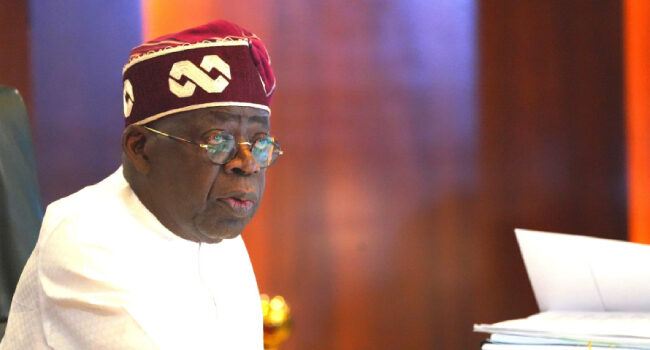
PRESIDENT Bola Ahmed Tinubu has acknowledged the growing hardship facing Nigerians due to rising fuel prices, while urging citizens to remain hopeful, stressing that the country is still better positioned compared to some others.

News Point Nigeria reports that the President made the remarks on Friday during a visit to Bayelsa State, where he inaugurated a number of projects.
Addressing concerns about the current economic situation, Tinubu admitted the impact of rising fuel costs on citizens but encouraged a perspective of resilience.


“I hear you from various angles of the economy. The fuel price is biting hard, but look around, let’s just thank God together that you are better off,” he said.
The President also compared Nigeria’s situation with developments in other African countries, noting that the economic challenges being experienced are not unique to Nigeria.
“Listen to them in Kenya, in other African countries, what they are going through. We will not look back. We will continue to find ways to ameliorate the suffering of the vulnerable. This is a government that cares,” he added.
Tinubu further assured that the government is actively working to ease the burden on citizens, attributing the current economic strain to broader global factors.
“I am glad the Head of Service is here. Look at the numbers with the finance, economic planning, and budgeting, and we will see what we can do to ease the burden.
“But that is the development; the burden of it is what we are facing today. The challenge of the war we didn’t call for, but the effect of the interrelated world that we share. Both the joy and pain of it are universal,” he stated.

Since assuming office in May 2023, the Tinubu administration has introduced several economic reforms, including the removal of the petrol subsidy and the floating of the naira.
While these policies are intended to achieve long-term economic stability, they have contributed to increased hardship for many Nigerians, largely driven by rising inflation and a sharp increase in the cost of living.
The situation has been further worsened by ongoing geopolitical tensions in the Middle East, particularly involving the United States, Israel, and Iran, which have disrupted global energy markets.


More recently, petrol prices in Nigeria have surged to over ₦1,200 per litre, intensifying the financial strain on households and businesses across the country.