

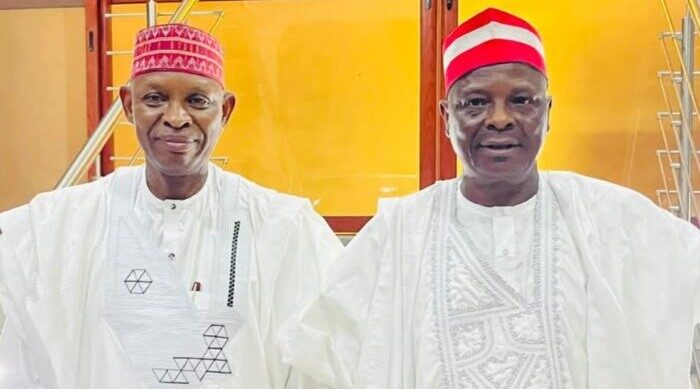
POLITICS is not merely the contest of power; it is the discipline of choice. It is a terrain where patience is tested, loyalty is strained, and leadership is measured not by noise but by consequence. Within this demanding landscape, the delayed defection of Governor Abba Kabir Yusuf did not arise from indecision, opportunism, or personal ambition. It emerged from a deliberate and sustained attempt to align loyalty with strategy, principle with progress, and mentorship with the realities of governance.

From the very beginning, Abba Kabir Yusuf’s political life has been defined by obedience and restraint. His rise was neither abrupt nor rebellious. He stood firmly within the shadow of his political mentor, Senator Rabi’u Musa Kwankwaso, absorbing the culture of movement politics where discipline outweighs impulse and structure takes precedence over personal will.
Even as governor of Kano, one of Nigeria’s most politically significant states, Abba remained ideologically grounded in the belief that leadership must not outgrow loyalty.


Yet politics evolves, and governance confronts leaders with questions that ideology alone cannot answer.
Governor Abba’s delay in defecting to the APC was rooted in a singular objective: he wanted Kano’s political realignment to be collective, dignified, and anchored around his mentor. On several occasions, he made deliberate and quiet efforts to soften Kwankwaso’s stance, urging him to look beyond rigid demands and toward the broader possibilities of national alignment. Abba understood what many pretended not to see: that Kwankwaso’s value within Nigerian politics was already established and did not require transactional bargaining to be affirmed.
In this pursuit, Abba became more than a governor; he became a bridge. His travels, both local and international, were not personal adventures but diplomatic missions. The planned meeting in France, the subsequent engagement attempts in the UAE, and the eventual discussion with President Bola Ahmed Tinubu in Abuja were all part of a calculated effort to create neutral ground for dialogue. Each step reflected Abba’s belief that reconciliation must be pursued persistently, even when outcomes are uncertain.
It is no longer a secret that political restructuring within the APC, including the removal of Dr Abdullahi Umar Ganduje as National Chairman, was widely interpreted as an opening gesture toward Kwankwaso. The intention was clear: to create space, reduce friction, and encourage reintegration. Yet, despite the overtures, the response remained distant. Even when a direct meeting between President Tinubu and Kwankwaso was proposed after Abba’s engagement with the President, it was deliberately declined.
At the heart of the impasse was rigidity. The insistence that any return to the APC must be predicated on a vice-presidential ticket revealed a fundamental misreading of political timing.
While Kwankwaso remains charismatic, influential, and a proven crowd mobilizer, succession politics is not dictated by entitlement but by alignment, trust, and gradual consensus. Abba saw this clearly and tried repeatedly to counsel moderation, patience, and realism.

Throughout this period, Abba Kabir Yusuf endured silently. He absorbed political marginalization within his own movement without public complaint. He exercised little to no influence over party structures, candidate selection, or even local government political arrangements. Yet, despite these constraints, he never uttered a single negative word against his mentor. On the contrary, he publicly warned commentators and social media actors against disparaging Kwankwaso. This was not weakness; it was character.
However, governance eventually demands a reckoning.
Kano State could no longer afford political isolation. Development, security, infrastructure, and economic revival require synergy with the centre. The cost of standing apart had become too visible to ignore. The Wuju-Wuju road project stands as a powerful symbol of this reality. Conceived during Kwankwaso’s tenure at an estimated cost of about five billion naira, the project languished for years in abandonment. Today, through federal intervention, the same project is being revived at a staggering cost of forty six billion naira. This is not merely inflation; it is the price of delay, distance, anddoel disconnection.


For Abba Kabir Yusuf, this was the turning point. Kano first ceased to be a slogan and became a moral imperative. Development cannot be sentimental. Security cannot be postponed. Governance cannot wait for perfect alignment when the people are paying the price of political stasis. His defection to the APC, therefore, was not a rejection of loyalty but an expansion of responsibility.
Even in switching paths, Abba remained faithful to his values. He left without insults, without bitterness, without revisionist attacks on his past. His silence spoke louder than justification. It reflected a leader who understands that respect does not end where agreement fails. That is humble AKY for you. Gentle and Courteous.
In the final reckoning, politics must answer to morality, and morality must answer to consequence. Leadership is not validated by how long one waits, but by when one chooses to act. Governor Abba Kabir Yusuf’s decision reflects a timeless truth: when loyalty begins to delay collective progress, conscience must intervene. Kano’s future could not remain hostage to prolonged negotiations or rigid postures, no matter how noble their origins.
History is unkind to leaders who confuse patience with prudence. It remembers instead those who understood that power is a means, not an inheritance, and alignment is not surrender when it unlocks development, security, and dignity for the people. Abba’s choice affirms that governance is a trust, one that demands difficult decisions taken in humility and restraint.
In choosing Kano first, prioritising peace, unity and the progress of the people over comfort, action above endless persuasion, and responsibility than loyalty, Abba Kabir Yusuf has placed himself on the harder side of leadership. And it is often on that harder side that the future is quietly secured.
- Abdulkadir is a Fellow of the Nigerian Guild of Editors (FNGE), a veteran journalist, and a public affairs analyst. He writes from Kano City.