

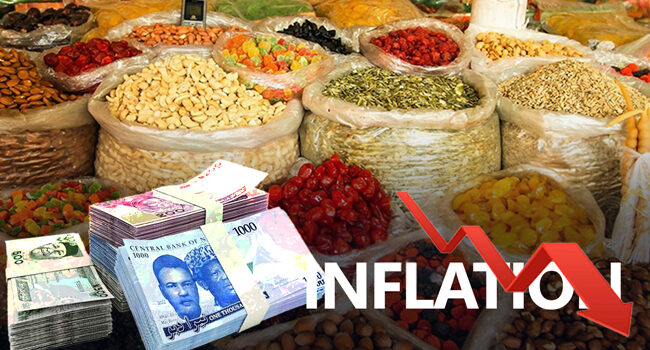
HEADLINE inflation rate moderated to 14.45 per cent in November 2025, from the 16.05 per cent recorded in October 2025.

News Point Nigeria reports that the drop followed years of surging prices that triggered a cost-of-living crisis in the country.
According to the latest figures released by the National Bureau of Statistics (NBS) on Monday, this represented a decline of 1.6 percentage points month-on-month.


Consumer inflation peaked near 35% last December before falling after the NBS revised its base year and adjusted the weight of items in its price basket.
Food inflation was at 11.08% year on year in November compared with 13.12% in October.
“The Consumer Price Index rose to 130.5 in November 2025, reflecting a 1.6-point increase from the preceding month (128.9).
“In November 2025, the Headline inflation rate eased to 14.45 per cent relative to the October 2025 headline inflation rate of 16.05 per cent.
“Looking at the movement, the November 2025 Headline inflation rate showed a decrease of 1.6 per cent compared to the October 2025 Headline inflation rate,” the NBS report read.
A leather artisan unfolds pieces of dyed skins in his shop at the Kurmi market in Kano, on September 10, 2025. (Photo by OLYMPIA DE MAISMONT / AFP)
Data from the report showed that the average CPI for the twelve months ending November 2025 increased by 20.41 per cent compared with the average of the preceding twelve months, representing a sharp slowdown from the 32.77 per cent recorded in November 2024.

Food and non-alcoholic beverages remained the largest contributor to headline inflation on a year-on-year basis, accounting for 5.78 percentage points, followed by restaurants and accommodation services at 1.87 percentage points and transport at 1.54 percentage points.
Housing, water, electricity, gas, and other fuels contributed 1.22 percentage points, while education services and health accounted for 0.90 and 0.88 percentage points, respectively.
At the month-on-month level, food and non-alcoholic beverages also drove price increases, contributing 0.49 percentage points, followed by restaurants and accommodation services at 0.16 percentage points and transport at 0.13 percentage points.


A factory worker piles up hides out of the setting-out machine at the Ztannery factory in Kano, on September 11, 2025. (Photo by OLYMPIA DE MAISMONT / AFP)
A breakdown of inflation across locations showed that urban inflation stood at 13.61 per cent year on year in November 2025, representing a steep decline of 23.49 percentage points from the 37.10 per cent recorded in November 2024.
On a month-on-month basis, urban inflation slowed to 0.95 per cent from 1.14 per cent in October, while the twelve-month average urban inflation rate eased to 20.80 per cent.
In contrast, rural inflation was higher at 15.15 per cent year on year in November, although this was still 17.12 percentage points lower than the 32.27 per cent recorded in the corresponding period of 2024.
Month-on-month rural inflation accelerated sharply to 1.88 per cent from 0.45 per cent in October, reflecting stronger price pressures in rural areas during the month.
Food inflation also moderated significantly on an annual basis. The NBS reported that food inflation stood at 11.08 per cent year on year in November 2025, down by 28.85 percentage points from 39.93 per cent recorded in November 2024.
However, month-on-month food inflation rose to 1.13 per cent from a contraction of 0.37 per cent in October, driven by price increases in items such as dried tomatoes, cassava tubers, shelled periwinkle, ground pepper, eggs, crayfish, egusi, oxtail, and fresh onions.
The average annual food inflation rate for the twelve months ending November 2025 was 19.68 per cent, compared with 38.67 per cent in the corresponding period of 2024.
Core inflation, which excludes volatile agricultural produce and energy prices, stood at 18.04 per cent year on year in November 2025, down from 28.75 per cent in November 2024.
On a month-on-month basis, core inflation eased slightly to 1.28 per cent from 1.42 per cent in October, while the twelve-month average core inflation rate fell to 20.76 per cent.
Other sub-indices showed that farm produce inflation stood at 0.79 per cent in November, compared with zero per cent in October, while energy inflation rose to 1.08 per cent from 0.50 per cent.
The Central Bank of Nigeria (CBN) said last month that it wanted inflation to fall further as it left its main interest rate unchanged.
Inflation slowed for the seventh month in a row in October to 16.05% year on year.
However, the CBN’s Governor Olayemi Cardoso said inflation was still too high, and the MPR was maintained at 27%.
“Headline inflation remains high at double digits, requiring sustained efforts towards moderating it further,” Cardoso told a press conference.
“The decision was underpinned by the need to sustain the progress made so far towards achieving low and stable inflation.”
Cardoso said the bank was adjusting the corridor on its Standing Facility to +50 to -450 basis points around the MPR, cutting its deposit rate and encouraging banks to lend rather than parking money with the central bank.