

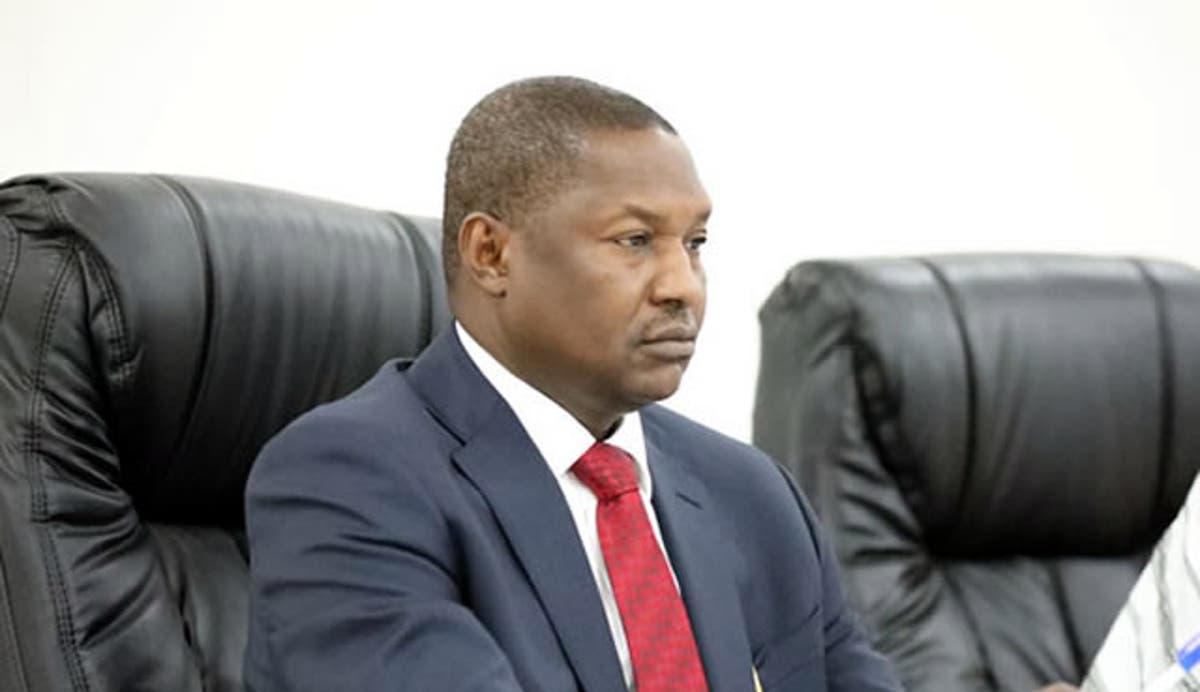
INVESTIGATORS of the Economic and Financial Crimes Commission (EFCC) have traced a significant portion of the wealth allegedly accumulated by Abubakar Malami, former Attorney-General of the Federation and Minister of Justice, to multiple high-profile public finance transactions, including Paris Club refunds to states, unpaid Central Bank of Nigeria (CBN) agricultural loans, and the repatriation of looted funds linked to late military ruler, General Sani Abacha.

News Point Nigeria reports that Malami is expected to be arraigned before a Federal High Court in Abuja on multiple counts bordering on corruption and abuse of office.
Properties estimated to be worth over ₦200 billion have reportedly been linked to the former justice minister, most of which investigators believe were acquired during his tenure as attorney-general between 2015 and 2023 under former President Muhammadu Buhari.


Through statements issued by his media team, Malami has denied all allegations, describing them as politically motivated and insisting that he would vigorously defend himself in court.
At the centre of the EFCC investigation is the controversial Paris Club refund arrangement. Nigeria exited the Paris Club of creditors in 2005 after paying $12 billion in exchange for an $18 billion debt write-off.
Although the debts were largely incurred by the federal government, the repayment was made from the federation account, prompting state governments to demand refunds.
To compute the refunds, the federal government engaged consultants who later claimed professional fees in excess of $400 million. Acting on Malami’s legal advice, the federal government approved deductions of about $418 million from state allocations to pay the consultants.
The Nigeria Governors’ Forum (NGF) vehemently opposed the arrangement, accusing Malami of acting in the interest of the consultants rather than the states. In a heated exchange between 2021 and 2022, the governors alleged that the claims were fraudulent and vowed to challenge them in court.
Despite initial resistance, President Buhari later approved the payments, a move that deeply angered state governors. EFCC investigators have now reportedly traced a substantial part of Malami’s alleged wealth to kickbacks arising from the Paris Club refund payments.

Another strand of the investigation centres on the Anchor Borrowers Programme (ABP) launched by the CBN in 2015 to boost food production and reduce import dependence. Under the scheme, farmers and agribusinesses received loans and farm inputs.
Investigators allege that Malami obtained a ₦4 billion loan under the programme using the name of one of his wives, Hajiya Bashir Asabe, which was never repaid. Both Malami and his wife have now been charged to court over the loan.
The CBN reportedly disbursed over ₦1 trillion under the ABP, with more than ₦600 billion still outstanding, fuelling concerns that parts of the programme may have been abused by politically exposed persons.


The EFCC is also probing Malami’s role in the repatriation of $321 million of Abacha loot recovered from Switzerland. Although the funds had been recovered and frozen as early as 2013 under the Goodluck Jonathan administration, repatriation stalled in 2015 due to legal action by the Abacha family.
Before Malami’s tenure, Nigeria had already engaged Swiss lawyers, paying millions of dollars in fees to recover the funds from Liechtenstein and Luxembourg. All that remained was for the Nigerian government to sign a memorandum of understanding with Swiss authorities on utilisation of the funds.
However, in 2017, Malami controversially engaged two Nigerian lawyers, Oladipo Okpeseyi and Temitope Isaac Adebayo to handle the same recovery process, resulting in an additional $16.9 million paid as commission and professional fees from the recovered funds.
Investigators allege that the engagement duplicated work already completed by foreign lawyers and that payments from the commission were subsequently traced back to Malami.
Both lawyers have reportedly been detained and interrogated by the EFCC and are said to have made statements useful to investigators.
EFCC sources say the investigation is ongoing, with more assets and financial trails still being examined. The case marks one of the most high-profile corruption probes involving a former attorney-general in Nigeria’s history.
As Malami prepares to face the courts, the unfolding investigation is expected to reignite national debate over transparency in public finance, asset recovery processes, and accountability among top government officials.