

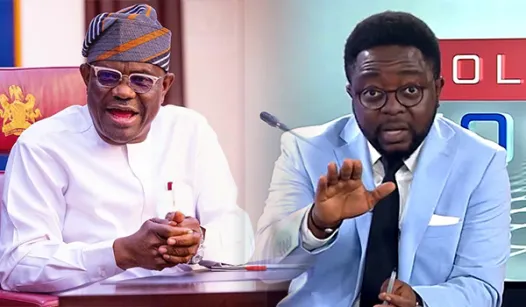
THE Minister of the Federal Capital Territory, Nyesom Wike, has denied issuing any threat to Channels Television anchor, Seun Okinbaloye, insisting that his controversial remark was merely figurative and never intended to be taken literally.
News Point Nigeria reports that Wike made the clarification on Tuesday in Abuja while receiving the management and staff of Daar Communications, stating that his earlier comment had been widely misinterpreted and taken out of context.
Reflecting on the incident, the minister expressed frustration over how his remarks were perceived, noting that people often “capitalise on things” without considering the full context.


“You can imagine what happened in our press conference. And people just, you see, people just capitalise on things. Even when I explained there that, ‘look, it’s not correct. I didn’t say I would kill him. All I was trying to explain is that figuratively,” Wike said.
He added that his reaction was borne out of anger at what he described as an unprofessional line of questioning during the interview.
“I was so angry. How can you descend so low? You are an interviewer. How do you now begin to say something that…you are no longer interviewing your guests… You are now saying this is what is going on? It’s not fair,” he stated.
Continuing, Wike questioned the interpretation of his words, arguing that his expression was exaggerated and not meant as a literal threat.
“If I can break this…how can you break? I mean, how can? And people will capitalise on everything. Those who have defeated several, then they will come under you and say, look, do this, do this, do this,” he added.
The controversy originated from comments made by the minister during a media parley on Friday, April 3, where he reacted strongly to Okinbaloye’s analysis on the Channels Television programme Politics Today.

During that exchange, Wike had said, “If there was any way to break the screen, I would have shot him,” a statement that quickly sparked widespread backlash across media and civil society.
Addressing the issue, the minister maintained that the remark was intended to convey frustration rather than a physical threat, stressing that it should not be interpreted literally.
However, Okinbaloye, in a subsequent broadcast on Sunday, stood his ground and rejected any form of intimidation, insisting that such rhetoric has no place in a democratic society.


“I am not afraid, and I will never be intimidated,” the television anchor declared.
The incident has since drawn sharp criticism from media organisations and civil society groups, further amplifying the controversy.
The Nigeria Union of Journalists and Amnesty International both described the minister’s statement as reckless, calling on him to issue a public apology.
Similarly, the Independent Broadcasters Association of Nigeria warned that it could boycott Wike’s media engagements if no apology is forthcoming.