

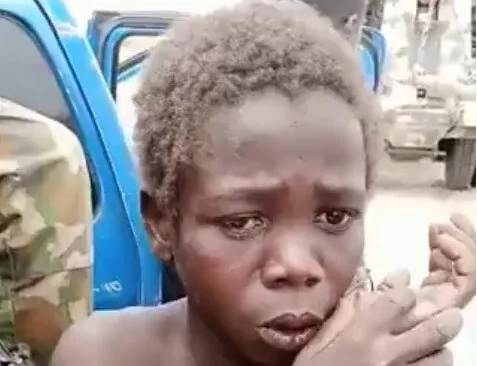
AN EIGHT-YEAR-OLD, abducted as a toddler by Boko Haram, has recounted years of hardship, fear, and longing for his family after escaping captivity in the Lake Chad region.

News Point Nigeria reports that his story offers a rare and heartbreaking glimpse into the largely overlooked reality of thousands of boys abducted and forced into survival under the insurgent group’s control often far from global attention that has largely focused on kidnapped women and girls.
The child, who spoke in a fragile but determined voice, said he was taken at the age of four when Boko Haram fighters attacked his village, Kaburi, in Borneri, in Cameroon.


Since that day, he has not seen his parents. “My parents were in Cameroon. I have not seen them for about four to five years now,” he said.
For years, the boy lived in forest camps and abandoned settlements, where he said life was defined by hunger, fear, and constant attempts to escape.
“After I was abducted, I was always planning to escape. There was a time we tried, but some people with guns and sticks caught us and brought us back,” he recounted.
His eventual escape came when he sighted troops and ran toward them, hoping for freedom.
“When I saw the soldiers, I ran to them because I thought they would take me back to my father,” he said. “I am not enjoying the forest. It is bad. I have been looking for my mother for a long time. Don’t you see how I have been suffering?”
The boy described a harsh existence, where even basic necessities were scarce.

He survived by begging for food from families in nearby communities or working for a caregiver, performing menial tasks such as farming and fetching water in exchange for meals.
“I usually beg before getting something to eat. There is a woman we work for, she gives us food after we do work,” he said.
He added that he owned only one piece of clothing, which was torn during his escape.


Personal hygiene was equally difficult. With no access to basic tools, he occasionally relied on others to help cut his hair with scissors.
“I don’t have anything to cut my hair. Someone once helped me with scissors,” he said.
Although the boy said he was never forced to carry a weapon, he witnessed armed fighters regularly.
“In their camp, many people have guns. Some have long guns,” he said, adding that he often saw militants engaging in combat with soldiers. “I see them chasing soldiers,” he said.
Despite his exposure to violence, he insisted he had never handled a firearm. “I have never held a gun,” he said.
Now in the care of security forces, the boy’s only wish is to be reunited with his family.
When asked if he would ever return to the forest, his response was immediate: “I don’t want to go back. I just want to find my mother.”
Security experts and officials say the boy’s story reflects a broader and deeply troubling trend.
Across Nigeria, Cameroon, Niger, and Chad, Boko Haram has abducted thousands of children, particularly boys whom they recruit and train in remote camps across the Lake Chad Basin.
According to the Multinational Joint Task Force (MNJTF), the group has increasingly turned to child recruitment as part of its evolving strategy.
Colonel Timothy Antigha said intelligence reports confirm that Boko Haram continues to deploy children in both combat and support roles.
“The recruitment of child soldiers is one of the most brutal tactics deployed by Boko Haram,” he said.
The group has also released propaganda videos showing children dressed in military fatigues and carrying assault rifles, further highlighting the scale of the crisis.
International organisations have repeatedly raised alarm over the exploitation of children by armed groups.
The United Nations has documented widespread violations against children in conflict zones across the region.
According to a report presented by Virginia Gamba, the UN Special Representative for Children and Armed Conflict, thousands of children have been subjected to abduction, forced recruitment, and other abuses.
Between 2017 and 2019 alone, at least 3,601 children were affected, with Boko Haram responsible for recruiting over 1,300 of them.
The group’s campaign of terror, which includes mass abductions such as the 2014 kidnapping of schoolgirls in Chibok, continues to cast a long shadow over communities in the region.
While military operations have weakened Boko Haram’s territorial control, the human cost of the conflict remains deeply entrenched.
For this young survivor, the scars are not just physical but emotional, marked by years of separation, fear, and loss. His story is a stark reminder that beyond the headlines and statistics are children whose lives have been disrupted in unimaginable ways.
And for him, the conflict is not over until he finds his way back home.