

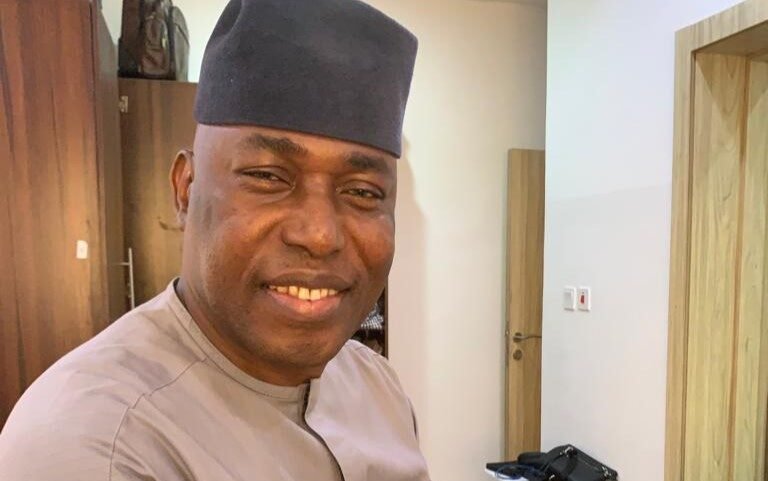
OLUSOLA Oke, SAN will arrive on the 7th Floor on Tuesday April 7, 2026. The fisherman turned lawyer and politician will mark the day in Akure, capital of Ondo State with a presentation of his autobiography titled, ‘From The Ocean To The Bar’.Enjoy some appetizers from the very remarkable book, which promises to be a classic on law, ethics, politics and leadership. The Attorney General of the Federation (AGF) Prince Lateef Fagbemi, SAN wrote the Foreword to the Book. The starters:
‘Political financing and my legal profession’
From the very beginning of my political journey, I made a solemn personal covenant: politics would always be my second address; never my first. At the same time, my legal profession would remain the anchor of my identity and livelihood. This principle was not merely philosophical; it was a necessary orientation for navigating the treacherous waters of Nigerian politics, where fortunes shift quickly, alliances dissolve without warning, and victory often carries as much cost as defeat.
Politics, as I have lived it, is an arena governed not by fairness but by the winner-takes-all. In this political environment, even the most brilliant, patriotic, or well-intentioned contestant may find himself punished for losing, ostracised by the system he once sought to serve, and treated as an adversary, simply for having aspired.


…Over the past twenty years, I have contested the governorship, either as an aspirant in the primaries or as a candidate, four times. Few people appreciate the emotional, financial, and spiritual weight of such a journey. Unlike in other regions of Nigeria, where wealthy patrons sometimes sponsor candidates, the Southwest political culture largely emphasises self-financing. Those who have the resources often use them to pursue their own ambitions; very rarely do they underwrite another man’s dream. Therefore, every aspirant must rely, primarily, on his own sweat, networks, and savings.
…Contesting a gubernatorial election in Nigeria is a venture that requires billions of naira, often without any guarantee of a return. The candidates are expected to finance consultations, logistics, publicity, mobilisation, transportation, accommodation for supporters, security and all the subtle yet unavoidable expenses that form the lifeblood of political power. Additionally, party members often depend on aspirants for survival; the aspirant becomes the de facto welfare officer, bank, and benefactor. The same crowd that gathers for aspirant A will wait for aspirant B, not out of ideological commitment, but out of economic imperatives.
…The Nigeria political behaviour is a system that makes it difficult to blame individuals, because existing socio-economic realities compel such behaviour. However, with all sincerity and frankness, contesting and losing elections can be emotionally and financially draining. Looking back now, I can say, without hesitation, that if I am not counted among the comfortable Nigerians today, it is largely because of politics. Politics has consumed my hard-earned resources, which I could have used to build vast business empires; it has slowed the expansion of my legal practice, which is my sole means of livelihood.
…Each time I entered a political contest or race, I would pour everything into it: resources, intellect, time, and physical strength. The 2024 election cycle, in particular, exacted the heaviest toll. Given my age, experience, and years of accumulated political investment, I felt a firm conviction to give it my best, perhaps a significant push, and assurances that there would be free and fair elections, which turned out to be a fluke.
I invested deeply in the contest, encouraged by my understanding of the Ondo State political terrain and my genuine desire to serve my people, with a governance model that could transform the state. However, as with many endeavours in public life, the outcome did not align with the investment. The financial loss was substantial, and the emotional weight, even, heavier.
In addition to financial evaporation, politics has also affected my professional identity. The legal profession thrives on consistency, presence, mental clarity, and a steady cultivation of clientele. Yet, every political contest pulled me away from my chambers and courts. It disrupted routines, distanced me from clients, and sometimes eroded hard-earned professional momentum. After every political cycle, I would return to my law practice, only to discover that it had suffered. Clients, particularly corporate ones, often prefer stability over political visibility. Many of them, unsure of the future of a politically active lawyer, quietly move elsewhere. Despite these setbacks, I take pride in the fact that my legal practice remains viable, and is able to sustain me. I have never sought contract awards or wealth through public office.

…Yet, I harbour no regrets. My motivation was never etched on selfish ambition. My deepest desire has always been to use the gifts God gave me: my intellect, my education, my exposure, and my leadership experience, to improve the lives of my people, particularly in Ondo State and in Nigeria as a whole. I have always believed that governance should elevate the forgotten, empower the marginalised, and restore dignity where neglect has taken root.
Politics, nonetheless, has not been without its blessings. It has given me visibility, far beyond what legal practice alone could offer. In almost every state I visit in Nigeria, someone would recognise me as a national leader or as a former governorship candidate. It has given me influence, relationships, and the ability to understand Nigeria at its most complex intersections of culture, power, and aspiration. These opportunities, though intangible, enrich the soul and broaden my philosophical horizons.
I acknowledge the duality of political life. Alongside admiration come enmity, jealousy, misrepresentation, and resistance. In politics, even success attracts hostility. Some fear your competence; some resent your courage; some cannot stand the fact that you cannot be selfishly influenced or manipulated. Political life is a theatre of human passions, ambition, rivalry, fear, loyalty, betrayal, admiration, and contempt, which are interwoven into a single fabric. So, it is with politics: wherever there is influence, controversy is never far behind.


With all these trajectories, I have refused to succumb to hopelessness. I believe, deeply, that God does not waste human experiences. Every step I have taken, every contest won or lost, every door opened or closed, has formed part of a larger purpose that might not have been fully revealed. Perhaps the work I am meant to do lies not only in occupying office but in shaping political culture, mentoring the next generation, advocating for my people, and influencing policy from whichever platform God provides.
Therefore, my political journey has been costly; financially, emotionally, and professionally, but it has not been wasted. I have planted seeds in my people’s consciousness. I have demonstrated that principled politics is possible. I have shown that service matters more than position. Similarly, I have kept faith with my calling, even when the path was difficult. I remain grateful to God for the experience, the strength, love of my people, and inner conviction that my story is still unfolding. Politics may have drained my pockets, but it has enriched my life, expanded my wisdom, sharpened my conviction, and affirmed my purpose, and for these, I remain positive and thankful…
Looking back across the many seasons of my life recounted in this narrative, one truth stands out clearly: destiny rarely unfolds along a straight path. My early years were marked by interruptions, detours, and periods of uncertainty. Education was once abandoned for the fishing trade, and years passed in religious devotion and family occupation before the path of learning reopened. Nevertheless, what appeared at that time to be delays later revealed themselves as preparation. The discipline learned from the sea, the humility cultivated through hardship, and the resilience developed in moments of rejection all became essential tools in navigating the later complexities of professional and public life.
Equally significant in this journey is the enduring influence of my family, community, and faith. The sacrifices of my parents, particularly the determination to believe deeply in the transformative power of education, remain central to the story. Their commitment reflects a profound African truth: individual success is rarely achieved in isolation. It is the fruit of communal investment, nurtured by the encouragement, sacrifices, and prayers of many others.
The Ilaje environment itself played a formative role in shaping my character and worldview, as this autobiography shows. The rhythms of coastal life, the culture of cooperation among fishermen, and the moral lessons embedded in communal living instilled values that remained constant throughout my life’s later pursuits. Even as the journey moved into the demanding spheres of law, politics, and leadership, the riverine lessons of my childhood continued to guide and provide relevant perspectives.
The legal profession became more than a career. It evolved into a platform for advocacy, justice, and service to society. Rising to the rank of a Senior Advocate of Nigeria represented not merely personal achievement but the culmination of years of disciplined efforts and ethical commitment. The Bar became a space where intellectual rigour, moral conviction, and a sense of responsibility to the nation could converge.
Nonetheless, the journey did not end within the courtroom. Public life and political engagement opened another chapter of service; one defined by both aspiration and sacrifice. Leadership, as reflected in this book, is neither a quest for privilege nor a pursuit of personal acclaim. It is a demanding responsibility that requires resilience, patience, and an unwavering commitment to the collective good.
-The serial on “Before Tinubu Leaves Northern Elites Behind” will continue next week as there is a time for everything. Cheers.
– Oloja is former editor of The Guardian newspaper and his column, Inside Stuff, runs on the back page of the newspaper on Sunday. The column appears on News Point Nigeria newspaper on Monday.