

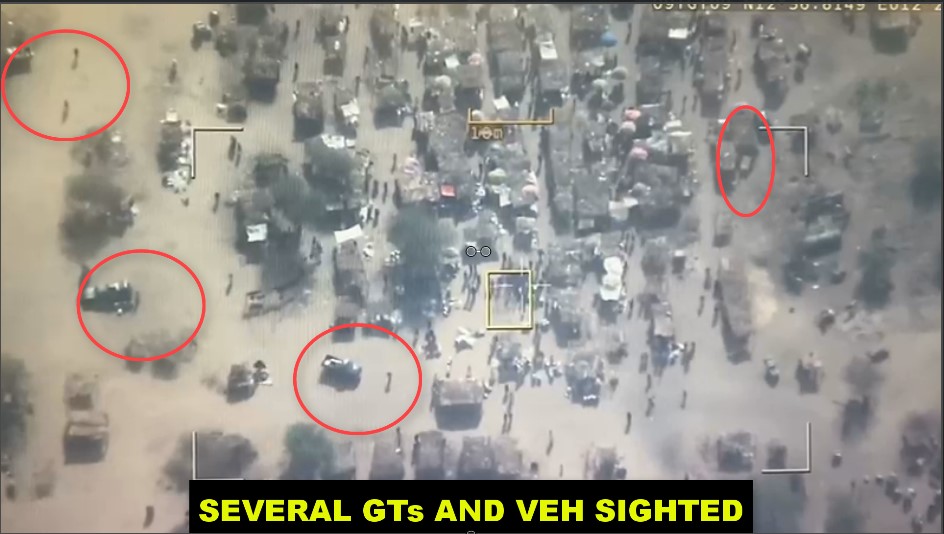
THE Nigerian Army troops under Operation Hadin Kai have defended their decision to strike a suspected terrorist location in Jilli Village, Gubio Local Government Area of Borno State, even as controversy continues to trail reports of civilian casualties.

News Point Nigeria had earlier reported that no fewer than 50 people were feared killed after a military airstrike hit a weekly market at Jilli village, located along the border between Borno and Yobe states, on Saturday evening.
The incident, which occurred at the popular Jilli Market between the Gubio and Geidam areas, reportedly threw traders and residents into panic as multiple explosions rocked the busy trading centre.


The strikes were executed by the Air Component of Operation HADIN KAI in coordination with the Nigerian Army, following an earlier operation that had targeted and destroyed terrorist positions in the area.
However, in a statement issued on Sunday, the Media Information Officer of the Northeast Joint Task Force, Operation Hadin Kai, Lt. Col. Sanni Uba, maintained that the location struck was a known terrorist enclave and logistics hub long identified as a major movement corridor and convergence point for Islamic State West Africa Province terrorists and their collaborators.
According to him, “The Air Component of Joint Task Force (North East) Operation HADIN KAI (OPHK), in a carefully, well-coordinated, planned, and intelligence-driven operation, has successfully conducted a precision air strike on a known terrorist enclave and logistics hub located near the abandoned village of Jilli in Gubio Local Government Area of Borno State.”
He explained that the successful strike followed sustained Intelligence, Surveillance and Reconnaissance (ISR) missions over the Bindul–Jilli axis, an area long identified as a major terrorist movement corridor.
Uba recalled that in January 2026, troops moving from Gubio towards Damasak were hit by an Improvised Explosive Device (IED), resulting in the death of eight soldiers, while several others were wounded. He added that more recently, on April 9, coordinated attacks were recorded in Ngamdu and Benisheikh, allegedly supported by the same terrorist logistics network.
He said the theatre command subsequently intensified surveillance and intelligence gathering across the area in response to persistent reports of terrorist movement and logistics activities.

According to him, multiple reports received on April 11 indicated that ISWAP gun trucks and motorcycles were moving along the axis, prompting intensified ISR coverage.
“During the surveillance mission, a contingent of motorcycles was observed moving in the direction of Jilli, followed shortly by additional vehicles, all converging on the same location. These movements were corroborated by credible human intelligence sources confirming that the elements were terrorists, collaborators, and logistics handlers,” he stated.
He added that in line with operational procedures, a rigorous targeting process was undertaken, with target fidelity confirmed through multiple intelligence sources and persistent aerial surveillance.


“Upon final validation, the Air Component executed a series of precision strikes on the objective, while surveillance platforms maintained continuous overwatch for real-time battle damage assessment,” he said.
Uba stressed that post-strike assessments confirmed high accuracy, with the destruction of the identified terrorist logistics enclave. He added that scores of terrorists were neutralised, their vehicles and technicals destroyed, while surviving elements fled in different directions.
According to him, intelligence further indicated that the neutralised elements were in the final stages of receiving logistics for coordinated attacks on troop locations within the Gubio axis.
“This decisive action has therefore significantly disrupted imminent terrorist plans and degraded their operational capability within the theatre,” he stated.
He also disclosed that on April 12, a suspected terrorist logistics courier identified as “Turja Bulu” was arrested in Ngamdu town. During preliminary investigation, the suspect reportedly confessed to participating in the April 9 attack on a 29 Brigade location in Benisheikh.
The suspect, he said, had been dispatched by ISWAP from Jilli to deliver food supplies to another group of terrorists hibernating around the Magumeri–Gubio axis.
Uba described the operation as a demonstration of the resolve and operational capability of Operation Hadin Kai to sustain pressure on terrorist elements, disrupt their logistics networks, and deny them freedom of movement.
He further reiterated the command’s ban on the use of motorcycles across the North-East operational theatre, particularly in Borno and Yobe states, noting that such movements are treated with utmost seriousness due to their frequent use by insurgents.
Corroborating the Army’s justification for the strike, Babagana Umara Zulum revealed that the Borno State Government had shut down Jilli market five years ago due to its alleged use as a hub for insurgents and their logistics suppliers.
The governor made this known while reacting to the airstrike, which reportedly claimed over 50 lives at the market on Saturday.
In a statement sent to News Point Nigeria on Sunday by his Special Adviser on Media, Dauda Iliya, Zulum said he had been fully briefed on the airstrike carried out by Operation Hadin Kai in the border community.
“I have been properly briefed on the airstrike carried out by the Air Component of Operation Hadin Kai on Jilli market, a border town between Borno and Yobe states. Let me state categorically that the Borno State Government closed Jilli and Gazabure markets five years ago,” the statement read.
The governor added that he was in close consultation with the Yobe State Government and the military hierarchy over the incident.
Zulum explained that the state government maintains close coordination with the military and other security agencies before resettling communities or reopening markets, especially in insurgency-affected areas.
He reiterated his administration’s commitment to protecting law-abiding citizens while sustaining collaboration with security agencies to restore lasting peace and stability across the state.
The governor also urged residents to remain vigilant and cooperate with security agencies by providing credible information to support ongoing military operations.