

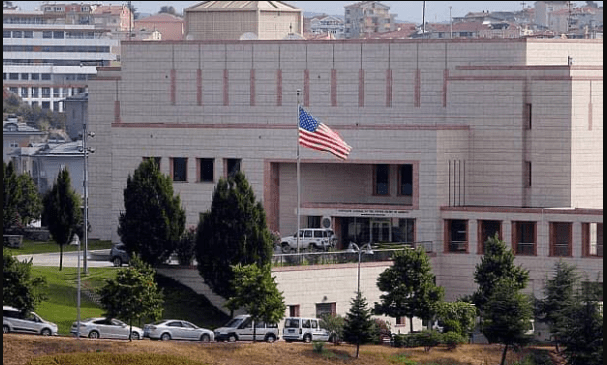
THE United States Mission in Nigeria has announced the suspension of visa appointments at its Embassy in Abuja, in a development that underscores rising security concerns and shifting diplomatic signals regarding Nigeria.

The announcement, made via the mission’s official X handle on Thursday sighted by News Point Nigeria, stated that the embassy in Abuja would no longer conduct visa interviews for the time being.
“U.S. Embassy Abuja is closed for visa appointments. Applicants should check their email for details on rescheduled appointments,” the statement read.


However, the mission clarified that visa processing continues uninterrupted at the U.S. Consulate General in Lagos.
“Visa operations at U.S. Consulate General Lagos continue,” it added.
The embassy also noted that services for American citizens remain accessible under limited conditions.
“American citizen services are available in emergencies and by appointment,” the statement further explained.
The suspension of visa appointments comes amid a broader security advisory issued by the United States Department of State, which recently authorised the departure of non-emergency personnel from its Abuja embassy.
The directive, issued on Tuesday, was accompanied by an updated travel advisory expanding Nigeria’s “Do Not Travel” list to 23 states, with Plateau, Jigawa, Kwara, Niger, and Taraba newly added to the highest risk category.

While Nigeria remains under a Level 3 advisory “Reconsider Travel” the department warned that several parts of the country face heightened risks due to crime, terrorism, civil unrest, kidnapping, and limited access to healthcare.
According to the advisory, Americans in Nigeria are often targeted for kidnapping and robbery, while terrorist threats persist across multiple public locations, including markets, religious centres, hotels, and large gatherings.
The State Department also raised serious concerns about healthcare delivery in Nigeria, noting that hospitals frequently demand immediate cash payments, ambulance services are unreliable and poorly equipped, and blood supply systems are inconsistent.


Medical facilities in the country, the advisory added, generally fall short of U.S. or European standards, with emergency evacuations often necessary in critical situations.
The advisory categorised high-risk areas into regional clusters, reflecting widespread insecurity across different parts of Nigeria.
In the North-East, states such as Borno, Yobe, Gombe and parts of northern Adamawa were flagged for terrorism, crime, and kidnapping, with warnings that terrorist groups continue to plan and execute attacks, sometimes in collaboration with local gangs.
North-Western states including Kebbi, Kaduna, Kano, Katsina, Sokoto, and Zamfara were cited for persistent banditry, communal clashes, and kidnapping, with security operations capable of occurring without warning.
In the South-East and Niger Delta regions, Abia, Anambra, Bayelsa, Delta, Enugu, Imo, and Rivers—excluding Port Harcourt—were listed for high levels of crime, kidnapping, and civil unrest, with armed gangs and violent protests posing significant risks.
The inclusion of Plateau, Jigawa, Kwara, Niger, and Taraba highlights the spread of insecurity into new regions, particularly in the Middle Belt, where farmer-herder conflicts have intensified.
The advisory described conditions in these states as unstable and unpredictable, warning that security counter-operations may take place without prior notice.
In response to these risks, the State Department urged U.S. citizens in Nigeria to enrol in the Smart Traveller Enrollment Programme, avoid large gatherings, vary daily routines, and establish evacuation plans that do not rely on U.S. government assistance.
It also recommended that individuals set up “proof of life” protocols with family members in the event of kidnapping.
In contrast to the U.S. position, the Federal Government of Nigeria has reassured citizens and the international community that the country remains stable and fully functional.
The Minister of Information and National Orientation, Mohammed Idris, conveyed this assurance in a statement sent to News Point Nigeria on Thursday through his media aide, Rabiu Ibrahim.
According to Idris, public institutions across Nigeria continue to operate without disruption to governance, economic activities, or daily life.
He described the U.S. advisory as a routine precaution guided by internal protocols, insisting that it does not accurately reflect the overall security situation in the country.
“While we acknowledge isolated security challenges in some areas, there is no general breakdown of law and order, and the vast majority of the country remains stable,” he stated.
The minister highlighted ongoing security efforts, noting that operations across various regions have yielded measurable gains through coordinated military action, intelligence-driven interventions, and strengthened inter-agency collaboration.
“Our security agencies remain actively engaged in protecting lives and property, and the results of these efforts are increasingly evident,” he added.
He further noted that recent operations have disrupted criminal networks, reduced the activities of armed groups, and improved safety conditions in vulnerable communities.
Despite the advisory, the government maintained that Nigeria remains open for business, travel, and investment, pointing to ongoing economic reforms that are boosting investor confidence and enhancing the country’s global standing.
“International partners and investors continue to engage actively with Nigeria, reflecting confidence in the country’s stability and long-term prospects,” Idris said.
He also urged foreign governments to ensure their advisories reflect current realities and ongoing progress within Nigeria.
“We encourage our international partners to continuously engage with Nigerian authorities to obtain a more comprehensive and current understanding of the situation on the ground,” he added.
The Federal Government reiterated its commitment to sustaining security improvements and ensuring the safety of citizens and visitors, assuring that Nigeria remains a safe and welcoming destination despite emerging concerns.