

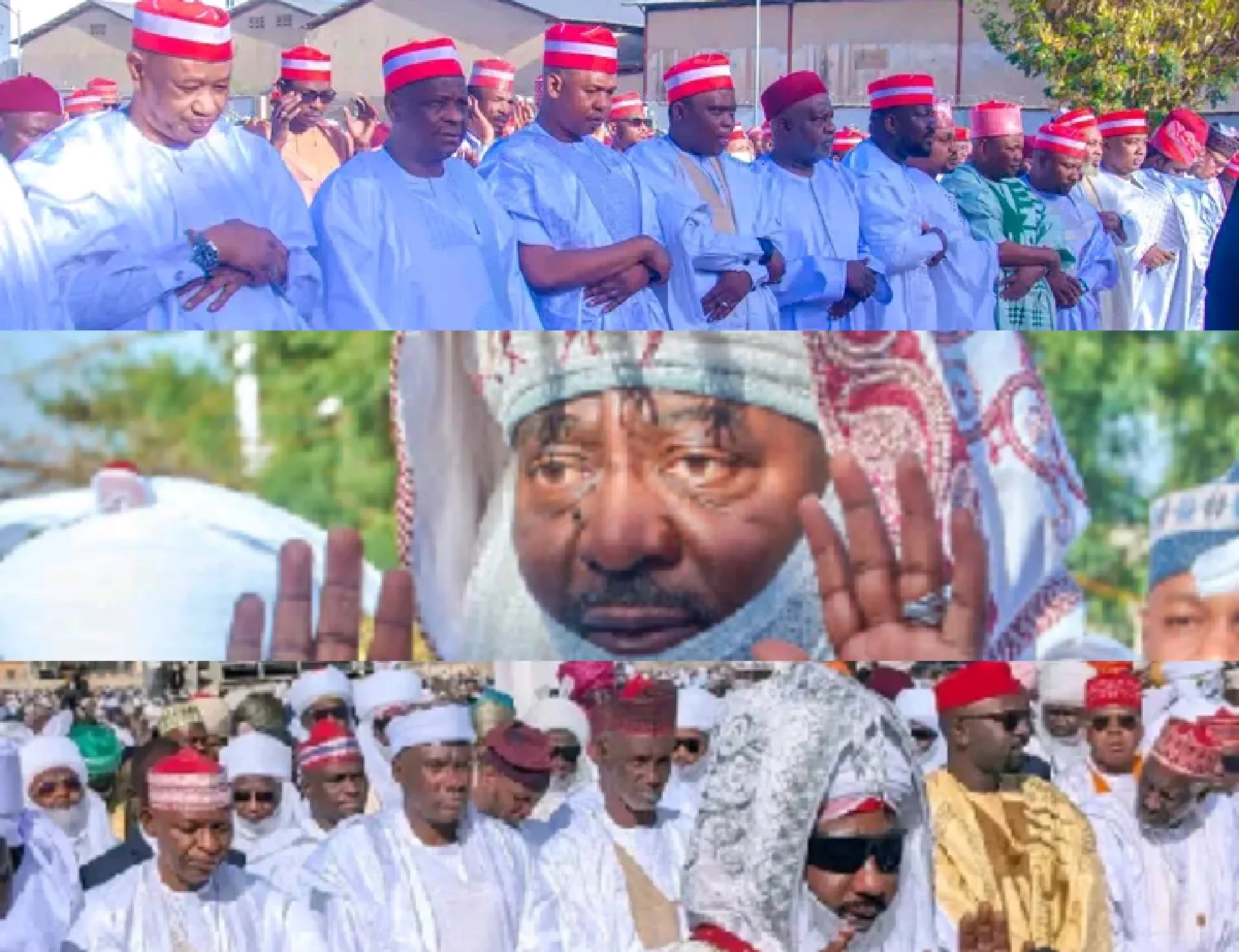
FOR the first time in recent years, Kano State witnessed an unprecedented development during the celebration of Eid al-Fitr, as three separate prayer gatherings were held across the city, reflecting deepening divisions among the state’s traditional and political leadership.

News Point Nigeria reports that the parallel observances, led by the 16th Fulani Emir of Kano, Muhammadu Sanusi II, the 15th Fulani Emir, Aminu Ado Bayero, and former governor Rabiu Musa Kwankwaso, underscored the lingering tensions stemming from the protracted emirship dispute and shifting political alliances in the state.
At approximately 8:00am, Muhammadu Sanusi II led the Eid prayer at the historic Kofar Mata Eid Ground, a traditional venue for such gatherings in Kano.


The prayer attracted top government officials and a large number of residents, including Governor Abba Kabir Yusuf, Secretary to the State Government Umar Faruq, and the Commissioner of Police, Ibrahim Adamu Bakori.
According to a close associate of the Emir, Muhammad Dallatu, the sermon focused on unity, peaceful coexistence, and the need for reconciliation among the people of Kano.
Simultaneously, Aminu Ado Bayero conducted a separate Eid prayer at the Nasarawa Palace, drawing his own supporters and key dignitaries.
The prayer was led by Sheikh Kamaluddeen Albasa, who delivered a message centred on peace, unity, and the importance of maintaining stability in the state.
The Emir’s spokesperson, Abubakar Balarabe Kofar Na’isa, confirmed the presence of notable figures such as the Director-General of the National Productivity Centre, Baffa Babba Dan Agundi, and former Secretary to the State Government, Usman Alhaji.
In another development, the National Leader of the Kwankwasiyya Movement, Rabiu Musa Kwankwaso, held a separate Eid prayer at his residence mosque along Miller Road.

The gathering was attended by prominent loyalists, including Deputy Governor Aminu Abdussalam Gwarzo and former Commissioner for Science and Technology, Yusuf Kofar Mata.
Kwankwaso’s media aide, Saifullahi Hassan, described the event as peaceful and reflective, emphasising unity, gratitude, and spiritual devotion.
The division witnessed during the Eid celebrations is widely linked to the ongoing emirship crisis in Kano, which dates back to 2020 when Muhammadu Sanusi II was dethroned and replaced by Aminu Ado Bayero.


The situation took another turn in 2024 when Sanusi II was reinstated, resulting in parallel royal authorities and competing claims to legitimacy.
Political developments have further complicated the situation, particularly the recent defection of Governor Abba Kabir Yusuf from the New Nigeria Peoples Party (NNPP) to the All Progressives Congress (APC), a move analysts say has reshaped alliances within the state.
Historically, Eid prayers in Kano have served as a unifying event, bringing together the Emir, political leaders, and residents at a single location, most notably the Kofar Mata Eid Ground.
This year’s multiple gatherings mark a significant departure from that tradition, raising concerns about growing fragmentation within Kano’s traditional and political structures.