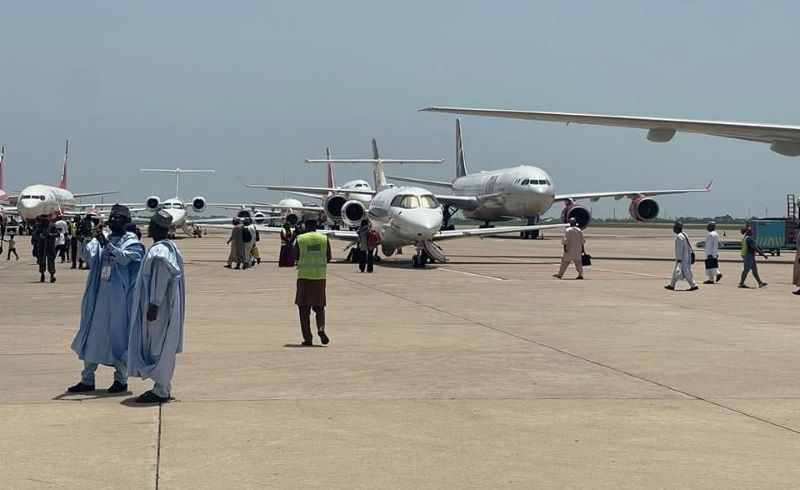
THE Federal Airports Authority of Nigeria (FAAN) has disclosed that three of the 22 airports under its management account for approximately 80 per cent of the country’s air traffic, highlighting the challenge of balancing infrastructure investment between high-volume aviation hubs and other airports across the national network.

News Point Nigeria reports that the Managing Director and Chief Executive of FAAN, Mrs Olubunmi Kuku, identified the Murtala Muhammed International Airport (MMIA), Lagos, as the busiest airport in the country, accounting for 68 per cent of the authority’s total traffic, followed by the Nnamdi Azikiwe International Airport, Abuja, and the Malam Aminu Kano International Airport, Kano.

Read also: National Assembly Demands Mandatory Ebola Screening At Airports, Seaports, Land Borders
Speaking as a keynote panellist at the World Aviation Festival in Lisbon, Portugal, on the theme, “Defining the Airport of the Future—Technology, Partnerships and People,” Kuku said the concentration of passenger traffic at a few major airports required a carefully calibrated investment strategy.

She explained that the strategy must address operational safety, infrastructure efficiency and passenger experience without neglecting other facilities within the country’s airport network.
“Three airports account for 80 percent of the traffic, but I still have 19 others and five other airports that I’m supporting that I also need to prioritise,” she said.


The FAAN chief’s disclosure underscores the capital-allocation dilemma facing the authority as it seeks to modernise Nigeria’s busiest aviation gateways while maintaining infrastructure and operational standards across the wider airport network.
Kuku explained that FAAN’s investment priorities were guided by a three-pronged approach, with safety serving as the primary consideration, particularly in the execution of airside infrastructure projects.
“For me, it’s been threefold. The first is a very clear criterion that focuses on safety, so you will see that a lot of our investments largely focus on some of the airside activities because that’s what we need to have our basic operations running and functional,” Kuku said.

She added that FAAN had concentrated, over the past three years, on rehabilitating major airports, particularly the country’s primary international gateways.
Read also: Kano Doctors Threaten Two-Week Warning Strike Over Unmet Demands
According to her, the authority is undertaking runway rehabilitation projects, including complete resurfacing and runway extensions where feasible, alongside the installation of improved airfield lighting systems at selected airports.

Nigeria’s six international airports are located in Lagos, Abuja, Port Harcourt, Kano, Enugu and Maiduguri.
Against the backdrop of its dominant share of national air traffic, the Murtala Muhammed International Airport in Lagos is undergoing a major terminal modernisation programme intended to improve operational efficiency, passenger processing and the overall airport experience.
Kuku said Terminal 1 of the airport was being completely gutted and reconfigured rather than expanded, in a move aimed at improving the utilisation of existing space and streamlining passenger movement through immigration, customs and other processing points.
She also spoke about plans to improve rail connectivity within the airport environment, linking its terminals and extending access to the cargo terminals.
“For Lagos tops within the airport environment, linking its terminals and extending access to the cargo terminals.
“What it does is it allows us to connect the city very quickly to the airport with five stops within our airport. It connects our terminals and links our cargo terminals to the last stop,” she said.
Read also: Two Persons Severely Burnt As Diesel Tanker Explodes Under Lagos’ Otedola Bridge
The proposed rail extension is expected to strengthen connectivity between the airport, the wider Lagos urban transport network and cargo-handling facilities, potentially reducing dependence on road-based access.
The project forms part of broader efforts to improve airport accessibility and operational efficiency, particularly at Nigeria’s busiest aviation gateway, as FAAN continues to balance the demands of high-traffic facilities with the infrastructure needs of other airports under its management.