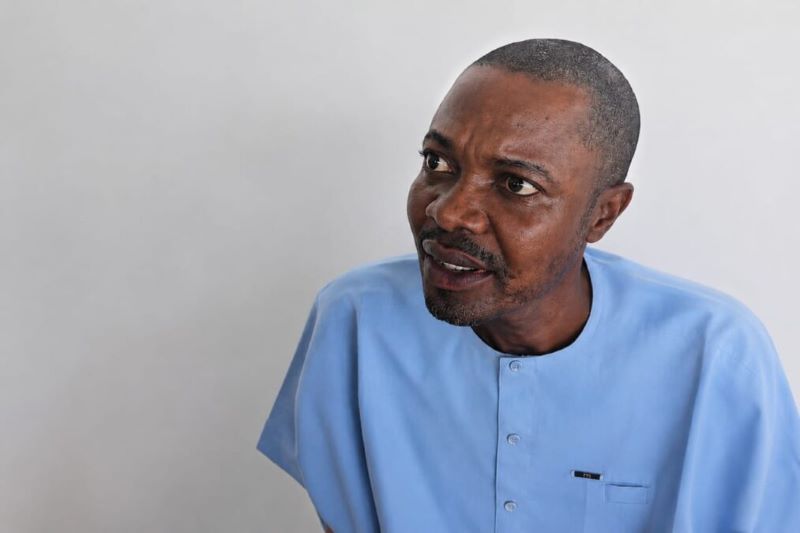

THE purported Director-General of the Presidential Foreign Investment Promotion Council (PFIPC), Adeniyi Adeyemi, has rejected the House of Representatives Ad hoc Committee’s decision to interrogate him at an undisclosed location while he remains in police custody, insisting that any appearance before lawmakers should be conducted publicly.

News Point Nigeria reports that Adeyemi, through his lawyer, Ademola Oyedokun, made his position known on Wednesday, saying although he welcomed the House investigation into the alleged establishment and operations of the PFIPC, he opposed the committee’s plan to question him behind closed doors.

Read also: Court Strikes Out FG’s Forgery Charges Against ‘Fake Agency’ DG Adeyemi

According to the lawyer, fairness demands that Adeyemi be given the opportunity to publicly respond to allegations that were made against him during the committee’s open hearings.


“We have read that the committee intends to interview our client at an undisclosed date and place. We ask it, respectfully, to think again.
“Everyone else in this matter has been heard in public, and what has been said about our client was said in public. He should be allowed to answer in the same place it was said,” the statement read.
Oyedokun urged the committee to invoke its constitutional powers under Section 89 of the Constitution to compel the police to produce Adeyemi before lawmakers during a public sitting.

“Section 89 of the Constitution gives the committee power to summon any person and to compel his attendance.
“We ask it to use that power and to require the police to produce our client at a public sitting.

“He will attend on any date it names, with his counsel, and answer every question put to him,” he said.
The lawyer further argued that while the criminal allegations against Adeyemi would be addressed before the Federal High Court and the relevant investigative agencies, the House inquiry into how the PFIPC came into existence and whether government officials acted upon it deserved to be conducted openly.
“Our client does not ask the committee to compromise any investigation. He will answer in public the questions this committee was constituted to ask, and will reserve, upon legal advice, any question touching a matter before a court or an agency.


Read also: Reps Summon DMO, TCN Over Irregular N54.57tn Borrowing, N446.7bn Debt
“Those may be taken separately and in private. What cannot be right is that the whole of his account be taken behind a closed door because part of it is sensitive.
“We will not argue our client’s case in a press statement. The allegations are before the Federal High Court and before several agencies, and they will be answered there, on oath.
“But this committee is asking a different question: how this council came to exist, and who in government acted upon it.
“That question our client is anxious to answer, and Nigerians are entitled to hear it answered in public. We ask only that they remember, meanwhile, that no court has yet heard him say a single word,” he said.
Oyedokun also challenged the legality of his client’s continued detention, maintaining that the bench warrant relied upon by the police only authorised Adeyemi’s arrest and production before the Federal High Court, and not his prolonged detention.
“No order committing him to custody has ever been made, served on him or shown to him, and none could have been made, because he has never been brought before any court,” he stated.
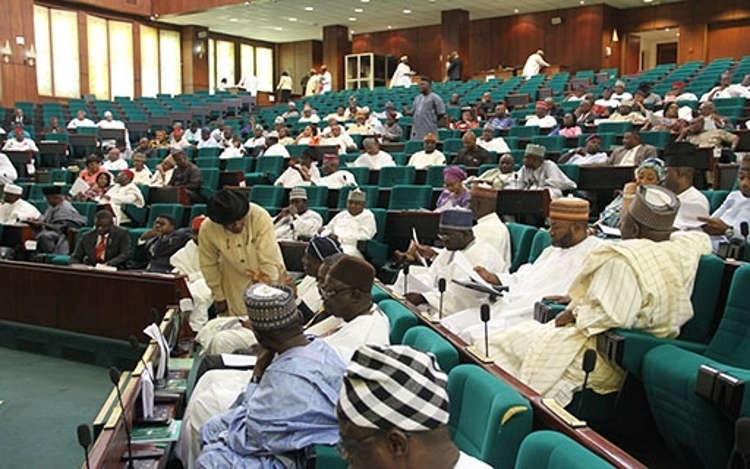
The House of Representatives Ad hoc Committee investigating the alleged establishment and operations of the controversial council had on Tuesday announced that it would interrogate Adeyemi at an undisclosed location while he remains in police custody.
Committee Chairman, Yusuf Gagdi, explained that the arrangement was necessary to avoid interfering with ongoing investigations by the Nigerian Police Force, the Economic and Financial Crimes Commission (EFCC), and the Independent Corrupt Practices and Other Related Offences Commission (ICPC).
Gagdi said the committee had invited Adeyemi to appear before it but was informed by the police that he remained in custody pursuant to a court order.
Read also: ‘I Will Leave After Four Years’, Makinde Joins Obi In One-Term Presidency Pledge
He added that the National Assembly would not act in a manner that undermined the judiciary or violated the principle of separation of powers, stressing that lawmakers lacked the authority to override an existing court order directing the suspect’s detention.
The committee is investigating allegations surrounding the creation and operations of the PFIPC, including claims of impersonation, forgery, financial impropriety, and the unlawful use of government facilities and official insignia.