

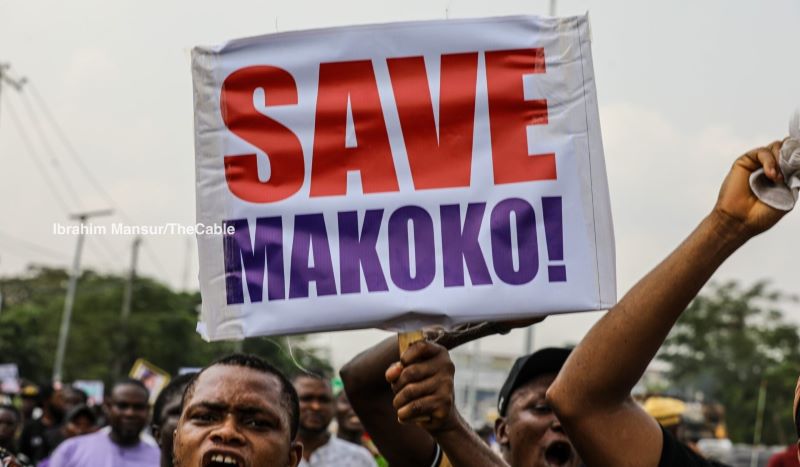
CONTROVERSY surrounding the demolition of structures in Makoko and other communities by the Lagos State Government has continued, with residents staging a protest over the government’s actions on Wednesday.

News Point Nigeria reports that the protesters said the demonstration was against alleged land grabbing, forceful eviction and displacement across Lagos. However, the protest turned rowdy when police fired teargas to disperse the crowd.
Many protesters reportedly sustained varying degrees of injury while running helter-skelter as teargas was deployed.


A community leader who participated in the protest, Jude Ojo, claimed that police fired not only teargas but also live ammunition.
He alleged that an unidentified protester sustained a gunshot wound to the leg and was rushed to the hospital, a claim the Lagos State Police Command has denied.
Speaking on Channels Television’s The Morning Brief on Thursday, Ojo said the protesters posed no threat.
“We were not carrying guns or sticks; we are harmless, and your policemen were around. Why are you afraid?” he asked.
Ojo said the protesters had decided to sit peacefully after being denied access.
“We said that if you were not going to attend to us or allow us to come in, we would sit down until you were ready to give us attention. The next thing we experienced was gunshots and teargas. A man was shot in the leg and rushed to the hospital. I don’t know his name, but it should be shown on camera,” he said.

He expressed disappointment with the Lagos State Government, describing the incident as a departure from democratic ideals.
“I was teargassed and everyone started running helter-skelter, trying to find an escape route. These are the people we voted for is this the democracy we yearned for? It was a very big disappointment on the part of the government,” Ojo added.
However, speaking on Channels Television’s Sunrise Daily on Thursday, Lagos State Police Commissioner, Moshood Jimoh, denied that police fired gunshots at the protesters.


Jimoh said officers only used the minimum force of teargas to disperse the crowd.
“No gun was fired. I was there. I was appealing to them to remain peaceful, but they continued to hurl abuses at me. As a police officer, I am trained to work under this kind of pressure, so I did not react,” he said.
The police commissioner said he contacted the leadership of the Lagos State House of Assembly to intervene.
“We spoke with the leadership of the Lagos State House of Assembly, who promptly despite being in recess sent five honourable members to appeal to them. Still, it fell on deaf ears because their aim was to enter the House of Assembly and cause mayhem, which we will not allow,” Jimoh said.
On the allegation that a protester sustained a gunshot wound, Jimoh said the injury could have occurred while protesters were fleeing from teargas.
“When teargas is fired, people run to leave the scene. It is during that process that some may sustain injuries. To our records, nobody reported a gunshot injury to us during the operation after they had been warned that force would be used if they refused to disperse,” he said.
He added that one of the protest organisers later reported alleged bullet wounds to the area commander, who inspected the injury and determined that it was not caused by a bullet.
While acknowledging citizens’ rights to protest and freedom of expression, Jimoh described the protesters as an “unknown group” chanting war songs.
The Lagos State Government has defended its decision to demolish structures in Makoko and other communities, saying the action is to protect lives and properties.
According to government officials who featured on Ask Lagos, a weekly X-space discussion aimed at creating engagements between the Government and residents, the demolitions were for security reasons.
The contentious demolitions in Makoko and other waterfront communities, they said, were essential steps toward a safer, more sustainable megacity.
There have been criticisms of the government actions as “anti-poor”and “unnecessary”. That is not true, Omotoso said, adding that the demolitions were driven primarily by public safety, environmental protection, and security considerations, particularly the dangers posed by illegal structures built beneath high-tension power lines and along critical waterways.
“No responsible government anywhere in the world can allow people to live directly under high-tension cables or obstruct vital waterways,” Omotoso said. “These actions are not punitive. They are preventive — to protect lives, avert disasters, and secure the future of Lagos.”