

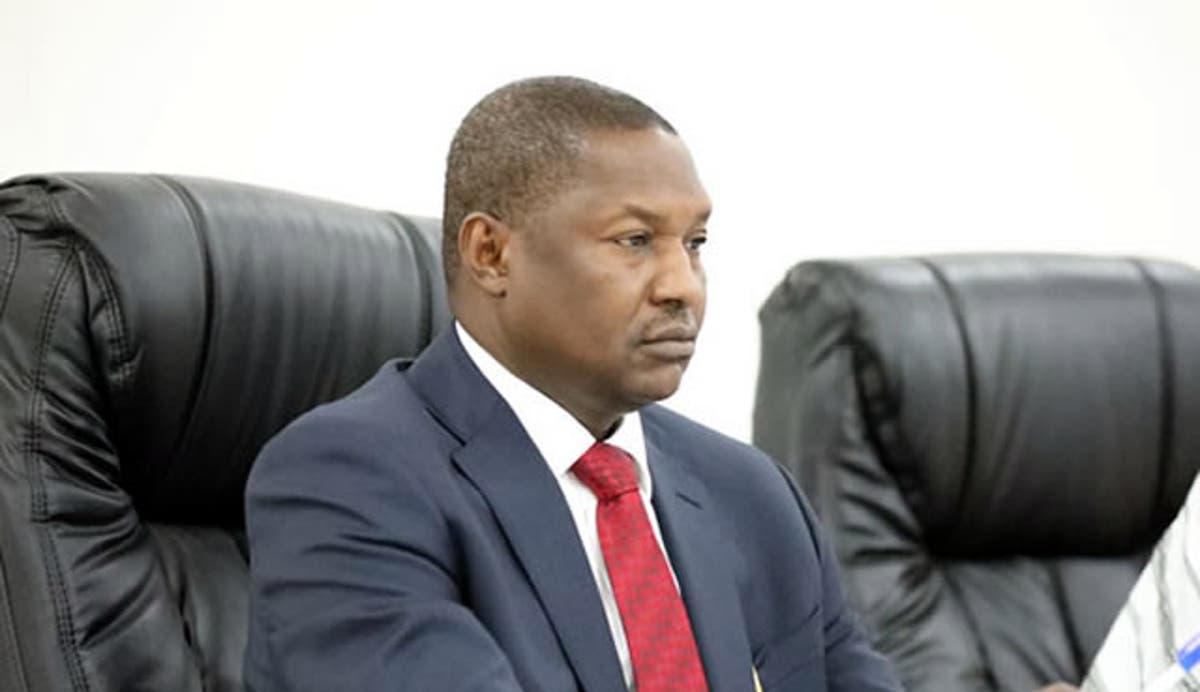
A POLITICAL storm is brewing around the continued detention of former Attorney-General of the Federation and Minister of Justice, Abubakar Malami, SAN, as the African Democratic Congress (ADC) and the Economic and Financial Crimes Commission (EFCC) trade sharp words over the legality, motive and timing of his detention.

News Point Nigeria reports that the ADC has accused the anti-graft agency of politicising its fight against corruption, warning that turning law enforcement into a political tool amounts to corruption itself.
The party faulted the EFCC’s handling of Malami’s bail, describing the agency’s actions as a veiled attempt to curtail the former minister’s political ambitions, particularly in his home state of Kebbi.


However, the EFCC has firmly rejected the allegations, insisting that Malami’s continued detention has nothing to do with politics but is strictly the result of his failure to meet clearly stated bail conditions.
The disagreement followed Malami’s detention by the EFCC for more than six days in connection with an ongoing investigation into alleged fraud linked to the Abacha loot.
In a statement sent to News Point Nigeria by its National Publicity Secretary, Bolaji Abdullahi, the ADC expressed concern over what it described as the questionable revocation of bail earlier granted to Malami, arguing that the move undermines the political neutrality of the EFCC.
According to the party, there is no evidence that Malami violated any of the conditions attached to his initial bail, adding that his continued detention shortly after attending a political gathering in Kebbi State raises serious questions about the agency’s motives.
“The ADC views Malami’s bail revocation by the EFCC as politically motivated,” Abdullahi said. “From all available evidence, Malami did not violate any of the legal conditions attached to his initial bail. As a senior lawyer and former number one law officer of the country, he understands fully what it means to violate bail conditions.”
Abdullahi argued that Malami’s attendance at a political rally linked to his governorship ambition in Kebbi should not, under any circumstance, form the basis for revoking bail, especially when he has reportedly cooperated with investigators.

He warned that restricting a citizen’s political engagement amounts to an abuse of power not granted to any law enforcement agency under the Constitution.
“No agency of government has the power to suspend political rights, redraw political boundaries, or determine where a citizen’s political interests may or may not be exercised,” the statement read.
The ADC further cautioned that the EFCC risks being perceived as a political gladiator rather than an impartial anti-corruption institution, stressing that politicising the anti-graft war is itself a dangerous form of corruption.


While reaffirming its support for the fight against corruption, the party demanded Malami’s immediate release on bail without conditions that, in its view, stifle his political rights, maintaining that he remains innocent until proven guilty by a court of competent jurisdiction.
In response, the EFCC dismissed the ADC’s claims as misleading and unfounded, insisting that Malami’s detention followed due process and was solely tied to his failure to comply with bail conditions.
In a statement sent to News Point Nigeria on Saturday, the Commission’s spokesman, Dele Oyewale, clarified that Malami was granted administrative bail on November 28, 2025, after a brief interrogation, pending the conclusion of investigations and possible arraignment.
Oyewale stressed that administrative bail is provisional and discretionary, subject to clearly defined conditions.
“Administrative bail is a discretionary temporary reprieve that allows a suspect to be released on stated conditions pending conclusion of the investigation and arraignment in court,” he said.
“To this effect, after his brief interrogation on November 28, 2025, Malami was offered provisional bail hinged on five requirements. He has neither met any of the requirements nor shown readiness to keep faith with them.”
The EFCC also addressed claims that Malami’s bail was revoked, describing such assertions as false. According to Oyewale, the former minister was never released on full bail, as the conditions attached to the administrative bail were never fulfilled.
Oyewale disclosed that Malami was scheduled to return for further interrogation on December 1, 2025, but requested a postponement through a letter dated December 4, citing ill-health.
The EFCC, he said, granted the request on compassionate grounds, despite the fact that the bail conditions remained unmet.
However, the commission noted that Malami neither submitted a medical report nor provided credible proof of ill-health to support his request.
“The Commission compassionately granted his plea even while his bail conditions had not been met,” Oyewale explained, adding that his reporting date was deferred to accommodate the request.
He said Malami was subsequently invited again on December 8, 2025, for further interrogation and was detained pending compliance with the outstanding bail conditions.
“The EFCC cannot allow the latitude granted the former Minister on his health to stand in the way of investigations,” Oyewale said.
The anti-graft agency also dismissed allegations that Malami was barred from participating in political activities or granting media interviews, describing such claims as “bogus” and “ridiculous.”
“The EFCC has no interest in the political affiliation of its suspects,” Oyewale stated. “Such claims from a former chief law officer of the nation are strange.”
The commission urged Malami to comply fully with the bail conditions he acknowledged and signed on November 28, and to continue cooperating with investigators as the probe progresses.
As the standoff continues, the case has sparked broader public debate about the intersection of politics, law enforcement and accountability, with observers closely watching how the EFCC navigates allegations of bias while pursuing its mandate to fight corruption.