

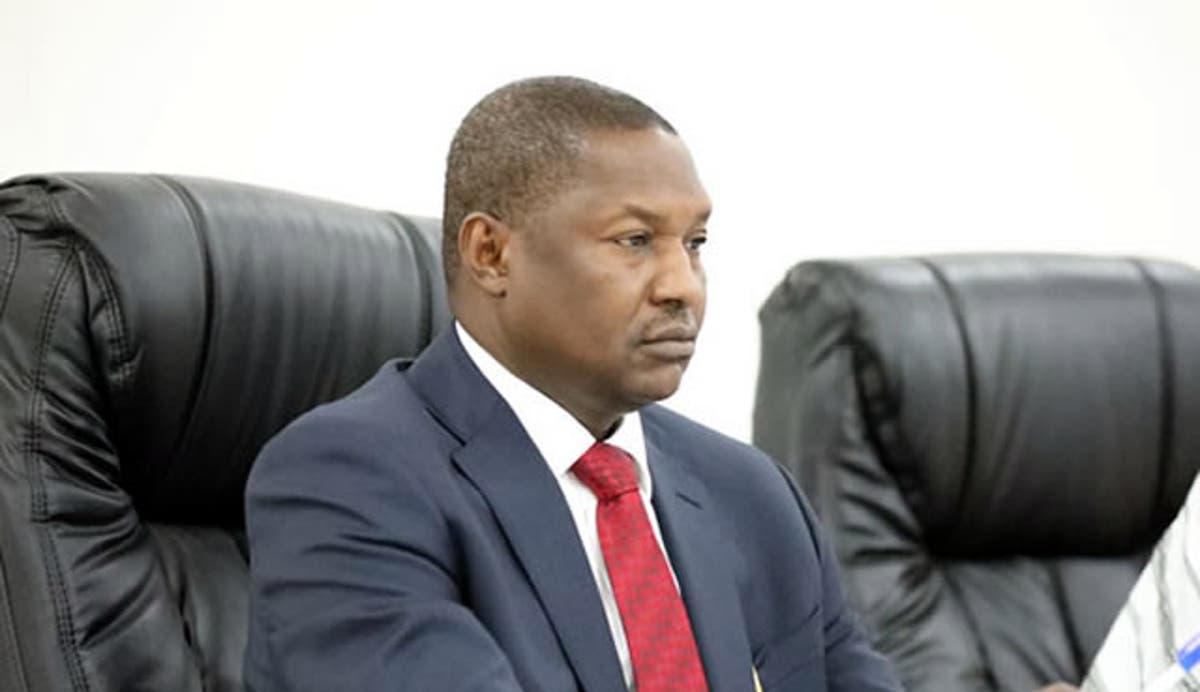
FORMER Attorney General of the Federation and Minister of Justice, Abubakar Malami (SAN), may remain longer in the custody of the Department of State Services (DSS) as the agency intensifies investigations into allegations bordering on terrorism financing and other security-related matters.

Multiple security sources disclosed that the DSS is already taking steps to obtain a court order to keep the former justice minister in detention pending the conclusion of what officials described as sensitive and complex investigations that could span several months.
Malami’s latest legal ordeal began on Monday, moments after he perfected his bail and was released from the Kuje Correctional Centre in Abuja. He was immediately taken into custody by DSS operatives shortly after stepping out of the facility, where he had been detained since early December over allegations initially brought against him by the Economic and Financial Crimes Commission (EFCC).

Security sources said the DSS considers the issues under investigation too weighty to allow his immediate release, hence the move to secure judicial approval for extended detention.
“The investigation is likely going to take a long time. This is why we are working to get a court order to detain him further,” a source familiar with the matter told The PUNCH.
Malami was first arrested by the EFCC over allegations that he conspired with his wife, Asabe, and their son to conceal proceeds of unlawful activities valued at approximately N8.7 billion.
The EFCC alleged that the funds were laundered through multiple corporate entities, bank accounts, and high-value real estate transactions in Abuja and other parts of the country.
The former AGF and his family members were arraigned on December 29, 2025, before a Federal High Court in Abuja on 16 counts bordering on money laundering and conspiracy. They all pleaded not guilty to the charges.
Malami had remained in custody from December 8 after failing to meet initial bail conditions. On December 18, a Federal Capital Territory High Court, presided over by Justice Babangida Hassan, upheld his detention, ruling that it was lawful.

It was not until January 7 that Justice Emeka Nwite of the Federal High Court granted Malami, his wife, and son bail in the sum of N500 million each, with stringent conditions. The court ordered each defendant to provide two sureties with verifiable landed property in Asokoro, Maitama, or Gwarimpa areas of Abuja. Title documents were to be deposited with the court, while the sureties were required to submit affidavits of means.
Twelve days after securing bail, Malami perfected the conditions and was released—only to be re-arrested by the DSS minutes later.
Sources revealed that the DSS is grilling Malami over his alleged role in the handling of a terrorism financiers list released by the United Arab Emirates (UAE) in 2021, as well as other terrorism-related petitions.


“There are several issues he is being questioned on. One of them is the handling of the terrorism financiers list released by the UAE and how some terror financiers were treated during his tenure as AGF. This investigation will take a very long time. I am not sure he will be released anytime soon,” a source said.
In 2021, the UAE named six Nigerians among individuals accused of financing Boko Haram. The list was part of the UAE Cabinet Resolution No. 83 of 2021, which designated 38 individuals and 15 entities as supporters of terrorism.
Those listed included Abdurrahaman Ado Musa, Salihu Yusuf Adamu, Bashir Ali Yusuf, Muhammed Ibrahim Isa, Ibrahim Ali Alhassan, and Surajo Abubakar Muhammad. The disclosure sparked widespread controversy in Nigeria, with questions raised over intelligence handling and enforcement actions by local authorities.
Ironically, Malami, while serving as Attorney General, had publicly vowed that the government would not shield any individual linked to terrorism or its financing, insisting that anyone found culpable would face prosecution regardless of status.
Investigators are now said to be revisiting those declarations in light of allegations currently levelled against him.
Another security source disclosed that Malami is also being questioned over an arms cache allegedly discovered in his residence in Kebbi State, as well as multiple petitions accusing him of terrorism financing.
“Terrorism and terrorism financing are serious offences globally. No responsible government would turn a blind eye to such allegations, no matter how highly placed the individual involved,” the source said.
The source added that inter-agency cooperation between the EFCC and DSS is standard practice, stressing that the DSS remains the primary agency responsible for investigating terrorism-related offences.
“For now, it is best to allow the DSS to do its job,” the source said.